
 By
By The henna on my hands hasn’t fully faded yet.
I keep noticing it when I chop onions — the rust-brown lace still climbing my knuckles, already ghosting at the edges, going the way of most beautiful things. I got married eleven days ago. Three days of ceremonies, two sets of parents, and a catering negotiation that should have its own diplomatic record. My fingers are stained with turmeric from tonight’s cooking, which means the henna and the spice are layered together now, and I find I don’t mind that at all.
My name is Priya Krishnamurthy — Priya Patel now, officially, though I keep forgetting to answer to it. I’m twenty-seven years old, I’m a pharmacist at JFK Medical Center in Edison, and I am sitting in the kitchen of our new apartment on Plainfield Avenue writing this with a bowl of coconut curry cooling beside me and a heart so embarrassingly full I don’t entirely know what to do with it.
Let me tell you where I come from, because it matters for everything I’m going to write here.
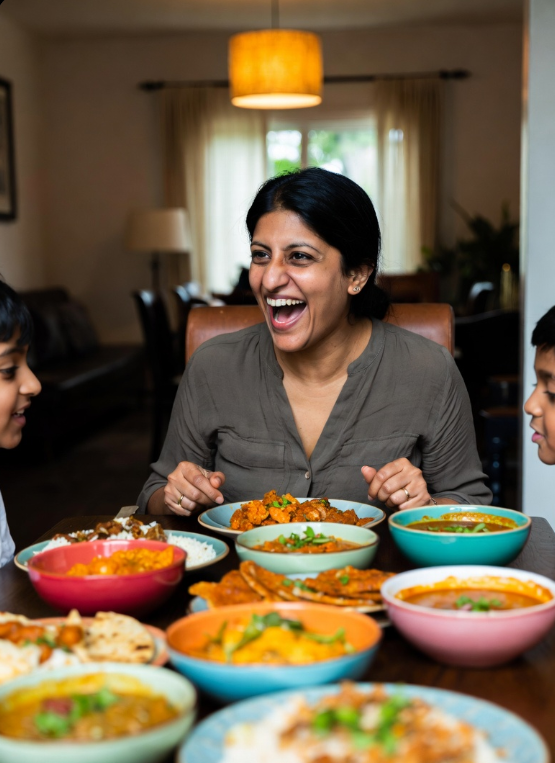
I grew up three miles from this apartment, in a house that smelled permanently of tamarind and coconut oil and the particular mineral heat of a wet grinder running at full speed at six in the morning. My mother, Lakshmi Krishnamurthy, is Tamil. She grew up in Chennai, came to New Jersey in 1985 with my father Venkatesh and a set of stainless steel vessels she refused to leave behind, and proceeded to cook every single meal from scratch for the next three decades without apology or exception. No canned anything. No shortcuts. No “American food” except on extremely rare occasions when she was in a generous mood, which usually meant boxed macaroni and cheese eaten with visible suspicion.
Amma — that’s what I call her, what Tamil children call their mothers — is the kind of cook who measures turmeric in her palm. If you ask her how much, she says “enough.” If you ask her how long something simmers, she says “until it’s ready.” I grew up thinking this was normal. I grew up thinking every mother spent three hours making dinner, that fresh coconut chutney was just something that existed in the morning, that the smell of mustard seeds hitting hot oil was simply what a house smelled like. It wasn’t until I got to Rutgers that I understood this was not, in fact, how most families operated.
My college roommate, Jen, was from Connecticut. The first time she came home with me for a weekend, Amma made sambar, rasam, rice, two kinds of curry, and fresh idli for breakfast. Jen stood in the kitchen doorway watching my mother grind batter at 7 AM and said, quietly, “My mom makes Eggo waffles.”
I didn’t know how to explain that for Amma, cooking isn’t a hobby or even a chore. It’s the primary language she uses to say everything that matters. Love is sambar made from scratch. Welcome home is coconut rice. I’m proud of you is a four-course meal she’ll deny took any effort at all.
I learned to cook by watching, the way you learn a language you’re surrounded by. I never took a class. I couldn’t give you a recipe for Amma’s sambar in the same way I can’t explain how I know to speak Tamil — it’s just in there, downloaded through proximity and repetition and years of standing at the counter while she moved through the kitchen like she was conducting something invisible.
What I make isn’t exactly Amma’s cooking. It’s mine — Tamil at the foundation, American around the edges, influenced by the food anthropology course I took at Rutgers that made me realize every cuisine is a record of migration and survival. When I cook, I’m somewhere between Chennai and New Jersey, between 1985 and right now, between my grandmother’s kitchen and this one, where there are still cardboard boxes stacked against the wall and no furniture in the living room and exactly one pot I know the location of, which is the one on the stove.
Raj — my husband, the cardiologist, the man who cried at our wedding with his whole face like a child, bless him — came into the kitchen last night and found me grinding urad dal for dosa batter at nine o’clock in the evening. We had just moved in. The bedroom wasn’t unpacked. There were literally no sheets on the bed.
“Priya,” he said, “we don’t have sheets.”
“We have dosa batter,” I said.
He looked at me for a long moment, then went and ordered sheets on his phone. This is our marriage, I think. He handles the logistics. I handle the provisions. We’re going to be fine.
Raj is Gujarati, which means our wedding was a three-day negotiation between two food cultures that each believe, with genuine religious conviction, that their cuisine is simply the best cuisine and the other side’s food is “fine, I suppose, if you like that sort of thing.” Amma’s opening position was full South Indian catering, all three meals. Raj’s mother, Pushpa — a force of nature in a purple salwar kameez — wanted Gujarati food, obviously, because what else would you serve. The compromise we landed on: South Indian breakfast (idli, vada, dosa, three chutneys, Amma’s domain entirely), Gujarati lunch (the Patels handled it, and the dhokla was genuinely extraordinary, I will admit this freely), and a fusion dinner that pleased absolutely no one entirely but offended no one catastrophically. Pushpa described the rasam as “interesting.” Amma said the shrikhand was “very sweet.” Both of these were politely deployed insults. I love both of them.
The ceremony itself, though — that was everything. I wore my grandmother’s red Kanjeevaram silk sari, the one Amma has kept in tissue paper for thirty years. When I came out, Raj’s face just… went. He cried in the way men cry when they’ve been trying not to and lose the fight all at once. And my father — Venkatesh Krishnamurthy, retired software engineer, a man who communicates primarily through silence and newspaper rustling — wept openly during the ceremony. I have seen my father cry exactly twice in my life: when his mother died, and at my wedding. I don’t know what to do with that yet, except hold it.
So: that’s who I am, that’s where I come from, and that’s how I ended up in this apartment on Plainfield Avenue making coconut curry before the furniture arrived.
In our family, coconut means beginning. Amma made coconut rice — thengai sadam — on my first day of school, my first day of college, and the morning after my wedding. Coconut is the flavor of starting something. It’s rich and gentle and slightly sweet, and it makes everything it touches feel looked after. I didn’t have the time or the equipment to make proper thengai sadam tonight — the wet grinder is still in a box somewhere — so I made this instead: a fast, deeply coconut-flavored curry that takes thirty minutes and uses things you can find at any grocery store, which is important because I don’t know where the Indian grocery store is yet in my new neighborhood. (There will be one. This is Edison, New Jersey. There is always an Indian grocery store.)
This curry is not Amma’s recipe. It’s mine, built from what she taught me about how South Indian flavors work: the bloom of mustard seeds in hot oil, the brightness of curry leaves, the way turmeric and coriander make a base that can hold almost anything. I use coconut milk from a can because tonight I don’t have a fresh coconut, and you do what you can with what you have. Amma would raise an eyebrow at the can. I’d tell her the curry is still made with love. She’d say “hmm” in a way that means “I suppose.”
The mustard seeds hit the oil and popped, and the curry leaves went in right after, and the whole apartment smelled like something I’ve known my whole life. Raj walked in from unpacking boxes in the bedroom, stopped in the kitchen doorway, and said, “That smells like home.”
He meant it as a compliment. I started crying a little, just quietly, into the onions, which I could blame on the onions if I needed to. He didn’t ask. He just put his arms around me from behind while I stirred, the way he’s been doing since we were dating, and we stood there for a minute while the coconut milk bubbled gently and the apartment smelled like the beginning of something.
I am so happy it scares me a little. I was raised to believe happiness is something you earn through suffering, something that arrives after enough sacrifice and hard work and violin practice. I didn’t expect it to show up like this: warm and uncomplicated, smelling like mustard seeds and coconut milk in a kitchen where the boxes aren’t even unpacked yet.
Here’s the curry. Make it on a weeknight. Make it when you’re tired. Make it when you need something that tastes like it was made with care but only has thirty minutes to show for it.
I’ve made this curry probably a dozen times now, but that first night in the new apartment—stirring it while he held on and the city hummed outside—is the version I keep coming back to. It’s the kind of recipe that doesn’t ask much of you, which is exactly what I needed when everything else felt so new and tender. Thirty minutes, one pan, and somehow it tastes like you’ve been doing this forever.
30-Minute South Indian Coconut Curry
Prep Time: 10 minutes | Cook Time: 20 minutes | Total Time: 30 minutes | Servings: 4
Ingredients
- 2 tablespoons coconut oil (or any neutral oil)
- 1 teaspoon black mustard seeds
- 10–12 fresh curry leaves (dried will work, but fresh is everything)
- 1 medium yellow onion, finely diced
- 4 cloves garlic, minced
- 1-inch piece fresh ginger, grated
- 2 green chiles, slit lengthwise (serrano or Thai; use one if you want mild)
- 1 teaspoon ground coriander
- 1/2 teaspoon ground cumin
- 1/2 teaspoon turmeric
- 1/2 teaspoon red chili powder (or to taste)
- 1 teaspoon salt, plus more to taste
- 2 medium tomatoes, chopped (or one 14-oz can diced tomatoes, drained)
- 1 can (13.5 oz) full-fat coconut milk
- 2 cups mixed vegetables, cut into 1-inch pieces (cauliflower, zucchini, green beans, or whatever you have)
- 1/2 cup water
- Juice of 1/2 lime
- Fresh cilantro, for serving
- Cooked basmati rice or warm roti, for serving
Instructions
- Bloom the mustard seeds. Heat the coconut oil in a large, deep skillet or dutch oven over medium-high heat. When it shimmers, add the mustard seeds. Let them pop and sputter for about 30 seconds — don’t walk away. This is the most important step, and it takes less than a minute. The popping means the oil is hot enough and the seeds are releasing their flavor.
- Add the aromatics. Add the curry leaves — stand back slightly, they’ll crackle and spit. Add the diced onion and cook, stirring frequently, for 5–6 minutes until softened and translucent at the edges. Add the garlic, ginger, and green chiles and cook for another 2 minutes until fragrant.
- Build the spice base. Add the coriander, cumin, turmeric, chili powder, and salt. Stir everything together and cook for 1 minute, letting the spices toast in the oil. The mixture will look dry and paste-like — this is correct.
- Add the tomatoes. Add the chopped tomatoes and cook for 3–4 minutes, stirring frequently, until they break down and the oil begins to separate from the tomato mixture. You’re looking for the sauce to deepen in color and become jammy.
- Pour in the coconut milk. Add the coconut milk and water, stirring to combine everything. Bring to a gentle simmer — not a boil, which can make coconut milk separate. Taste and adjust salt.
- Cook the vegetables. Add your vegetables. Cover and cook over medium-low heat for 8–10 minutes, until the vegetables are tender but not mushy. Stir once halfway through.
- Finish and serve. Squeeze in the lime juice and stir. Taste one more time — add salt if needed, another squeeze of lime if it needs brightness. Scatter fresh cilantro over the top. Serve over basmati rice or with warm roti.
Nutrition (per serving)
Calories: 310 | Protein: 5g | Fat: 22g | Carbs: 24g | Fiber: 5g | Sodium: 580mg