Sophie came for her week. She arrived on Monday with her nursing textbooks, her clinical scrubs, and the calm competence of a twenty-one-year-old woman who has spent three years learning how to care for bodies that are failing.
She walked into the house and she saw Paul — in the wheelchair, the ventilation mask on, the eye-tracking device mounted, the feeding tube port visible on his abdomen — and she didn't flinch. She said, "Hey, Grandpa. I'm here." She went to him and kissed his forehead above the mask and sat beside his wheelchair and said, "What are you reading?" And they talked — Paul typing with his eyes, Sophie reading aloud, the conversation mediated by machines but alive.
Sophie is a nurse now. Not licensed yet — she has one more year — but she's a nurse. She helped with morning care: the transfer from bed to wheelchair, the washing, the dressing, the feeding pump management. She did it with the ease of a professional and the tenderness of a granddaughter, and the combination was something I'd never seen before — the clinical and the personal fused into one set of hands.
She gave me three days off. Not fully off — I was in the house, in the garden, nearby — but off from the direct caregiving, the constant hands-on work that has been my life for eighteen months. Karen came in the mornings. Sophie covered the afternoons and evenings. For three days, I was not the primary caregiver. I was the wife. Just the wife.
I didn't know what to do with myself. I gardened. I baked (pepparkakor, in July, because the dough was in the freezer and I needed something for my hands to do). I walked Sven — longer walks, thirty minutes instead of twenty, down to Brighton Beach and back. I sat on a rock by the lake and breathed and the breathing was mine, unassisted, free, and I felt guilty for noticing my own breathing when Paul's breathing requires a machine.
Sophie made dinner one night: her version of the meatballs. Mamma's recipe, the one Mamma taught her at sixteen. She rolled them in my kitchen, at my counter, with my bowls, and the meatballs were round and even and she pureed Paul's portion with the cream gravy and held the cup and fed him and Paul eye-typed: "SOPHIE'S MEATBALLS." The machine said it. Sophie said, "They're Grandma Ingrid's." Paul typed: "THEY'RE YOURS NOW TOO."
Yours now too. The meatballs passing. Mamma to Sophie, skipping a generation, landing in the hands that will carry them forward.
Sophie left on Sunday. She hugged Paul for a long time. She hugged me for a long time. She said, "I'll be back, Grandma. Whenever you need me." She meant it. I believe her. The thread holds.
Sophie’s version of the meatballs — Mamma’s meatballs, now Sophie’s too — reminded me that a recipe is never really finished; it keeps changing hands and picking up something new with each person who makes it. The Apricot Meatballs I’m sharing here are the ones I return to when I want that same feeling: something round and warm and finished with a glaze that is just a little unexpected, a little sweeter than you planned. Paul would have them pureed with the sauce, Sophie would roll them exactly right, and I would stand at the counter grateful that food gives us a way to say things words can’t quite reach.
Apricot Meatballs
Prep Time: 20 min | Cook Time: 25 min | Total Time: 45 min | Servings: 6
Ingredients
- 1 1/2 lbs ground beef (80/20)
- 1/2 cup plain breadcrumbs
- 1/4 cup whole milk
- 1 large egg, lightly beaten
- 1 small yellow onion, grated
- 1 tsp salt
- 1/2 tsp black pepper
- 1/2 tsp garlic powder
- 1/4 tsp ground allspice
- 1 cup apricot preserves
- 1/3 cup ketchup
- 2 tbsp apple cider vinegar
- 1 tbsp soy sauce
- 1/2 tsp crushed red pepper flakes (optional)
Instructions
- Preheat oven. Heat oven to 400°F. Line a large rimmed baking sheet with foil and set a wire rack on top; coat the rack lightly with cooking spray.
- Soak breadcrumbs. In a large bowl, combine breadcrumbs and milk and let stand 2–3 minutes until the breadcrumbs absorb the milk and turn soft and paste-like.
- Mix the meatball base. Add the ground beef, egg, grated onion, salt, pepper, garlic powder, and allspice to the soaked breadcrumbs. Mix with your hands just until combined — do not overwork or the meatballs will be dense.
- Roll the meatballs. Scoop and roll the mixture into balls about 1 1/2 inches in diameter (roughly 2 tablespoons each). You should get about 24 meatballs. Arrange them evenly on the prepared rack.
- Bake. Bake on the center rack for 18–20 minutes, until cooked through and lightly browned on the outside. An instant-read thermometer should read 165°F at the center.
- Make the apricot glaze. While the meatballs bake, combine apricot preserves, ketchup, apple cider vinegar, soy sauce, and red pepper flakes (if using) in a small saucepan over medium heat. Stir and cook 4–5 minutes until the preserves melt and the sauce is smooth and slightly thickened. Taste and adjust sweetness or acidity as needed.
- Combine and finish. Transfer the baked meatballs to a large skillet or saucepan over low heat. Pour the apricot glaze over the meatballs and gently stir to coat. Cook together for 3–4 minutes, turning occasionally, until the meatballs are glazed and glossy.
- Serve. Serve immediately over egg noodles, mashed potatoes, or steamed rice. For a smoother consistency suitable for blending, add 2–3 tablespoons of warm cream to the sauce before pureeing.
Nutrition (per serving)
Calories: 390 | Protein: 24g | Fat: 16g | Carbs: 38g | Fiber: 1g | Sodium: 620mg
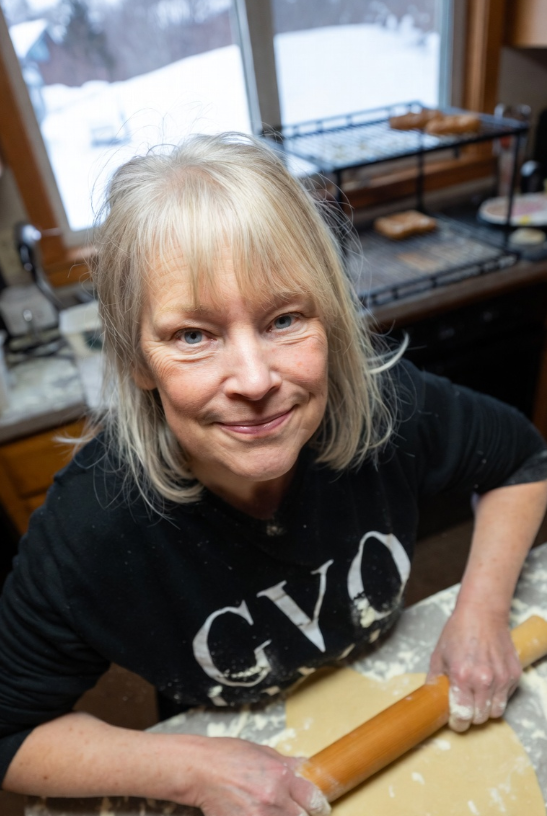
About the cook who shared this
Linda Johansson
Week 171 of Linda’s 30-year story
· Duluth, Minnesota
Linda is a sixty-three-year-old retired nurse from Duluth, Minnesota, living alone in the house where she raised her children and said goodbye to her husband. She lost Paul to ALS in 2020 after two years of watching the kindest man she'd ever known lose everything but his dignity. She cooks Scandinavian comfort food and Minnesota hotdish and the pot roast Paul loved, and she sets two places at the table out of habit because it makes her feel less alone. Every recipe she writes is a person she's loved.
