
 By
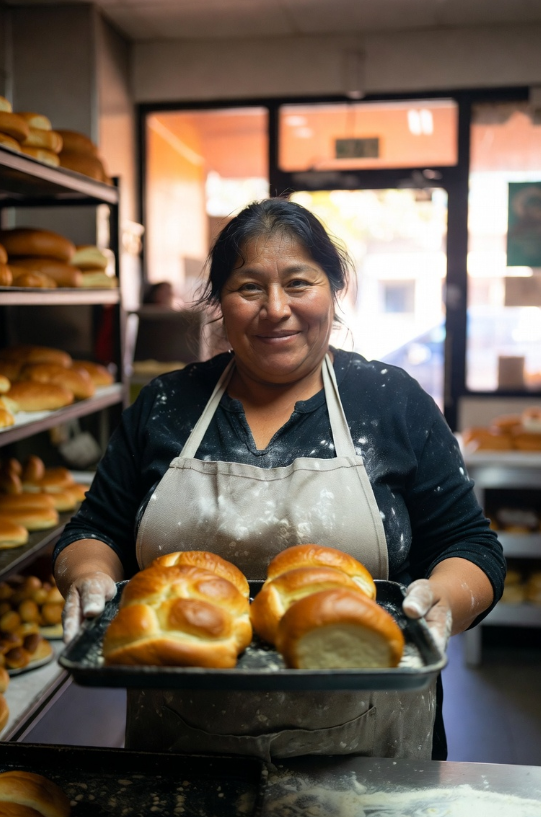
By A woman came into the bakery this week — young, maybe twenty-two, with a toddler on her hip and circles under her eyes that looked like bruises. She ordered one concha and a coffee and sat at the corner table and broke the concha in half and gave the bigger half to the toddler and drank the coffee black and slow, the way you drink coffee when you are making it last because you can't afford another. I know that woman. I was that woman. I was twenty-two with circles under my eyes in a restaurant on Alameda Avenue, washing dishes, sending money to Rosa, living on tips and fear.
I brought her a bag — six conchas, two empanadas, a container of arroz con leche — and I said, "For later." She looked at me like I had spoken a foreign language, and then she cried, and then she said "Gracias" in a voice that cracked on the second syllable, and I said "De nada" and went back to the kitchen because if I stayed I would cry too and crying in front of customers is bad for business, though crying in the pantry is apparently fine because I do it twice a week.
Luis asked me later why I gave away food and I said because Rosa would have and Luis said we can't afford to give away food and I said Rosa couldn't afford it either and she did it anyway and Luis looked at me and nodded because he knows when I am channeling Rosa and he knows not to argue with Rosa, alive or dead.
Isabella has been reading about Clara Barton this week — the founder of the Red Cross — and she announced at dinner that she wants to work in a war zone someday, helping people. She is thirteen. She is planning to save the world. I said: "Finish eighth grade first." She said: "I can do both." She probably can. She is Isabella. She can do anything she decides to do, and she has already decided to do everything.
Diego asked me why we came to America. He has asked before, but this time was different — this time it was not a child's question but a boy's question, the question of someone who is beginning to understand that the answer is complicated and sad and involves things his mother doesn't talk about at the dinner table. I said: "Because Mexico was dangerous and America was possible." He said: "Do you miss it?" I said: "Every day." He thought about that and then he went to his room and I heard him typing on the old laptop we got him for school, and I don't know what he was typing but I hope it was something about bridges — the kind you cross and the kind you build.
I made arroz con leche this week — rice pudding, the kind Rosa made with cinnamon sticks and condensed milk and a pinch of vanilla, served cold in ceramic bowls that I bought at a yard sale for fifty cents each and that look like something Rosa would have owned. Arroz con leche is not a recipe — it is a lullaby in food form. It is the thing you eat when the world is too much and you need the world to be less. I made a double batch and kept half at the bakery for customers and half at home for the children, and the woman with the toddler came back on Thursday and I gave her a cup without charging and she smiled and the smile was worth more than the cup.
Rosa called on Sunday. She said she felt okay. She asked me to describe the bakery — every detail, every table, every smell. I described it for twenty minutes, down to the crack in the tile by the bathroom door and the way the morning light hits the pastry case and turns the conchas gold. She listened without speaking and when I finished she said, "It sounds beautiful, mija." And I said, "It's yours, Mamá. It has your name." And she was quiet for so long I thought the call had dropped, but she was just crying, softly, on the other end of the line in a kitchen in Anapra that I can still see when I close my eyes.
That Sunday call stayed with me all week—Mamá crying softly on the other end of the line, picturing a place she helped build from nothing. When I needed to make something for the bakery case that felt like comfort and like her at the same time, there was only one answer. Arroz con leche is Rosa’s recipe, the one she made on hard nights when the border felt widest, and making it now is the closest thing I have to sitting at her table. Here is how she taught me.
Arroz con Leche (Rosa’s Rice Pudding)
Prep Time: 5 minutes | Cook Time: 45 minutes | Total Time: 50 minutes | Servings: 8
Ingredients
- 1 cup long-grain white rice
- 2 cups water
- 4 cups whole milk
- 1 can (14 oz) sweetened condensed milk
- 2 cinnamon sticks
- 1 teaspoon pure vanilla extract
- 1/4 teaspoon fine salt
- Ground cinnamon, for serving
Instructions
- Start the rice. Combine the rice, water, cinnamon sticks, and salt in a medium heavy-bottomed saucepan over medium heat. Bring to a gentle boil, then reduce heat to low, cover, and cook until the water is fully absorbed, about 15 minutes.
- Add the milk. Pour in the whole milk and stir to combine. Increase heat to medium and cook uncovered, stirring frequently, until the milk is mostly absorbed and the rice is very soft and creamy, about 20 to 25 minutes. Do not rush this step — low and slow is the difference between porridge and a lullaby.
- Sweeten. Reduce heat to low and stir in the condensed milk. Cook, stirring constantly, for another 5 minutes until the pudding thickens to a loose, pourable consistency. It will continue to thicken as it cools.
- Finish. Remove from heat. Discard the cinnamon sticks. Stir in the vanilla extract.
- Serve. Spoon into bowls — ceramic if you have them. Dust generously with ground cinnamon. Serve warm, or refrigerate and serve cold. Both are correct. Both are Rosa.
Nutrition (per serving)
Calories: 275 | Protein: 8g | Fat: 5g | Carbs: 50g | Fiber: 0g | Sodium: 130mg