
 By
By Lockdown. The word arrived on Monday like a door closing — schools closed, offices closed, Kevin at the dining room table with his laptop, three kids home indefinitely, and the whole country holding its breath. Iowa didn't lock down as hard as some states — Governor Reynolds was cautious about closures — but the schools closed and the offices emptied and the grocery store became a place of masked anxiety and empty shelves where the toilet paper used to be, and suddenly the world was different in a way that nobody had a recipe for.
But I had recipes. I had forty-seven jars of canned vegetables in the pantry. I had a freezer full of August corn and October chili. I had Marlene's recipe cards and a kitchen that had been built for exactly this — not for a pandemic, but for feeding people when the world gets hard, because that's what the kitchen has always been for. The kitchen is the shelter. The food is the weapon. The woman at the stove is the army. I've been training for this my whole life. I am a farmer's daughter. I know what to do when the horizon looks wrong: you feed. You keep feeding. You don't stop.
I made bread. Real bread — the kind I've made a few times, flour and water and yeast and salt and time, but this time it felt different. This time the bread wasn't a project or an experiment. The bread was necessary. The bread was the thing I could do when I couldn't do anything else. The schools were closed and I couldn't teach my kids and the offices were closed and I couldn't assess crop damage and the world was closing and I couldn't stop it, but I could make bread. I could mix the dough and knead it and let it rise and punch it down and shape it and let it rise again and bake it and the bread would come out of the oven golden and warm and real, and real was the only thing I wanted. Real food. Real warmth. Real yeast doing real work in real flour. The pandemic could have everything else. It could not have my kitchen.
The kids settled into a strange new rhythm. Noah set up his school laptop in his room and attended classes through a screen and played saxophone between Zoom calls, the music drifting through the house like a weather system. Emma organized her school workspace with the intensity of a girl who processes uncertainty through order — color-coded folders, a schedule posted on her wall, a designated area for each subject. Jack went to the garden. The soil temperature was forty-four. Six degrees from planting. The virus couldn't touch the soil temperature. The virus couldn't stop the spring. Jack crouched in the backyard and checked the thermometer and came inside and said, "Six more degrees." The countdown was the only news that mattered.
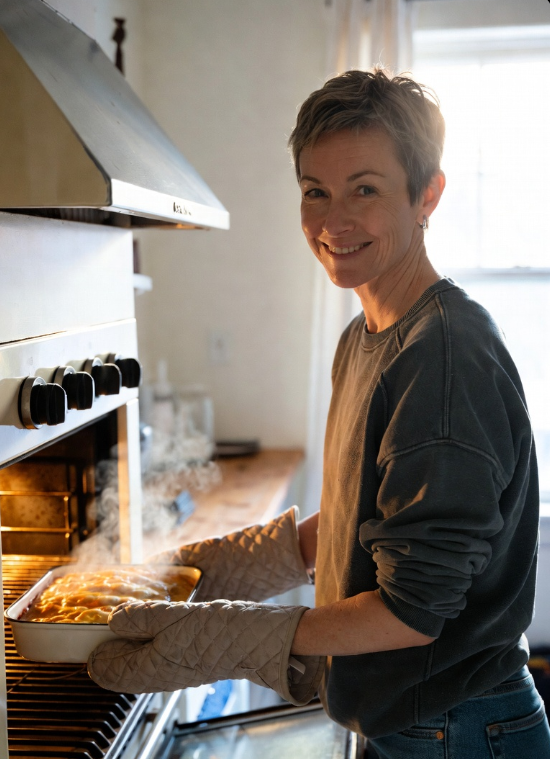
The bread I made during those first weeks of lockdown was plain and honest — flour, water, yeast, salt — but once the panic settled into something more like rhythm, I wanted warmth that felt like a little celebration of still being here, still feeding people, still holding the house together. This baked bagel French toast with maple glaze is what I landed on: it uses what’s already in the kitchen, it fills the oven with the same golden smell that got me through March and April, and when I set it on the table, the kids actually stopped what they were doing and came to eat. After weeks of Zoom calls and soil thermometers and color-coded schedules, a pan of something sweet and warm and made by hand was the closest thing we had to normal — and normal, right then, was everything.
Baked Bagel French Toast with Maple Glaze
Prep Time: 15 min | Cook Time: 35 min | Total Time: 50 min | Servings: 6
Ingredients
- 4 plain or cinnamon-raisin bagels, sliced into 1/2-inch rounds
- 4 large eggs
- 1 cup whole milk
- 2 tablespoons granulated sugar
- 1 teaspoon vanilla extract
- 1/2 teaspoon cinnamon
- 1/4 teaspoon nutmeg
- Pinch of salt
- 2 tablespoons unsalted butter, melted (plus more for greasing)
- For the Maple Glaze:
- 1/2 cup pure maple syrup
- 2 tablespoons unsalted butter
- 1/4 teaspoon vanilla extract
- Pinch of cinnamon
Instructions
- Preheat and prep. Heat your oven to 375°F. Grease a 9x13-inch baking dish with butter and set aside.
- Make the custard. In a large bowl, whisk together the eggs, milk, sugar, vanilla, cinnamon, nutmeg, and salt until smooth and fully combined.
- Soak the bagels. Working in batches, dip each bagel round into the custard mixture, letting it soak for about 20–30 seconds per side so the custard soaks through. Arrange the soaked rounds in a single overlapping layer in the prepared baking dish.
- Add butter and bake. Drizzle the melted butter evenly over the top of the arranged bagel slices. Bake for 30–35 minutes, until the tops are golden brown and the custard is set with no jiggle in the center.
- Make the maple glaze. While the french toast bakes, combine the maple syrup and butter in a small saucepan over medium-low heat. Stir until the butter melts and the mixture is smooth, about 2 minutes. Remove from heat and stir in the vanilla and cinnamon.
- Glaze and serve. Remove the baked french toast from the oven and let it rest for 5 minutes. Drizzle the warm maple glaze generously over the top and serve straight from the pan.
Nutrition (per serving)
Calories: 340 | Protein: 10g | Fat: 11g | Carbs: 51g | Fiber: 2g | Sodium: 380mg