
 By
By Last week I wrote about making the miso salmon at 4 in the morning, and a few of you wrote back to say you’ve done the same thing — stood in a quiet kitchen while everyone else slept, cooking not because you were hungry but because your hands needed something to do. I wasn’t expecting that. I wasn’t expecting any of this, honestly. Writing about food to strangers feels strange and also, somehow, necessary.
This week was harder.
I don’t mean that as a warning. I just mean: it was. Miya had a bad stretch — four nights in a row where she wouldn’t settle until two in the morning, and then woke again at five, and I spent those hours doing the thing I’m not supposed to do, which is lying in the dark calculating how many total hours of sleep I’ve had in the past week and then spiraling about what that means for my cognitive function and therefore my ability to parent and therefore — well. You know how it goes, or maybe you don’t, and if you don’t, I hope you never find out.
My therapist calls it the anxiety spiral. I call it my brain eating itself. We’re both right.
On Tuesday, somewhere in the middle of the fourth sleepless night, I found myself thinking about Obachan Fumiko. This is not unusual — I think about her often, and more so since Miya arrived, as if having a daughter has opened a door in me that goes back and back through all the women who came before. But on Tuesday night I wasn’t thinking about her warmly. I was thinking about her practically, which is maybe the most Fumiko way to think. I was thinking: she raised a son in a country that had locked her family up. She cooked Japanese food in Sacramento in an era when nobody knew what miso was. She made dashi every single morning of her life, in a small apartment in Japantown, with the same quiet precision she brought to everything. And she did it without a support group or a therapist or a blog where strangers told her she wasn’t alone.
I don’t want to romanticize her suffering. Fumiko was resilient because she had to be, and “having to be” is not a virtue — it’s just a circumstance. But at 2 a.m. with a crying infant, I found something useful in thinking about her standing at her own stove, making something warm and nourishing out of the materials available to her. So that’s what I did.
I made kitsune udon.
Fumiko made kitsune udon the way she made most things: without a recipe, without measuring anything, without explanation. I watched her make it maybe a dozen times growing up, and what I retained was impressionistic at best — the pale gold of the broth, the way the aburaage (the fried tofu skin) soaked up the dashi until it was soft and glossy and sweet, the thick white udon noodles that she always cooked a little past al dente because, she said, that’s how they should be. She garnished it with thinly sliced scallions and sometimes a soft-boiled egg and sometimes nothing at all.
After she died, I found her recipe cards. They were in a tin box in her kitchen drawer, written in her spidery Japanese script on index cards that had gone soft at the corners from decades of handling. I hired a tutor to help me read them. The kitsune udon card wasn’t there — either she’d never written it down, or it had been lost, or she considered it too basic to need a card, the way you don’t write down how to breathe. So I found a recipe elsewhere, and then I adjusted it the way you always have to adjust recipes when you’re cooking from memory: more of this, less of that, until it tasted the way I remembered.
It took three tries over two weeks to get it right. The broth was the hardest part. Fumiko’s dashi was quieter than most — not aggressively fishy, just deeply savory, a suggestion of the ocean rather than a shout. I was overshooting it at first, steeping the kombu too long, adding too much bonito. The second batch I went in the opposite direction and came up too thin. The third time I made it the way she’d shown me: kombu in cold water, brought slowly to a near-simmer over low heat, then the bonito added and steeped for exactly three minutes before straining. Patient. Unhurried. The Fumiko way.
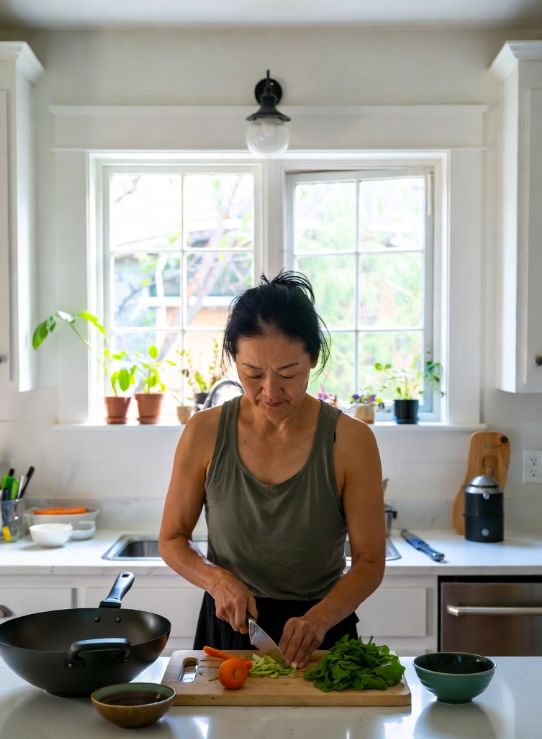
I made it after Miya’s 2 a.m. feeding on Wednesday, when she’d finally gone back to sleep and I was too wound up to follow. I stood at the stove and watched the kombu uncurl in the cold water. I watched the broth slowly change color — pale green to gold to a faint amber. I added the bonito and watched it bloom and sink. I strained it, seasoned it with soy sauce and mirin and a small spoon of sugar, and then I simmered the aburaage in the broth until it absorbed everything and became something new.
The smell was Fumiko’s kitchen. Just exactly that. There is no other way to say it.
I stood over the pot and cried a little, which felt both self-indulgent and completely appropriate for 3 in the morning, and then I ate my bowl of udon standing at the kitchen counter in the gray light, and my brain, for the first time in four days, got quiet.
I’ve been thinking about why that works — the cooking, the ritual of it. My therapist talks about “grounding techniques,” which are essentially ways of anchoring yourself to the present moment when your brain is sprinting toward catastrophic futures. The standard ones are sensory: name five things you can see, four you can hear, and so on. Cooking does all of that at once. The smell of kombu steeping. The sound of a low simmer. The way aburaage feels between your fingers before it goes into the pot — soft and spongy, a little oily, slightly cool. The color of the broth going golden. You can’t be in the future when you’re watching dashi.
I think Fumiko knew this. She didn’t have the language for it — she would have thought “grounding technique” was a very strange phrase — but she cooked every day, with full attention, without shortcuts, as if the making was as important as the eating. I understand that now in a way I didn’t when I was a child watching her in that small apartment kitchen, impatient for the bowl.
Brian was home on Thursday. He looked at the pot on the stove — I’d made a double batch, because once I had the broth right I didn’t want to stop — and said, “Is that the Japanese noodle thing?” He ate it without complaint, which is about as much enthusiasm as Brian brings to anything that isn’t beer or a burger. I didn’t tell him it was the recipe I’d spent two weeks working out, or that I’d cried over it, or that making it felt like the most important cooking I’d done since we brought Miya home. I just said, “Yes, it’s the Japanese noodle thing.”
Miya was asleep in the living room in her little bouncy seat, making the small sounds she makes when she’s dreaming. Brian was on his phone. I ate my bowl at the kitchen table and watched the steam rise, and thought about Fumiko, and about the Japan she never went back to, and about the ways we carry the people we love forward through time — not by becoming them, but by remembering what they showed us with their hands.
This recipe is my version. It will not be exactly like Fumiko’s, because nothing I make will ever be exactly like hers. But it’s mine now, and someday, I hope, it will be Miya’s.
I’ve made this punch probably a dozen times since that first afternoon I threw it together for Miya’s welcome-home gathering — the day I realized that feeding a crowd, even imperfectly, is its own kind of keeping. This punch felt right because it was the simplest gesture of hospitality I could offer: something bright and easy, made from grocery-store staples, poured without ceremony. After a few rounds of tweaking ratios and one very sticky kitchen counter, here’s what I landed on.
The Best Party Punch
Prep Time: 15 min | Cook Time: None | Total Time: 15 min | Servings: 20
Ingredients
- 64-ounce jug cran-raspberry juice
- 64-ounce jug fruit punch (NOT Hawaiian Punch)
- 32-ounce jug pineapple-orange juice (see note)
- 1 to 1 1/2 liters ginger ale (optional)
Instructions
- Mix the punch. Combine everything together in a pitcher and serve immediately or refrigerate until ready to serve. If making ahead, add ginger ale right before serving.
- Scale as needed. The punch recipe can be increased or decreased as needed using this simple formula: TWO parts cran-raspberry juice to TWO parts fruit punch to ONE part pineapple-orange juice. For every gallon of juice mixed, add 1 to 1 1/2 liters ginger ale, if desired.
Nutrition (per serving)
Calories: 76 kcal | Protein: 0.4g | Fat: 0.2g | Saturated Fat: 0.02g | Carbs: 19g | Fiber: 0.3g | Sugar: 17g | Sodium: 4mg