
 By
By It is six in the morning. The kitchen window faces east, and in July that means the sun comes in low and yellow over the ridge where the wild blueberries grow. Frost is at my feet — the dog, not the poet, though the distinction narrows over time. He has been restless since five. He knows the grandchildren are coming today. He always knows.
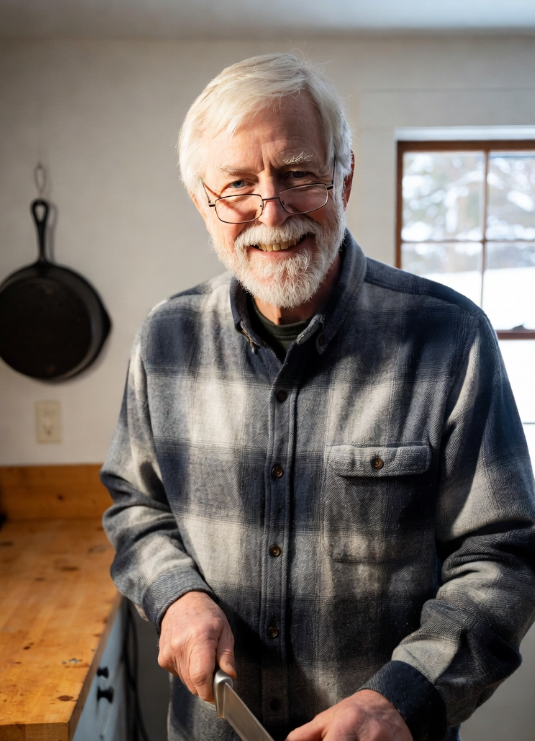
My name is Walt Bergstrom. I am sixty-three years old. I live in a white clapboard farmhouse on the outskirts of Burlington, Vermont, on a road that did not get paved until I was seven. My family has been on this land for six generations. In Vermont, you say that and people nod. It is just a thing that is true, like the cold, like the mud in April, like the way the light hits Lake Champlain on a clear morning and makes you understand why your great-great-grandfather looked at this place and decided he was done moving.
I taught English at Champlain Valley Union High School in Hinesburg for thirty-eight years. Hemingway. Frost. Thoreau. Short sentences. Active verbs. No unnecessary words. I retired last summer, and I still do not quite know what to do with myself between eight and three on weekdays. My wife Helen says I wander the house like a man looking for something he cannot name. She is not wrong.
What I have found, in the year since retirement, is the kitchen.
This is not as dramatic as it sounds. I have always cooked. A man who grew up in Vermont in the 1950s learned to feed himself out of necessity — winters were long, the drive to town was not always possible, and no one in this house complained about the weather or waited for someone else to put food on the table. My mother, Helen Sr., cooked the way Vermont women of her generation cooked: without sentiment, without recipes written down, and without any particular interest in your opinion of the result. New England boiled dinner. Baked beans, overnight, with salt pork and molasses. Brown bread steamed in a coffee can. Maple cream pie from syrup my father tapped himself. The food was plain and it was serious, and it kept us alive through winters that would have flattened anyone without the sense to take them seriously.
I learned to cook by watching my mother, the way you learn most things in Vermont — quietly, from a distance, without being told you are learning. She did not give lessons. She cooked and you watched and eventually you could do it yourself. That was the pedagogy. It served me well.
My wife Helen has been the primary cook in this house for thirty-six years, and she is better at it than I am in the ways that matter: she is patient, she follows recipes faithfully, and she does not consider the oven a suggestion. I am better at the things that require stubbornness: tending a long braise, watching a pot of beans through an afternoon, managing a wood fire. We have divided the kitchen the way you divide most things in a long marriage — without a formal agreement, gradually, each person drifting toward what they do best until the arrangement seems inevitable.
Retirement has blurred those lines. Helen is still working. She is a nurse, and nurses do not retire on schedule; they retire when they decide they are done, and Helen has not decided. So I am home, and the kitchen is available, and I have been filling it the way retired schoolteachers fill available spaces: with slightly too much preparation and a quiet satisfaction in the doing of things that need doing.
The blueberries came first.
We have a ridge behind the house, past the sugarhouse and above the old stone wall, where wild lowbush blueberries have grown since before I can remember. My mother picked them. I picked them as a boy. Helen and I have picked them every July for thirty-five years, the same as the berries themselves — reliable, unhurried, unimpressed by their own significance. They are small, the wild ones. Smaller than what you buy at the grocery store, and darker, and more tart. They are not trying to be impressive. They are just blueberries, doing what blueberries do in July in Vermont, which is to grow on that ridge and wait for someone with the patience to pick them.
Yesterday afternoon I went up alone. Frost came with me. We were up there for two hours, the dog investigating the stone wall while I worked through the bushes with a coffee can, which is how my mother did it and how I do it. I came back with about three cups. Enough for two batches of muffins. Enough for today.
David is bringing the kids up from Montpelier. Sarah is driving over from Portland with hers. Five grandchildren total, ranging in age from two to nine, and the farmhouse, which is quiet the other six days of the week, will not be quiet today. I have been informed by the nine-year-old — David’s oldest, a girl named Clara who has her grandmother’s frankness and her great-grandmother’s stubbornness — that she expects muffins. She said this on the phone two days ago. Not requested. Expected.
I made twelve.
The muffin recipe is my mother’s, which means it has no written form. I have reconstructed it over the years from memory and trial and error, mostly error, until I arrived at something that tastes the way I remember. The method is simple: flour, sugar, baking powder, salt, an egg, milk, oil, and berries. Nothing complicated. Nothing that requires a stand mixer or a specialty ingredient or a trip to a store that sells things my mother would have regarded with suspicion. A bowl, a fork, a muffin tin, an oven set to four hundred and held there for twenty minutes. That’s all.
I have been teaching people things for thirty-eight years, and the thing I tried hardest to teach — harder than Hemingway, harder than the five-paragraph essay, harder than the difference between a semicolon and a colon — was this: simple is not the same as easy, and easy is not the same as good. The simplest things require the most attention, because there is nothing to hide behind. A muffin is just a muffin. It is flour and sugar and blueberries. There is no technique to distract from whether the blueberries are good, whether you mixed the batter until it was just combined and no further, whether you watched the oven. The muffin tells you everything.
These are good. I know because I ate one standing at the counter at five-forty-five this morning, before the grandchildren arrived, before the noise started, in the quiet kitchen with the east light coming in and Frost hopeful at my feet. I gave him a piece. He was satisfied. I was satisfied. That seemed like enough of a verdict.
There is a thing I have come to understand about cooking, in this first year of having time to think about it: food is how we account for our days. Not every meal. Not even most meals. But the ones that matter — the ones made for people we love, on the days we have bothered to plan for their arrival — those meals are evidence that the day was worth something. Clara expects muffins because muffins mean I was thinking about her before she arrived. That is all it means. That is everything it means.
I hear tires on the gravel. Frost has already left the kitchen.
The muffins are on the counter, covered with a dish towel. Twelve of them. Five grandchildren. Helen will eat one if she has time between children. I will have one more. That leaves five, and they will be gone in twelve minutes, and Clara will look at me and say “more?” the way her grandmother says things: not a question, exactly, but not quite a demand. A statement of the obvious, offered for confirmation.
I told you I have three cups of blueberries. I made two batches. I am not unprepared.
---The recipe has not changed in thirty years, which is exactly the point — Clara is not coming to be surprised, she is coming to be remembered. Wild blueberry muffins are what I know how to make for her, and knowing how to make something for someone is its own kind of language. Here is how I make them.
Wild Blueberry Muffins
Prep Time: 10 minutes | Cook Time: 20 minutes | Total Time: 30 minutes | Servings: 12 muffins
Use wild blueberries if you can get them — smaller, darker, more tart. If you are using cultivated berries from the store, do not apologize for it. Use what you have. That has always been the Vermont position on ingredients, and it has served us well.
Ingredients
- 2 cups all-purpose flour
- 1/2 cup granulated sugar
- 1 tablespoon baking powder
- 1/2 teaspoon salt
- 1 large egg
- 1 cup whole milk
- 1/3 cup vegetable oil
- 1 teaspoon pure vanilla extract
- 1 1/2 cups fresh wild blueberries (or cultivated, rinsed and dried)
- 1 tablespoon sugar, for topping
Instructions
- Heat the oven. Set it to 400 degrees Fahrenheit. Grease a standard 12-cup muffin tin, or line it with paper cups. My mother greased with butter. I use whatever is at hand. Either works.
- Mix the dry ingredients. In a large bowl, whisk together the flour, sugar, baking powder, and salt. Make a well in the center.
- Mix the wet ingredients. In a separate bowl or a large measuring cup, beat the egg lightly, then add the milk, oil, and vanilla. Stir to combine.
- Combine. Pour the wet ingredients into the well in the dry ingredients. Stir with a fork until just combined. The batter will be lumpy. Leave it lumpy. Overmixing is the enemy of a good muffin. I cannot stress this enough. Stop stirring before you think you should stop stirring.
- Fold in the blueberries. Add the berries and fold them in gently with a rubber spatula — four or five folds, no more. Some berries will streak. That is fine.
- Fill the tin. Divide the batter evenly among the twelve cups. Each cup should be about 3/4 full. Sprinkle the tablespoon of sugar over the tops — a small amount per muffin. This gives them a faint crust. My mother always did this. I do not know who taught her.
- Bake. Place in the center of the oven for 18 to 22 minutes, until the tops are golden and a toothpick inserted in the center comes out clean. At 400 degrees in my oven, twenty minutes is usually right. Your oven may differ. Watch them after eighteen.
- Cool briefly. Let them sit in the tin for five minutes before turning them out onto a rack. Or eat one immediately. That is also an option, and in my experience the more popular one.
Nutrition (per serving)
Calories: 185 | Protein: 3g | Fat: 7g | Carbs: 28g | Fiber: 1g | Sodium: 185mg