The dog days of August. Edison bakes. The apartment A/C wheezes. I am making cold food exclusively because turning on the stove feels like an act of aggression against the thermostat.
Summer cooking in Tamil Nadu is an art form — Amma has a whole repertoire of dishes designed for heat. This week I made three of her cold preparations:
Puliyodarai — tamarind rice, served at room temperature. You make the tamarind paste first (a complex production involving tamarind, jaggery, peanuts, and a specific spice powder that Amma grinds herself), then mix it into cooked rice. It travels well, doesn't need reheating, and tastes better the next day. Amma packed this in my school lunch every September. I was embarrassed by it then. I'd trade everything in my adult life for one of those lunches now.
Sundal — chickpeas tempered with mustard seeds, curry leaves, and coconut. Cold or room temperature. Protein-rich, satisfying, and the perfect answer to "I'm hungry but it's too hot to cook."
And my favorite: raw mango rice — leftover rice mixed with grated raw mango, tempered with peanuts, dried chilies, and a generous squeeze of lemon. It's sour and crunchy and everything summer should be.
Raj, who is Gujarati and therefore accustomed to sweeter flavor profiles, has been converted to tamarind rice. He eats it for lunch at the hospital, cold from a container, and his colleagues ask what smells so good and he says "my wife's tamarind rice" with a pride that is disproportionate to the dish's simplicity.
At work, the heat has sent more patients to the ER — dehydration, heat stroke, medication issues exacerbated by the temperature. I've been counseling patients about medications that increase sensitivity to heat: diuretics, beta-blockers, certain antipsychotics. Most people don't know that their blood pressure medication can make them more vulnerable to heat stroke. That's why pharmacists exist — to know the things that fall between the cracks.
Saturday night, Raj and I sat on the apartment balcony after dark, when the temperature drops to merely uncomfortable, and ate puliyodarai with our hands. No plates. No table. Just rice, fingers, night air, and each other.
"This is the best restaurant in Edison," Raj said.
"This is a balcony."
"Best balcony restaurant in Edison."
I love this man. Even when it's too hot to love anything.
Raj eating cold tamarind rice out of a container at the hospital and fielding compliments from his colleagues is, honestly, one of my proudest moments as a home cook — but I know not every kitchen has access to Amma’s tamarind paste or her specific spice powder ground by hand. This Chicken Fried Rice Salad is the bridge I’d offer anyone who wants the spirit of those cold summer rice dishes without the production: it’s tangy, a little salty, loaded with protein, and built to travel. Make it the night before, pack it cold, and let someone at the office ask what smells so good.
Chicken Fried Rice Salad
Prep Time: 15 min | Cook Time: 10 min | Total Time: 25 min (plus chilling) | Servings: 4
Ingredients
- 3 cups cooked long-grain white rice, cooled completely (day-old rice works best)
- 2 cups cooked chicken breast, shredded or chopped
- 1 cup shredded red cabbage
- 1 cup shredded carrots (about 2 medium)
- 3 scallions, thinly sliced
- 1/2 cup frozen edamame, thawed
- 1/4 cup roasted peanuts, roughly chopped
- 2 tablespoons toasted sesame seeds
- 3 tablespoons soy sauce (low-sodium preferred)
- 2 tablespoons rice vinegar
- 1 tablespoon toasted sesame oil
- 1 tablespoon neutral oil (avocado or canola)
- 1 tablespoon fresh lime juice
- 1 teaspoon honey or agave
- 1 teaspoon fresh ginger, grated
- 1 clove garlic, minced
- 1/4 teaspoon red pepper flakes (or more to taste)
- Salt and black pepper to taste
Instructions
- Make the dressing. In a small bowl or jar, whisk together the soy sauce, rice vinegar, sesame oil, neutral oil, lime juice, honey, grated ginger, minced garlic, and red pepper flakes until fully combined. Taste and adjust — it should be tangy, a little salty, and slightly sweet.
- Prep the rice. If your rice is freshly cooked, spread it on a sheet pan and refrigerate for at least 30 minutes so the grains separate and cool completely. Cold, slightly dry rice holds up far better in a salad than warm, clumped rice.
- Combine the base. In a large mixing bowl, combine the cooled rice, shredded chicken, red cabbage, carrots, edamame, and scallions. Toss gently to distribute evenly.
- Dress and toss. Pour about two-thirds of the dressing over the rice mixture and toss well to coat. Taste, then add more dressing as needed. Season with salt and black pepper.
- Add the crunch. Scatter the chopped peanuts and toasted sesame seeds over the top. If eating immediately, fold them in gently. If packing for later, keep them separate and add just before serving so they stay crisp.
- Chill or serve. Serve immediately at room temperature, or cover and refrigerate for up to 3 days. Like Amma’s tamarind rice, this salad tastes better the next day once the dressing has had time to soak into the rice.
Nutrition (per serving)
Calories: 420 | Protein: 28g | Fat: 14g | Carbs: 46g | Fiber: 4g | Sodium: 680mg
About the cook who shared this
Priya Krishnamurthy
Week 72 of Priya’s 30-year story
· Edison, New Jersey
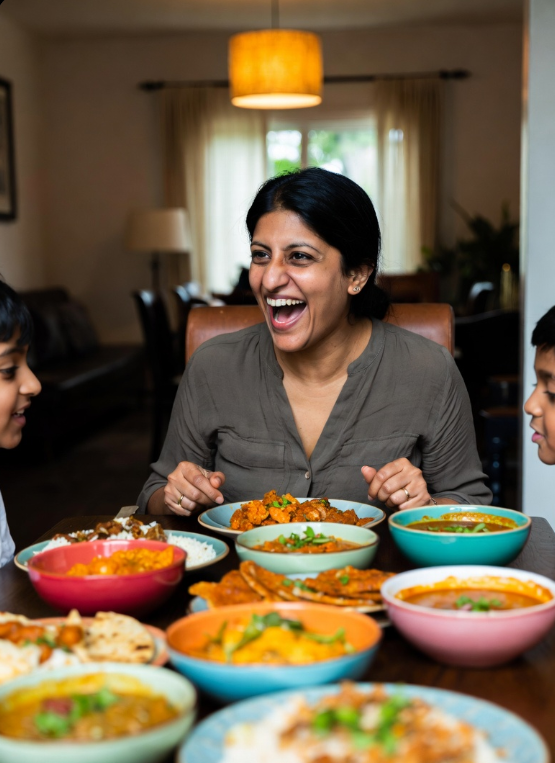
Priya is a pharmacist, wife, and mom of two in Edison, New Jersey — the town she grew up in, surrounded by the sights and smells of her mother's South Indian kitchen. These days, she splits her time between the hospital pharmacy, school pickups, and her own kitchen, where she cooks nearly every night. Her style is a blend of the Tamil recipes her mother taught her and the American comfort food her kids actually want to eat. She writes about the beautiful mess of balancing two cultures on one plate — and she wants you to know that ordering pizza is also an act of love.
