
 By
By The new kitchen is the wrong shape.
Not badly wrong — it’s a perfectly fine kitchen, the kind that would show well in a listing photo, with granite counters and stainless steel appliances and a breakfast bar that my husband Kevin loves and I’m still getting used to. But it’s the wrong shape for my hands. My hands know a different kitchen. A longer one, with worn laminate counters the color of a manila envelope and a window over the sink that looked out at the machine shed and a gas stove with one burner that ran hot and one that didn’t want to light without coaxing, and a drawer full of utensils that had been in that drawer since 1974 and weren’t going anywhere.
That was my mother’s kitchen. That was the farm.
We moved to Des Moines three weeks ago. Kevin had been commuting two hours a day for years, and with the kids getting older and the farm — well. The farm is gone. That happened last year, and I’m not ready to write about it yet, so I’ll just say: the farm is gone, and we’re in Des Moines now, and the kitchen is the wrong shape, and some mornings that’s a very small problem and some mornings it’s the only thing I can think about.
My name is Diane Holloway. I grew up outside Grinnell, Iowa, on four hundred acres of corn and soybeans that my family had farmed since 1908. I’m thirty-six years old. I have three kids: Noah, who is ten and still asleep because ten-year-old boys will sleep until noon if you let them; Emma, who is seven and already in the backyard with the neighbor girl she met four days after we moved in, because Emma makes friends the way a good seed takes to good soil — fast, no fuss, deep roots; and Jack, who is four years old and sitting at the breakfast bar right now, watching me with the expression he always has, which is the expression of someone who has seen everything and is mildly interested in all of it. He’s got my father’s face. He’s got my father’s quiet. It does things to my heart I don’t have words for.
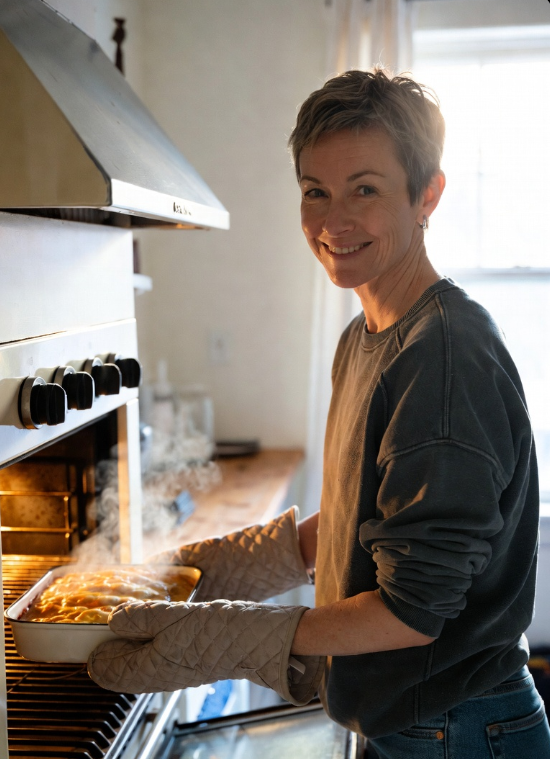
Today is Saturday. I’m making cinnamon swirl bread.
I make it on Saturdays because that’s what you do on Saturdays when you are a Weber. Except what my mother made wasn’t bread — it was cinnamon rolls. The real kind. The kind that take half the morning and fill the house with a smell that I am convinced is the actual smell of love. Marlene Weber’s cinnamon rolls, frosted with a cream cheese glaze she put on so thick that my father, Roger, always claimed he married her for those rolls. Honestly, I believe him. I’ve never tasted anything that came closer to a religious experience.
I don’t make the rolls. I make the bread instead, because the rolls take three hours start to finish and I have three kids and a house full of boxes we still haven’t unpacked and a husband who just cut his commute from two hours to twenty minutes and is so happy about it he practically skips to the car. The bread takes the same amount of active time — mixing, kneading, filling, rolling — but I can do the rise while I’m doing other things, and it comes out of the oven as one whole loaf instead of twelve individual rolls, which means I can slice it at the table and it feels like a meal instead of a project. My mother would understand. She’s practical like that.
I grew up in Grinnell. If you’re not from Iowa, you probably don’t know it — small college town, surrounded by cornfields in every direction, the kind of place where everybody knows everybody and that’s sometimes a blessing and sometimes the opposite. My dad farmed four hundred acres outside of town, corn and soybeans, the same land his grandfather had broken back in 1908. Weber land. Four generations on the same acreage. Growing up, that was just a fact, the way the earth is round and the corn grows in rows.
I was driving a tractor by ten. I was walking bean rows in the July heat — pulling weeds by hand, one of the most tedious jobs you can give a child, the kind of job that teaches you what patience really costs — by twelve. I showed cattle in 4-H. I won a blue ribbon for chocolate chip cookies at the Iowa State Fair in 1995, and I am more proud of that than my college degree, and I mean that completely. I went to Iowa State, studied agricultural business, graduated in 2001 and came home to Grinnell and helped my dad run the operation and thought that was what my life would look like, more or less, forever.
Then things changed. Things change. And now I’m in Des Moines, in a kitchen that’s the wrong shape, making the bread that smells like the right one.
Every Saturday morning of my childhood, my mother made cinnamon rolls in that farmhouse kitchen. She’d be up by six, which was sleeping in by farm standards. The dough would be started before I came downstairs, already in its first rise, covered with a dish towel that had watermelons on it that she’d had since the eighties. By nine the rolls would be in the oven, and by nine-thirty the cream cheese glaze would be going on, and by ten the four of us would be at that kitchen table — my dad with his Farm Bureau Spokesman, my mother with her coffee, me with whatever book I was reading — and we’d eat cinnamon rolls and not talk much, and that was its own kind of conversation.
What I remember most is the smell. Cinnamon and brown sugar and butter in a hot oven. That smell means Saturday. That smell means nobody has anywhere to be. That smell means the week is over and the morning is slow and the people I love are in the next room. I have been trying to put that smell in every kitchen I’ve lived in since I left home, and I have never once gotten it exactly right, and I keep trying anyway.
Jack is watching me roll out the dough. He does this — watches with a quiet attention that makes him seem older than four. He doesn’t ask a lot of questions. He just watches. Last week when I was making plain sandwich bread, I handed him a piece of dough and he sat there working it in his hands for twenty minutes like he was trying to understand something about it. Didn’t say a word. Just worked the dough.
“Grandma Marlene does it like that,” he said this morning, watching me spread the softened butter across the rolled-out dough.
“She does,” I said. “I learned from her.”
He nodded, like that confirmed something he’d already suspected.
I called my mother before anyone else was up today. She and my dad are in Grinnell, in the house in town — a small place, nothing like the farmhouse, but it’s theirs. My dad is tending a garden and watching crop reports on television and learning, at sixty-four, how to be a man without a farm to run, which is its own kind of work and not the easy kind. My mother sounds like herself on the phone, which is to say practical and direct and not given to dwelling on things that can’t be changed. She asked about the kids. She asked if the neighborhood seemed safe. She asked if Kevin’s commute was better.
“How’s the kitchen?” she asked, because she is my mother and she knows me.
“Wrong shape,” I said.
She laughed her short, dry laugh. “It’ll reshape itself,” she said. “Give it time.”
I’m giving it time. In the meantime, I make the bread on Saturdays. I mix the dough and let it rise and roll it out on the wrong-shaped counter and spread it with butter and brown sugar and cinnamon and roll it up tight and put it in the loaf pan and let it rise again, and by the time it comes out of the oven the whole house smells like the farmhouse kitchen, and for a little while that is exactly enough.
That’s what this space is going to be. Recipes, yes, but really it’s going to be about feeding a family in a new city while trying to carry the flavors of a place I grew up in and a life that has changed more than I expected in the last few years. I cook Iowa food. I cook practical food. I am not a food photographer and I am not fancy and my kitchen is the wrong shape, but the bread comes out right and the kids eat it standing at the counter before it’s even fully cooled, and most Saturday mornings, that is all I need it to do.
Welcome. I’m glad you’re here.
So this is the recipe I’m starting with—the one that started all of it, really, the one that makes the house smell like somewhere I belong. I can’t explain why getting the cinnamon swirl right felt like proof that we were going to be okay here, but it did, and it does, every time. Here’s how I make it.
Cinnamon Swirl Bread
Prep Time: 25 minutes | Cook Time: 35 minutes | Total Time: 2 hours 30 minutes (includes rise time) | Servings: 1 loaf (10 slices)
Ingredients
For the Dough- 3 cups all-purpose flour, plus extra for kneading
- 2 1/4 teaspoons active dry yeast (one standard packet)
- 1 tablespoon granulated sugar
- 1 teaspoon salt
- 3/4 cup whole milk, warmed to about 110°F
- 2 tablespoons unsalted butter, softened
- 1 large egg, room temperature
- 3 tablespoons unsalted butter, softened
- 1/3 cup brown sugar, packed
- 2 teaspoons ground cinnamon
- Pinch of salt
- 1 cup powdered sugar
- 2 to 3 tablespoons milk or heavy cream
- 1/2 teaspoon vanilla extract
Instructions
- Proof the yeast. Combine the warm milk, sugar, and yeast in a large bowl. Stir gently and let it sit for 5 to 10 minutes until it looks foamy on top. If nothing happens, your yeast is dead — start over with a new packet.
- Make the dough. Add the egg and softened butter to the yeast mixture and stir to combine. Add the flour and salt and mix until a shaggy dough forms, then turn it out onto a lightly floured surface and knead for 8 to 10 minutes, until the dough is smooth and just slightly tacky. It should spring back slowly when you press a finger into it.
- First rise. Shape the dough into a ball and place it in a lightly greased bowl, turning once to coat. Cover with a clean dish towel and set it somewhere warm — I put mine on top of the refrigerator — for 1 to 1 1/2 hours, until doubled in size.
- Make the filling. Mix the softened butter, brown sugar, cinnamon, and pinch of salt together in a small bowl until it forms a spreadable paste. Set aside.
- Shape the loaf. Punch down the risen dough and roll it out on a lightly floured surface into a rectangle about 9 inches wide and 16 inches long. Spread the cinnamon filling evenly across the entire surface, going all the way to the edges. Starting at one of the short ends, roll the dough up tightly into a log. Pinch the seam closed along the bottom.
- Second rise. Place the log seam-side down into a greased 9x5-inch loaf pan. Cover loosely with the dish towel and let it rise again for 45 minutes to 1 hour, until the dough crowns about an inch above the top of the pan.
- Bake the bread. Preheat your oven to 350°F. Bake the loaf for 30 to 35 minutes, until the top is deep golden brown. If you have an instant-read thermometer, the center should read 190°F. Let it cool in the pan for 10 minutes, then turn it out onto a rack.
- Make the glaze. Whisk together the powdered sugar, 2 tablespoons of milk, and vanilla extract. Add more milk a little at a time until it reaches a thick but pourable consistency. Drizzle over the loaf while it’s still slightly warm. Use more glaze than you think you need. That part is non-negotiable in this house.
- Slice and serve. Let the glaze set for about 5 minutes before slicing, if you can manage it. Serve warm. Watch the kids reach for it before you’ve even put down the knife.
Nutrition (per serving)
Calories: 290 | Protein: 5g | Fat: 8g | Carbs: 50g | Fiber: 1g | Sodium: 250mg