
 By
By The second week of August and I took a day off. A real day off — not a pandemic day off where I stay home and worry, but a day where I stayed home and cooked without obligation, cooked because I wanted to, cooked the way a painter paints on a Sunday, for the joy of it and not the demand. I made pasteles in August, which is insane, which is out of season, which violates every rule of Puerto Rican cooking that says pasteles are a December food and making them in August is like wearing a winter coat to the beach. I do not care. The rules are for people who have not spent five months in a pandemic. The rules can wait. The pasteles cannot.
I made twelve. Just twelve — not the sixty of Christmas, not the assembly-line production, but a small, personal batch, just me in the kitchen with the banana leaves and the masa and the filling, the grater and the cutting board and the string, the whole ritual compressed into a Wednesday afternoon because I needed the ritual more than I needed the result. The ritual is the prayer. The grating is the meditation. The folding is the faith — the faith that the banana leaf will hold, that the masa will set, that the pasteles will come out of the boiling water intact, the way they always have, the way Abuela Consuelo taught Mami who taught me, the chain unbroken even in August, even in a pandemic, even when the rules say December and my heart says now.
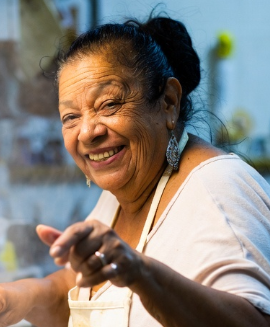
I brought two to Mami. She ate one slowly, sitting at her kitchen table, and I stood in her doorway — closer now, we have relaxed the distance slightly, not touching but closer — and watched her eat, and she closed her eyes after the first bite and something crossed her face that was not the fog, not the confusion, but something older, something deeper, something that lives below memory in the body itself. She opened her eyes and said, Navidad. Christmas. The pasteles tasted like Christmas and her body knew it and the knowing bypassed the fog and went straight to the place where the food lives, the place that the disease cannot reach.
When I brought those pasteles to Mami and watched her face travel back to Navidad, I understood something I had always known but never said out loud: December flavors do not belong to December. They belong to the people who need them. So if you have made something sacred and out-of-season and slightly rebellious, finish the day with this — a cranberry ginger upside down cake with rum whipped cream that smells like the holidays and asks no permission from the calendar. The rum is for the Caribbean in all of us. The cranberries are for every Christmas we are trying to hold onto. Bake it in August. Bake it for your Mami. Bake it because the rules can wait and the need cannot.
Cranberry Ginger Upside Down Cake with Rum Whipped Cream
Prep Time: 20 minutes | Cook Time: 45 minutes | Total Time: 1 hour 5 minutes | Servings: 10
Ingredients
- For the cranberry topping:
- 4 tablespoons unsalted butter, melted
- 3/4 cup packed dark brown sugar
- 2 cups fresh or frozen cranberries
- 1 teaspoon orange zest
- For the cake:
- 1 1/2 cups all-purpose flour
- 1 1/2 teaspoons baking powder
- 1/2 teaspoon fine salt
- 2 teaspoons ground ginger
- 1/2 teaspoon ground cinnamon
- 1/4 teaspoon ground cloves
- 1/2 cup (1 stick) unsalted butter, softened
- 3/4 cup granulated sugar
- 2 large eggs, room temperature
- 1 teaspoon pure vanilla extract
- 1/2 cup whole milk
- 2 tablespoons orange juice
- For the rum whipped cream:
- 1 cup heavy whipping cream, cold
- 2 tablespoons powdered sugar
- 2 tablespoons dark rum
- 1/2 teaspoon pure vanilla extract
Instructions
- Heat oven and prepare pan. Preheat oven to 350°F. Pour the melted butter into a 9-inch round cake pan, tilting to coat the bottom evenly. Sprinkle the brown sugar over the butter in an even layer.
- Arrange the topping. Scatter the cranberries over the brown sugar in a single, close layer. Sprinkle orange zest evenly over the cranberries. Set the pan aside.
- Whisk dry ingredients. In a medium bowl, whisk together the flour, baking powder, salt, ginger, cinnamon, and cloves until well combined.
- Cream butter and sugar. In a large bowl, beat the softened butter and granulated sugar together with a hand mixer on medium-high speed until light and fluffy, about 3 minutes. Scrape down the sides as needed.
- Add eggs and vanilla. Beat in the eggs one at a time, mixing well after each addition. Add the vanilla extract and mix to combine.
- Alternate wet and dry. With the mixer on low, add the flour mixture in three additions, alternating with the milk and orange juice (beginning and ending with flour). Mix just until no dry streaks remain — do not overmix.
- Fill and bake. Spoon the batter carefully over the cranberry layer and gently spread it to the edges with a spatula, taking care not to disturb the cranberry arrangement. Bake for 40–45 minutes, until a toothpick inserted in the center comes out clean and the edges pull slightly from the pan.
- Cool and invert. Let the cake cool in the pan on a wire rack for exactly 10 minutes — no longer, or the topping may stick. Run a thin knife around the edge, place a serving plate firmly over the pan, and invert in one confident motion. Let the pan rest for 30 seconds before lifting it away. Any cranberries that stick can be pressed gently back into place.
- Make the rum whipped cream. Just before serving, beat the cold heavy cream with powdered sugar, dark rum, and vanilla on medium-high speed until soft, billowy peaks form. Do not overwhip.
- Serve. Slice the cake while still slightly warm and serve each piece with a generous spoonful of rum whipped cream over the top.
Nutrition (per serving)
Calories: 390 | Protein: 4g | Fat: 21g | Carbs: 47g | Fiber: 1g | Sodium: 175mg