Paul made a decision: he's not going back to teaching in the fall. He told me Tuesday evening, on the porch, watching the lake. He said it simply, the way he says everything: "I'm not going back, Linda. The kids deserve a teacher who can write on the board and carry a textbook and stand for an hour. I can't do that anymore."
I didn't argue. The nurse in me agreed. The wife in me wanted to argue — wanted to say "you can do it, they'll accommodate you, the assistant can write on the board" — but the nurse was right and the wife knew it and Paul knew it and the decision was made.
Thirty-three years. The same school. The same subject. Thousands of students who learned about the War of 1812 and the Edmund Fitzgerald and Pickett's Charge from a man who cared more about history than anyone I've ever known. Done.
Paul called the principal on Wednesday. I don't know what was said. Paul went into his study and closed the door and when he came out thirty minutes later, his eyes were red but he was composed and he said, "They're naming the history classroom after me." I said, "The Johansson Classroom?" He said, "The Paul Johansson American History Room." He said it like it mattered, because it does. It's his name on a wall. It's the part of him that the school keeps.
Erik came over on Saturday with a project: a reading stand. He'd built it in his woodworking shop — adjustable angle, book holder, page-turning lip — designed so that Paul can read without holding the book. Erik didn't announce it as a medical device. He said, "I made you a thing." Paul looked at it and said, "This is beautiful, Erik." Erik said, "It's just wood." It's not just wood. It's Erik's way of saying: I see what you're losing. I can't stop the loss. But I can build you a reading stand.
Paul used it that evening. He sat in his chair with the stand on the arm, the book propped open, the pages held by the lip, and he read for two hours — without holding the book, without struggling, without the frustration that I've watched accumulate for months. He read the way he's always read: completely absorbed, occasionally looking up to tell me a fact. "Linda, did you know the SS Bannockburn was carrying wheat when it disappeared? Sixty-five thousand bushels of wheat. Just gone."
I did know. I've known for years. I'll let him tell me again. And again. And again.
I made wild rice soup for dinner. My recipe. The comfort soup. The soup I make when the world is too much and the only response is broth and rice and cream. Paul ate it with bread (torn, not cut) and he said, "Erik's stand is the best gift I've ever received." Not the books. Not the shipwreck memorabilia. A reading stand made of wood by a brother-in-law who doesn't talk much and shows love with his hands.
This family. We show love with our hands. Even when the hands don't work.
I’ve made this soup so many times that my hands know the recipe without me. That’s exactly why I made it that Saturday — because when Paul sat down in his chair with Erik’s reading stand and finally, finally read without struggling, I needed to be doing something useful with my hands in the kitchen while I held all of it together. This is the soup I reach for when the grief is quiet and the love is loud and you just need something warm on the table that says: we are still here, and we are okay.
Creamy Vegetable Turkey Soup
Prep Time: 20 min | Cook Time: 40 min | Total Time: 1 hr | Servings: 6
Ingredients
- 2 tablespoons unsalted butter
- 1 medium yellow onion, diced
- 3 stalks celery, sliced
- 3 medium carrots, peeled and sliced into coins
- 3 cloves garlic, minced
- 1/3 cup all-purpose flour
- 6 cups low-sodium chicken or turkey broth
- 2 cups cooked turkey, shredded or cubed
- 2 medium Yukon Gold potatoes, peeled and diced
- 1 cup frozen peas
- 1 cup heavy cream
- 1 teaspoon dried thyme
- 1/2 teaspoon dried rosemary
- Salt and black pepper, to taste
- Fresh parsley, chopped, for garnish
Instructions
- Sauté the aromatics. In a large heavy-bottomed pot or Dutch oven, melt the butter over medium heat. Add the onion, celery, and carrots. Cook, stirring occasionally, for 6–8 minutes until softened and the onion is translucent. Add the garlic and cook 1 minute more.
- Build the base. Sprinkle the flour over the vegetables and stir to coat evenly. Cook for 2 minutes, stirring constantly, to eliminate the raw flour taste.
- Add broth and potatoes. Gradually pour in the broth, whisking as you go to prevent lumps. Add the diced potatoes, thyme, and rosemary. Raise heat to medium-high and bring to a gentle boil, then reduce to a simmer.
- Simmer until tender. Cook uncovered for 15–18 minutes, until the potatoes are fork-tender and the soup has thickened slightly.
- Add turkey and peas. Stir in the cooked turkey and frozen peas. Simmer for 5 minutes until heated through.
- Finish with cream. Reduce heat to low. Stir in the heavy cream and heat gently — do not boil after adding cream. Taste and adjust salt and pepper as needed.
- Serve. Ladle into bowls and garnish with fresh parsley. Serve with good crusty bread, torn, not cut.
Nutrition (per serving)
Calories: 380 | Protein: 24g | Fat: 19g | Carbs: 28g | Fiber: 4g | Sodium: 520mg
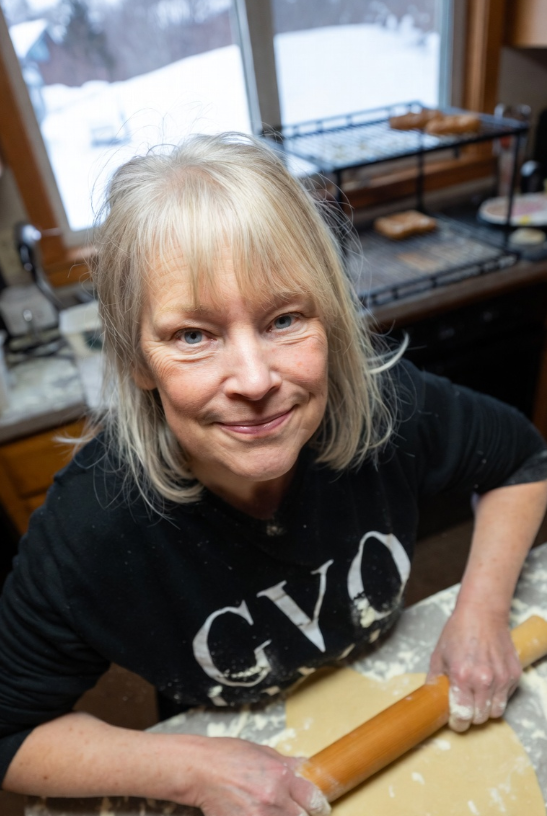
About the cook who shared this
Linda Johansson
Week 121 of Linda’s 30-year story
· Duluth, Minnesota
Linda is a sixty-three-year-old retired nurse from Duluth, Minnesota, living alone in the house where she raised her children and said goodbye to her husband. She lost Paul to ALS in 2020 after two years of watching the kindest man she'd ever known lose everything but his dignity. She cooks Scandinavian comfort food and Minnesota hotdish and the pot roast Paul loved, and she sets two places at the table out of habit because it makes her feel less alone. Every recipe she writes is a person she's loved.
