August. Five months of pandemic. The world is learning to live with the virus the way you learn to live with chronic pain — not by fixing it but by building around it.
The outdoor visits with Amma have become weekly. Every Saturday, lawn chairs, six feet, masks. She brings food. We bring Anaya. The pattern is established: Amma cooks, delivers, watches her granddaughter from across a distance that is both measurable and immeasurable.
Anaya has adapted. She no longer runs toward Amma — she walks to the edge of the zone, sits down, and talks. Two-year-old conversation, narrated at volume: "Paati, look! Anaya cook! Anaya make rice! Anaya eat nana!" Amma listens from her lawn chair and responds and the conversation flows across the gap like water finding a way.
Amma's cognitive status is unknown. We missed the six-month follow-up because of COVID — the neurologist's office was closed, then accepting only urgent cases, then slowly reopening. The appointment is rescheduled for September. Five months without a data point. Five months of watching through a screen, trying to assess cognitive function through FaceTime, which is like trying to take someone's temperature through a window.
She seems okay. The cooking is intact. The conversation is intact. The opinions are certainly intact ("Your hair is too long, Priya. You look like a student."). But the pauses are there — the moments where she searches for a word, where her hand hovers before reaching. I notice them and file them and say nothing.
I'm writing the book again. The pandemic chapter is flowing — the doorstep potato roast, the FaceTime sambar, the lawn chair visits. Sarah Chen says the pandemic material makes the book stronger, more urgent, more universal. Every reader now understands what it means to be separated from the person whose kitchen you're trying to preserve.
I made Amma's kootu this week — the chayote version, from memory, without checking the journal. I made it because I needed to prove to myself that I've internalized it, that it lives in my hands now, that even without the journal open, the recipe is mine.
It was right. Not close — right. The right amount of coconut, the right consistency, the right tempering. Mine.
The student has graduated from close to right. And somewhere in a lawn chair, six feet away, the teacher is watching.
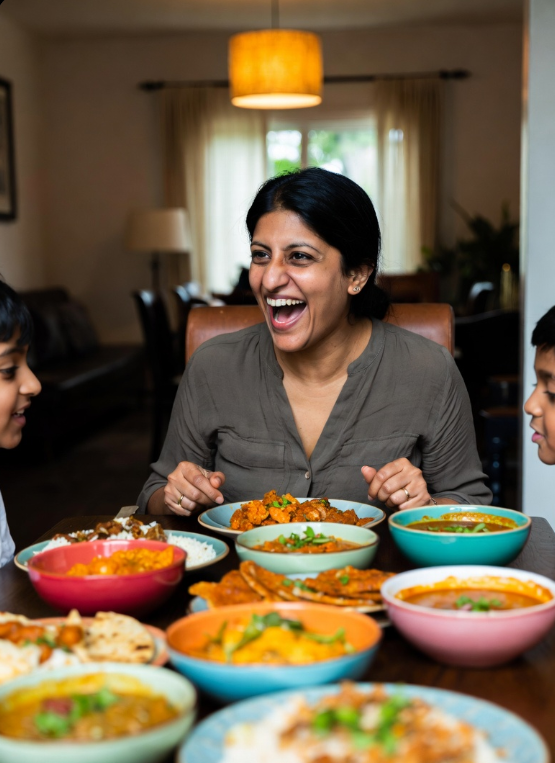
The week I made Amma’s kootu from memory — no journal, no notes, just my hands and what they’d learned — I understood something about the difference between following a recipe and owning one. This curry chicken and vegetables recipe sits in that same territory: warmly spiced, coconut-enriched, built around the kind of layered tempering that Amma always said you could only learn by feel. It’s not kootu, exactly, but it carries the same logic — vegetables and protein brought together by spice, coconut, and patience. Make it enough times and it becomes yours too.
Curry Chicken and Vegetables
Prep Time: 15 min | Cook Time: 35 min | Total Time: 50 min | Servings: 4
Ingredients
- 1 1/2 lbs boneless, skinless chicken thighs, cut into 1 1/2-inch pieces
- 2 tablespoons neutral oil (such as avocado or canola)
- 1 medium yellow onion, finely diced
- 4 cloves garlic, minced
- 1 tablespoon fresh ginger, grated
- 2 tablespoons curry powder
- 1 teaspoon ground turmeric
- 1 teaspoon ground cumin
- 1/2 teaspoon cayenne pepper (adjust to taste)
- 1 can (14.5 oz) diced tomatoes, with juices
- 1 can (13.5 oz) full-fat coconut milk
- 2 medium Yukon Gold potatoes, cut into 3/4-inch cubes
- 1 large carrot, sliced into 1/2-inch rounds
- 1 cup frozen peas
- 1 teaspoon kosher salt, plus more to taste
- Fresh cilantro, roughly chopped, for serving
- Cooked basmati rice or warm flatbread, for serving
Instructions
- Build the base. Heat oil in a large, deep skillet or Dutch oven over medium heat. Add the onion and cook, stirring occasionally, until softened and golden at the edges, about 7—8 minutes.
- Bloom the aromatics. Add the garlic and ginger and cook for 1 minute, stirring constantly, until fragrant. Add the curry powder, turmeric, cumin, and cayenne. Stir to coat the onion mixture and cook 1 more minute, letting the spices toast slightly in the oil.
- Add tomatoes and coconut milk. Pour in the diced tomatoes and their juices, scraping up any browned bits from the bottom of the pan. Stir in the coconut milk and 1 teaspoon salt. Bring to a gentle simmer.
- Add potatoes and carrots. Stir in the potato cubes and carrot rounds. Cover and simmer over medium-low heat for 12 minutes, until the potatoes are just beginning to soften.
- Add chicken. Nestle the chicken pieces into the simmering curry. Cover and continue cooking for 15 minutes, stirring once halfway through, until the chicken is cooked through and the potatoes are fully tender.
- Finish with peas. Stir in the frozen peas and cook uncovered for 2—3 minutes until bright green and warmed through. Taste and adjust salt as needed.
- Serve. Ladle over basmati rice or alongside warm flatbread. Top with fresh cilantro.
Nutrition (per serving)
Calories: 430 | Protein: 34g | Fat: 22g | Carbs: 26g | Fiber: 4g | Sodium: 510mg
About the cook who shared this
Priya Krishnamurthy
Week 227 of Priya’s 30-year story
· Edison, New Jersey
Priya is a pharmacist, wife, and mom of two in Edison, New Jersey — the town she grew up in, surrounded by the sights and smells of her mother's South Indian kitchen. These days, she splits her time between the hospital pharmacy, school pickups, and her own kitchen, where she cooks nearly every night. Her style is a blend of the Tamil recipes her mother taught her and the American comfort food her kids actually want to eat. She writes about the beautiful mess of balancing two cultures on one plate — and she wants you to know that ordering pizza is also an act of love.
