
 By
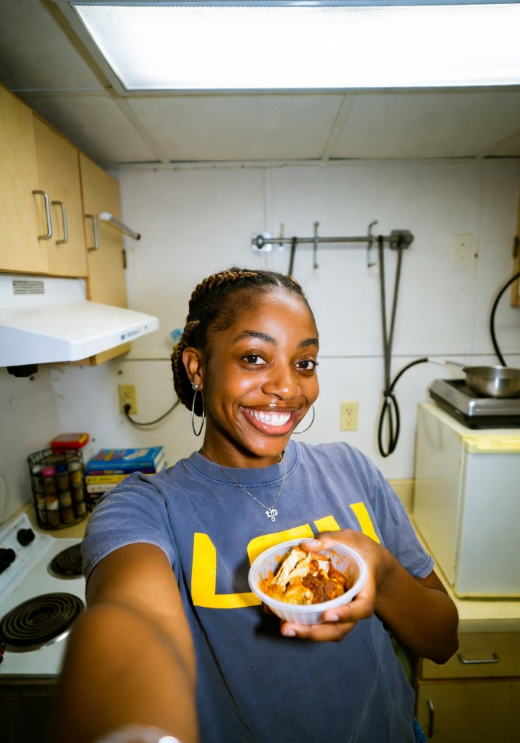
By It’s a Tuesday night and my roommate Destiny is standing in the doorway of our kitchen—which is generous, calling it a kitchen; it is a counter, two burners, and a microwave that sounds like it’s filing a complaint every time you use it—and she is watching me cook with the expression of someone who has been living on dining hall chicken tenders for two months and has only just now remembered that food can smell like something.
“What is that,” she says. Not a question. A statement of disbelief.
“Jambalaya,” I say.
She pulls out her phone and starts filming. I let her. I’m used to it.
My name is Aaliyah Denise Robinson. I’m twenty-two years old. I’m a junior at LSU studying pre-med biology, which means I spend most of my waking hours in lecture halls memorizing the Krebs cycle and most of my non-waking hours worrying about the MCAT. I live in a two-bedroom apartment in Baton Rouge with Destiny and our third roommate Jordan, who is from Cleveland and once told me, with complete sincerity, that she thought jambalaya was a type of music. She knows better now. I made it my personal mission.
I grew up twenty minutes from here, in Scotlandville—north Baton Rouge, historically Black, in the shadow of Southern University, which is where my brother Jamal went on a football scholarship before he moved to Houston and became a whole functioning adult. My parents, Marcus and Tanya, still live in the house on our street. It’s a stronger house than it used to be, for reasons I’ll get to, but the kitchen smells the same: onion and garlic and the particular warmth of something simmering low and slow. That smell is home. It’s also, if I’m being honest, the reason I cook.
My mama was a good cook. Efficient. Reliable. She worked from home as a medical coder with three kids underfoot, so she became a master of the one-pot meal, the crockpot dump, the thirty-minute dinner that tastes like it took three hours. Jambalaya on Mondays. Baked chicken and rice on Wednesdays. Red beans and rice on Fridays—which in Louisiana is basically gospel, not a choice, just the thing you do. I grew up eating her food and thinking this was how all households operated, that every family had a Monday meal and a Friday meal and a rhythm to their week that you could set a clock to.
Then I started spending Saturdays at MawMaw Shirley’s house in Baker, and I realized: Mama was efficient. MawMaw Shirley was transcendent.
MawMaw Shirley is my daddy’s mother. She is seventy-nine years old. She has a cast iron pot that is older than everyone in the family combined, and her gumbo will make you reconsider every choice you’ve ever made that led you away from her kitchen. Her crawfish étouffée has made grown men emotional. Her sweet potato pie won the church bake-off six years running, and if you suggest it was luck she will give you a look that could strip paint.
Every Saturday of my childhood, I stood on a step stool in MawMaw Shirley’s kitchen and she taught me to cook. Not from a recipe. From watching. From doing. From the particular education of standing next to someone who knows what they’re doing and paying close enough attention that eventually, their hands become your hands.
The first thing she taught me was roux. Thirty-five minutes, constant stirring, the color of dark chocolate, no shortcuts, no walking away. “Don’t rush the roux,” she said. “Don’t rush anything worth doing.” I was eight years old and I was already learning patience as a culinary principle. I didn’t fully understand it then. I understand it now.
I’m still going to Baker every other Saturday. Not because MawMaw Shirley needs help—she’d be offended by the suggestion, and I value my life—but because I know the time is finite and I intend to use every minute of it standing next to her, stirring something, learning. She’s slowing down a little. The gumbo days are getting shorter. The naps are getting longer. I don’t think about what that means. I just stir. I just listen.
The other reason I cook—the reason that’s harder to talk about but the one that lives underneath everything else—is the flood.
In August 2016, Baton Rouge got twenty-plus inches of rain in two days. A thousand-year flood, they called it, which is the kind of phrase that sounds like history until it’s your house. Our house took four feet of water. We evacuated to Southern University’s gym and slept on cots. When we came back, everything below four feet was gone—the furniture, Mama’s home office, my sister Kayla’s art supplies, the photo albums. My daddy spent five months rebuilding the house mostly by himself because the contractors were booked for a year and Marcus Robinson does not wait when there is work to be done.
What I remember most from those days—besides the smell, which was mold and mud and something deeper and more terrible—is MawMaw Shirley showing up on day two. She arrived with a pot of red beans and a cooler full of rice, and she fed us in the FEMA trailer in the driveway like it was the most natural thing in the world. Like the water hadn’t taken anything. Like the pot in her hands was proof that we were still here.
I was twelve. I understood something that day that I couldn’t have articulated then: food is the first step in recovery. MawMaw Shirley believed that. I believe it now. Everything else, as she would say, is commentary.
So I cook. I cook because Mama taught me efficiency and MawMaw Shirley taught me depth, and somewhere between the two of them I learned that you can have both. I cook because I’m a pre-med student with a $200-a-month grocery budget and three roommates who deserve to eat something that tastes like it came from a kitchen and not a vending machine. I cook because Scotlandville raised me to feed people, and LSU gave me a zip code twenty minutes from home where I am apparently the only person who knows how to make a roux.
The jambalaya I’m making tonight is not MawMaw Shirley’s jambalaya. MawMaw Shirley’s jambalaya requires more time and more pots than I currently own. This is my jambalaya—the version I developed in my apartment kitchen, adapted for two burners and a cutting board balanced on the counter because there is no room for both the cutting board and the toaster, and the toaster is non-negotiable because Jordan has complicated feelings about her morning bagel.
This jambalaya costs about $6 for four servings, closer to $1.50 per plate if you’re doing the math, which I always am. It takes 45 minutes, which is honest—I will never tell you something takes 10 minutes if it takes 45. It uses one pot. It requires no culinary training. It requires only the willingness to layer flavor properly, which I will walk you through step by step, and a Cajun seasoning blend, which you can find at any grocery store for $2 and which will last you three months.
Destiny finished filming about four minutes ago. She is now just standing there holding her empty bowl and looking at me with something close to reverence.
“You grew up eating this?” she says.
“Every Monday,” I say.
“Every Monday,” she repeats, like I told her something theological.
I text MawMaw Shirley a photo of the pot. She responds in four minutes: Too much rice. But you’ll learn.
She’s probably right. She always is. I’m learning. I’m stirring. I’m not rushing anything.
Here’s how you make it.
MawMaw Shirley’s four-word verdict still makes me smile, because she’s right — I’m still learning — but Destiny’s face told me everything I needed to know about what this dish can do for someone who’s never had it before. That’s exactly why I wanted to write it down properly: not just as a recipe, but as proof that Monday-night comfort food from Scotlandville can hold its own in any kitchen, anywhere. Below is exactly what I made, the way I made it.
Easy Jambalaya — The One-Pot Recipe That Made My Roommates Think I Grew Up in a Restaurant (I Grew Up in Scotlandville)
Prep Time: 10 minutes | Cook Time: 35 minutes | Total Time: 45 minutes | Servings: 4–6
Ingredients
- 1 lb andouille sausage, sliced into 1/4-inch rounds
- 1 lb boneless skinless chicken thighs, cut into 1-inch pieces (or 2 cups shredded rotisserie chicken, added at the end)
- 1 1/2 cups long-grain white rice, uncooked
- 1 can (14.5 oz) diced tomatoes, with liquid
- 2 1/2 cups chicken broth
- 1 medium green bell pepper, diced
- 2 stalks celery, diced
- 1/2 medium yellow onion, diced
- 4 cloves garlic, minced
- 1 1/2 tsp Cajun seasoning (I use Tony Chachere’s; if you don’t have Tony’s you are missing out on a cultural experience)
- 1/2 tsp smoked paprika
- 1/4 tsp cayenne pepper, or to taste
- 1 tbsp olive oil or vegetable oil
- Salt and black pepper to taste
- 3 green onions, sliced thin, for garnish
Instructions
- Brown the sausage. Heat your oil in a large, deep pot or Dutch oven over medium-high heat. Add the andouille sausage and cook for 3–4 minutes, stirring occasionally, until it picks up some color on both sides. The fat rendering out of the sausage is flavor going directly into your pot. Do not skip this step. Remove the sausage with a slotted spoon and set it aside, leaving the drippings in the pot.
- Cook the chicken. Season your chicken pieces with a pinch of salt, pepper, and a light dusting of Cajun seasoning. Add them to the same pot and cook over medium-high heat for 4–5 minutes, turning once, until they’re browned on the outside. They don’t need to be cooked through yet—they’ll finish in the pot. Remove and set aside with the sausage. (If you’re using rotisserie chicken, skip this step entirely and add it with the rice later.)
- Build the base. Reduce heat to medium. Add the diced onion, bell pepper, and celery to the pot—this is the holy trinity, and in Louisiana, the holy trinity is not a metaphor, it is a directive. Cook for 4–5 minutes, stirring occasionally, until the vegetables are softened and starting to smell like something wonderful. Add the garlic and cook for one more minute. Do not burn the garlic. Burnt garlic is a tragedy that cannot be undone.
- Add the seasoning and tomatoes. Stir in the Cajun seasoning, smoked paprika, and cayenne. Let the spices bloom in the vegetables for about 30 seconds—you’ll smell when it’s right. Pour in the diced tomatoes with their liquid and stir to combine, scraping up any browned bits from the bottom of the pot. Those bits are not burned. Those bits are flavor. Deglaze them.
- Add the rice and broth. Return the sausage and chicken to the pot. Add the uncooked rice and pour in the chicken broth. Stir everything together. Bring to a boil, then immediately reduce the heat to low, cover the pot tightly, and do not touch it for 20 minutes. I mean it. Do not lift the lid. Do not stir. The rice needs steam and time and your trust.
- Rest and fluff. After 20 minutes, remove the pot from heat. Keep the lid on and let it rest for 5 more minutes—this is where the rice finishes and the flavors settle. After resting, remove the lid and fluff gently with a fork. Taste for seasoning. Add salt, pepper, or a pinch more Cajun seasoning if needed. (If using rotisserie chicken, fold it in now and let it warm through for 2 minutes with the lid back on.)
- Serve and garnish. Dish it into bowls and top with sliced green onions. That’s it. That’s the whole thing. Text your MawMaw a photo. Brace for critique. Feed your roommates. Accept their admiration with grace.
Nutrition (per serving)
Calories: 520 | Protein: 34g | Fat: 22g | Carbs: 48g | Fiber: 3g | Sodium: 980mg