New Year's Eve. 2022. The year the book publishes. The year Hazel arrives. The year everything changes (again — everything always changes; the constancy of change is the military wife's only constant).
Caleb stayed up until 8:30 (his midnight) and banged pots with wooden spoons (the annual tradition, started accidentally, now permanent). Ryan and I toasted with sparkling cider. Hazel kicked at midnight.
The ball dropped. 2022. The year of the book.
Resolutions:
1. Have a baby (scheduled, not optional)
2. Publish a book (scheduled, not optional)
3. Survive Twentynine Palms (ongoing)
4. Cook 52 new recipes
5. Get Caleb to eat broccoli voluntarily (the ceasefire holds but true peace remains elusive)
6. Call Mom every night (forever)
The first review came in this week. An ARC reviewer — a military spouse blogger with a significant following — posted her review on Thursday:
'Dinner at 1800 is not just a cookbook. It's not just a memoir. It's a mirror. If you've ever stood at a stove at the end of a long day and thought 'who am I doing this for?' — this book answers that question. Rachel Abernathy writes with the sharp humor and bone-deep honesty of a woman who has survived deployments, PCS moves, and a desert kitchen with three square feet of counter space. She writes about her mother's recipe binder the way other writers write about sacred texts. Because that's what it is. A sacred text, written in casserole recipes and chicken soup and dinner at 1800.'
A mirror. A sacred text. Casserole recipes as scripture.
I read the review to Mom on the phone. She was quiet for a long time.
'She called my binder a sacred text,' Mom said.
'She did.'
'It's just a binder, Rachel. It's just recipes.'
'Mom. It was never just recipes. You know that.'
Silence. Then: 'I know.'
She knows. She's always known. She just couldn't say it herself. She needed someone else to say it — a stranger, a reviewer, a woman who read her recipes in a book her daughter wrote and called them sacred.
The binder is sacred. The kitchen is sacred. Dinner at 1800 is sacred.
Mom made her New Year's appetizer spread in Norfolk. I made mine in the desert. Same recipes. Different kitchens.
2022. The year of the book. The year of Hazel. The year the sacred text reaches the shelves.
Happy New Year. The reviews are good. The baby kicks. The pots are banging.
Let's go.
Mom’s New Year’s spread has always anchored the holiday — a table full of small things to share, the kind of food that invites people to stay and linger. When the reviewer called her binder a sacred text, I thought immediately of this hummus: roasted garlic, silky and warm, something Mom made every single December 31st without thinking twice about how much it meant. I made it in Twentynine Palms this year with my three square feet of counter space, Ryan and Caleb and a baby who hadn’t arrived yet, and the same recipe my mother was making at the same hour three time zones away. Same hummus. Different desert. The binder travels.
Easy Roasted Garlic Hummus
Prep Time: 10 minutes | Cook Time: 40 minutes | Total Time: 50 minutes | Servings: 8
Ingredients
- 1 whole head of garlic
- 1 tablespoon olive oil, plus more for drizzling
- 2 cans (15 oz each) chickpeas, drained and rinsed (reserve 1/4 cup liquid)
- 1/3 cup tahini
- 3 tablespoons fresh lemon juice (about 1 large lemon)
- 1/2 teaspoon kosher salt, plus more to taste
- 1/4 teaspoon ground cumin
- 2–4 tablespoons reserved chickpea liquid or cold water, to thin
- Smoked paprika, fresh parsley, and extra olive oil, for serving
- Pita wedges, sliced vegetables, or crackers, for dipping
Instructions
- Roast the garlic. Preheat oven to 400°F. Slice the top 1/4 inch off the head of garlic to expose the cloves. Place on a small square of foil, drizzle with 1 tablespoon olive oil, and wrap tightly. Roast for 35–40 minutes, until the cloves are golden and completely soft. Let cool for 10 minutes, then squeeze the cloves out of their skins into a small bowl.
- Blend the base. Add the tahini and lemon juice to a food processor and process for about 1 minute, until the mixture is pale and creamy. Scrape down the sides.
- Add the chickpeas and garlic. Add the drained chickpeas, roasted garlic, salt, and cumin to the food processor. Process for 1–2 minutes, until very smooth. Scrape down the sides as needed.
- Adjust consistency. With the processor running, drizzle in the reserved chickpea liquid or cold water, 1 tablespoon at a time, until the hummus reaches your preferred texture — smooth and creamy but still thick enough to hold a well.
- Taste and season. Taste and adjust salt and lemon juice as needed. Process once more to incorporate.
- Serve. Transfer to a wide, shallow bowl. Use the back of a spoon to create a swirl on the surface. Drizzle generously with olive oil, dust with smoked paprika, and scatter fresh parsley over the top. Serve with pita wedges, sliced cucumbers, carrots, and bell peppers.
Nutrition (per serving)
Calories: 185 | Protein: 7g | Fat: 9g | Carbs: 21g | Fiber: 5g | Sodium: 210mg
About the cook who shared this
Rachel Abernathy
Week 297 of Rachel’s 30-year story
· San Diego, California
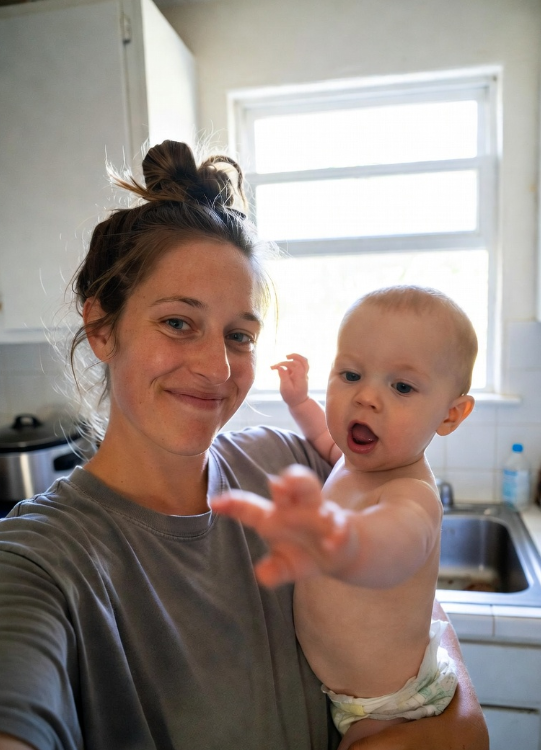
Rachel is a twenty-eight-year-old Marine wife and mom of two who has moved five times in six years and learned to cook a Thanksgiving dinner with half her cookware still in boxes. She married young, survived postpartum depression, and feeds her family of four on a junior Marine's salary with a freezer full of pre-made meals and a crockpot that has never let her down. She writes for the military spouses who are cooking dinner alone in base housing and wondering if they're enough. You are.
