
← Back to Blog

Flaky Cheddar-Chive Biscuits -- The Weekly Promise, Baked Into Every Layer

Paul's eye-tracking slowed this week. The fatigue is reaching his eyes — the last reliable muscles, the ones that have been communicating for him since the voice went. The typing takes longer. Full sentences are rare now. Single words. Sometimes just a letter. Sometimes just the eyes moving to "yes" or "no" on the screen. The narrowing. The world narrowing to yes and no. To single letters. To the movement of eyes that are tired. I read to him for three hours on Tuesday. He didn't type anything during the reading. He just listened. Eyes closed. Breathing assisted. The hiss and the beep and my voice, the three sounds that fill his world. I read about the Henry B. Smith — lost in 1913, all hands, the ship vanishing between Marquette and the Soo Locks in a November storm. Paul's face — what I can see of it around the ventilator mask — was still. Listening. Present. The mind behind the eyes, behind the mask, behind the failing body, still tracking the ship through the storm. The hospice nurse came on Wednesday. Dr. Andersen recommended hospice — not because the end is imminent (though it may be) but because the breathing is at forty-five percent and the decline is accelerating and the hospice team can provide support that the clinic visits can't. A nurse. A social worker. A chaplain. The team that specializes in the thing nobody wants to specialize in. The word "hospice" sits in the house now. Like the wheelchair, like the feeding tube, like the ventilator — another piece of equipment, another tool, another word that changes the shape of the air. I told Anna. She said, "Does that mean—" I said, "It means he's being cared for where he is. At home. With me." She said, "How long?" I said, "I don't know." She said, "We'll be there when you need us." I said, "I need you now." She said, "We're coming." I made bread. The weekly promise. The limpa rye. The smell. Paul breathed it in through the mask and his eyes moved — slowly, so slowly — to the screen, and he typed one word: "BREAD." Bread. The word. The smell. The promise. I will bake bread every Saturday until there is no one left to smell it. That is the promise. That is the vow. In sickness and in health, in bread and in silence.

Limpa rye takes time I don’t always have on the harder weeks, but the vow doesn’t require the exact loaf—it requires the smell, the warmth, the act of putting something in the oven and waiting. These Flaky Cheddar-Chive Biscuits have become my shorthand on the weeks when the world narrows and my hands need something to do that isn’t helpless. They come together quickly, they fill the room, and when Paul’s eyes moved to the screen and he typed “BREAD,” I knew it wasn’t about the specific recipe—it was about what it means that I keep baking. So I keep baking.

Flaky Cheddar-Chive Biscuits

Prep Time: 15 minutes | Cook Time: 14 minutes | Total Time: 29 minutes | Servings: 10 biscuits

Ingredients

  • 2 cups all-purpose flour
  • 1 tablespoon baking powder
  • 1 teaspoon kosher salt
  • 1/2 teaspoon garlic powder
  • 1/4 teaspoon black pepper
  • 1/2 cup (1 stick) unsalted butter, very cold, cut into 1/2-inch cubes
  • 3/4 cup sharp cheddar cheese, freshly shredded
  • 3 tablespoons fresh chives, finely chopped
  • 3/4 cup cold buttermilk, plus 1 tablespoon for brushing

Instructions

  1. Heat the oven. Preheat your oven to 425°F. Line a baking sheet with parchment paper and set aside.
  2. Combine the dry ingredients. In a large bowl, whisk together the flour, baking powder, salt, garlic powder, and black pepper until evenly mixed.
  3. Cut in the butter. Add the cold butter cubes to the flour mixture. Using a pastry cutter or your fingertips, work the butter into the flour until the mixture resembles coarse crumbs with a few pea-sized pieces remaining. Work quickly so the butter stays cold.
  4. Add the cheese and chives. Stir in the shredded cheddar and chopped chives, tossing to distribute evenly through the flour mixture.
  5. Add the buttermilk. Pour in the cold buttermilk and stir with a fork just until the dough comes together. It will be shaggy—do not overmix. Overworking the dough will make biscuits tough instead of flaky.
  6. Shape and fold. Turn the dough out onto a lightly floured surface. Gently pat it into a rectangle about 3/4 inch thick. Fold it in thirds like a letter, then pat out again to 3/4 inch. Repeat the fold once more. This creates the layers.
  7. Cut the biscuits. Pat the dough to a final thickness of 3/4 inch. Using a 2 1/2-inch round biscuit cutter, press straight down—do not twist—and cut out biscuits. Press scraps together gently and cut remaining biscuits.
  8. Brush and bake. Arrange biscuits on the prepared baking sheet, sides just touching. Brush the tops lightly with the remaining tablespoon of buttermilk. Bake for 12–15 minutes, until the tops are deep golden and the edges are set.
  9. Serve warm. Let rest for 2 minutes on the pan, then transfer to a rack or serve directly. These are best eaten the day they are made, still warm from the oven.

Nutrition (per serving)

Calories: 218 | Protein: 6g | Fat: 13g | Carbs: 20g | Fiber: 1g | Sodium: 370mg

Linda Johansson
About the cook who shared this
Linda Johansson
Week 197 of Linda’s 30-year story · Duluth, Minnesota
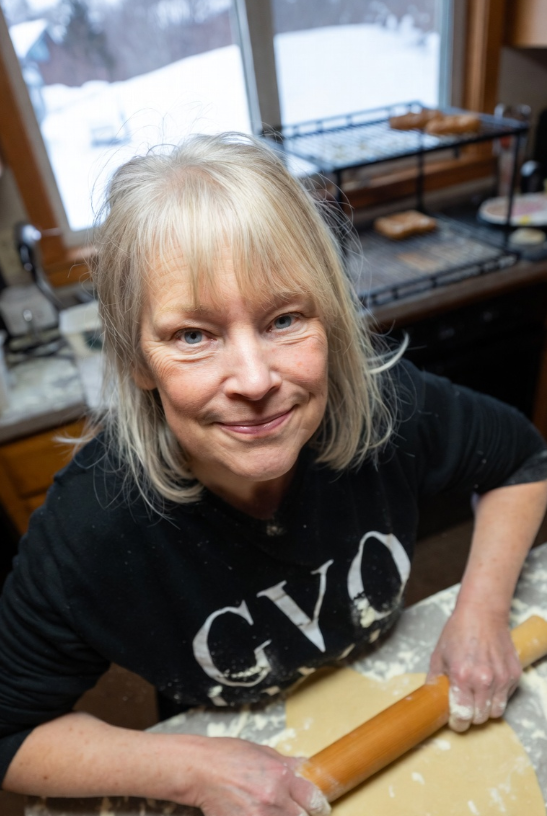
Linda is a sixty-three-year-old retired nurse from Duluth, Minnesota, living alone in the house where she raised her children and said goodbye to her husband. She lost Paul to ALS in 2020 after two years of watching the kindest man she'd ever known lose everything but his dignity. She cooks Scandinavian comfort food and Minnesota hotdish and the pot roast Paul loved, and she sets two places at the table out of habit because it makes her feel less alone. Every recipe she writes is a person she's loved.

How Would You Spin It?

Put your own twist on this recipe — what would you add, remove, or swap?