March again. Almost a year since this story started, and the world has turned one full rotation. Aiden is twenty-two months old and speaking in two-word sentences: "more please," "bye-bye Daddy," "no bath." His personality is solidifying — he is stubborn (me), dramatic (Brianna), and kind (I would like to claim this one too, but it might be Cheryl's influence, because everything good in this family traces back to Cheryl). He is going to be a big brother in six months, and he does not know it yet, and when he does know it, he will not understand it, and that is fine. Understanding comes later. Right now, he just needs to be twenty-two months old and loved.
Brianna is dealing with first-trimester nausea. She was sick with Aiden too, but this feels worse — she is queasy from morning to night, certain smells trigger it (coffee, meat cooking, Jerome's cologne that one time he came by the apartment), and her appetite has shrunk to crackers, ginger ale, and the occasional bowl of Mama's chicken soup. I feel useless in the way that men feel useless during pregnancy: the thing happening is happening inside someone else's body, and all I can do is hold her hair back and fetch crackers and try not to be the smell that triggers the next wave.
Work is steady. The 2017 production cycle is ramping up, and we are building the refreshed Grand Cherokee with new features that I helped calibrate on the line. There is a satisfaction in building something with your hands that millions of people will use. It is not the satisfaction of a basketball career. It is quieter, more anonymous. But it is real, and it is mine, and at the end of every shift, I can point to a vehicle on the line and say: I built that. My team built that. We were here, and the proof is driving on a highway somewhere, carrying strangers to places we will never go.
I think about the baby. I think about names. Brianna likes Zaria for a girl and Noah for a boy. I like Zaria too — it is strong, it is beautiful, it is different. Mama will have opinions. She always has opinions. But this is our baby and we will name them ourselves, and Mama will love whatever name we choose because she loves whatever we give her.
Sunday dinner was gumbo. Mama's gumbo is a Louisiana transplant, learned from her mother, who learned it from her mother, who made it in Shreveport with whatever was available. Mama's version: a dark roux (flour and oil cooked low and slow until it is the color of chocolate), okra, shrimp, andouille sausage, the holy trinity, and enough cayenne to make you sweat. Served over white rice with a slice of French bread. It is the dish that most clearly connects us to the South, to the migration, to the women who carried recipes north like luggage and planted them in Detroit kitchens and grew them into traditions. I ate two bowls and tasted three generations.
Mama’s gumbo gets all the glory—and it deserves every bit of it—but I keep thinking about that slice of French bread on the edge of the bowl, the one you use to chase the last of the roux around the bottom before you commit to a second helping. That bread is not an afterthought. It is part of the ritual. So I went looking for a roll I could make myself, something soft inside and just crusty enough outside to hold up against a dark, rich bowl of gumbo, and these French bread rolls are exactly that—the kind of thing Aiden will tear apart with his hands someday, the way I did, the way Mama still does.
French Bread Rolls
Prep Time: 20 minutes | Cook Time: 15 minutes | Total Time: 1 hour 35 minutes (includes rise time) | Servings: 12 rolls
Ingredients
- 1 cup warm water (105–115°F)
- 2 1/4 teaspoons active dry yeast (one standard packet)
- 1 tablespoon granulated sugar
- 1 tablespoon olive oil
- 1 teaspoon salt
- 3 cups all-purpose flour, plus more for dusting
- 1 egg white, lightly beaten (for brushing)
- 1 tablespoon water (to mix with egg white)
Instructions
- Activate the yeast. In a large bowl, combine the warm water, sugar, and yeast. Stir gently and let sit for 5–10 minutes until foamy. If the mixture does not foam, your yeast may be expired—start over with fresh yeast.
- Mix the dough. Add the olive oil and salt to the yeast mixture. Stir to combine. Add flour one cup at a time, stirring until a shaggy dough forms. Turn out onto a lightly floured surface and knead for 8–10 minutes until smooth, elastic, and slightly tacky but not sticky.
- First rise. Place the dough in a lightly oiled bowl, turning once to coat. Cover with a clean kitchen towel or plastic wrap and let rise in a warm spot for 45–60 minutes, until doubled in size.
- Shape the rolls. Punch the dough down and divide it into 12 equal pieces. Roll each piece into a smooth ball by cupping your hand over it and rolling it against the counter in small circles. Place rolls 2 inches apart on a parchment-lined baking sheet.
- Second rise. Cover the shaped rolls loosely and let them rise for another 20–25 minutes until noticeably puffed.
- Preheat and score. Preheat your oven to 400°F. Just before baking, use a sharp knife or razor blade to make a shallow slash across the top of each roll. Whisk together the egg white and 1 tablespoon water, then brush lightly over the tops of the rolls.
- Bake. Bake for 13–15 minutes until the rolls are deep golden brown and sound hollow when tapped on the bottom. For extra crispness, place a small pan of hot water on the lower oven rack during baking to create steam.
- Cool and serve. Let rolls cool on the baking sheet for at least 5 minutes before serving. Best eaten warm, alongside a bowl of gumbo or any rich, saucy dish that deserves a good piece of bread.
Nutrition (per serving)
Calories: 120 | Protein: 4g | Fat: 2g | Carbs: 23g | Fiber: 1g | Sodium: 195mg
About the cook who shared this
DeShawn Carter
Week 50 of DeShawn’s 30-year story
· Detroit, Michigan
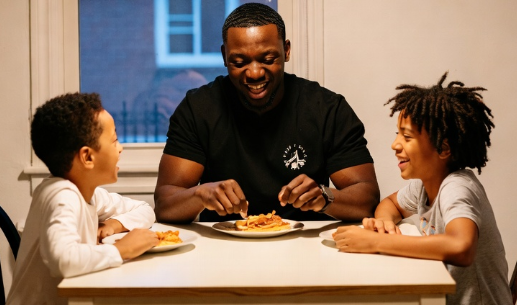
DeShawn is a thirty-six-year-old single dad, auto plant worker, and a man who didn't learn to cook until his wife left and his five-year-old asked, "Daddy, can you cook something?" He called his mama, who came over with two bags of groceries and spent six months teaching him the basics. Now he's the dad at the cookout who brings the ribs, the guy at the plant whose leftover gumbo starts fights, and living proof that it's never too late to learn.
