Fall arrived all at once. Monday was eighty degrees. By Friday it was fifty-five. The trees on KK are just starting to turn — yellow at the edges, like they're thinking about it. Everyone in Bay View pulled out their flannels simultaneously, as if a memo went out. Milwaukee doesn't do gradual transitions. We do whiplash.
My first full week as assistant brewer, operating in the role, not just holding the title. Marcus has started deferring to me on production decisions — malt orders, hop suppliers, scheduling. It's a lot of logistics that I didn't expect. I'm not just making beer anymore; I'm managing the making of beer. It's less romantic than it sounds, but I'm learning. Marcus taught me how to read the P&L report for the brewing operation, and I understood about sixty percent of it, which he said was better than he did his first year.
The Brewers are in a pennant race. Ninety wins. They haven't been to the playoffs since 2011, and the whole city is losing its collective mind. Dad watches every game. I watch every game. Mom watches every game, which is remarkable because Mom has been actively uninterested in baseball for as long as I've been alive, but she's caught the fever. She texted me on Thursday: "Yelich is cute." I have no response to that.
Cooking this week: fall comfort food. I made a pot of Babcia's żurek — sour rye soup. It's one of the most distinctly Polish dishes that exists: a base of fermented rye flour (you have to make the starter days in advance), simmered with smoked kielbasa, potatoes, garlic, marjoram, and a hard-boiled egg sliced on top. The smell is... polarizing. It's sour and smoky and pungent, and Americans who didn't grow up with it tend to approach it with suspicion. But if you grew up in a Polish kitchen, żurek is home.
Babcia's recipe card for żurek was the most detailed one in the stack — three cards, front and back, with notes in the margins. She was particular about this one. The starter has to ferment for exactly five days. The kielbasa has to be smoked, not fresh. The marjoram has to be dried, not fresh. "Fresh marjoram is for Italians," she wrote, which is the most Babcia thing she ever said.
I followed her instructions exactly. Five-day starter. Smoked kielbasa from Vince's. Dried marjoram from the Polish grocery on Mitchell Street. The result was extraordinary — sour, savory, warming, deeply complex. I brought a container to Mrs. Wojcik and she tasted it and closed her eyes and said, "Helen." Just her name. That was all she needed to say.
Making Babcia’s Žurek reminded me that kielbasa — good, smoked kielbasa from a place that knows what it’s doing — is the anchor of so many cold-weather meals in a Polish kitchen, and that instinct doesn’t stop at soup. When the week had finally settled and I needed something that came together quickly but still felt substantial, I turned to another kielbasa classic: German-Style Kielbasa and Noodles. It’s not Babcia’s recipe, but it speaks the same language — smoky, savory, warming, built for the kind of fall night where the temperature drops fifteen degrees before dinner and you just need the stove on.
German-Style Kielbasa and Noodles
Prep Time: 10 minutes | Cook Time: 25 minutes | Total Time: 35 minutes | Servings: 6
Ingredients
- 1 lb smoked kielbasa, sliced into 1/4-inch rounds
- 3 cups wide egg noodles, uncooked
- 1 medium yellow onion, diced
- 3 cloves garlic, minced
- 1 cup sauerkraut, drained and lightly rinsed
- 1 can (14.5 oz) low-sodium chicken broth
- 1/2 cup sour cream
- 2 tablespoons unsalted butter
- 1 teaspoon caraway seeds
- 1 teaspoon dried thyme
- 1/2 teaspoon ground black pepper
- Salt to taste
- 2 tablespoons fresh flat-leaf parsley, chopped (for garnish)
Instructions
- Cook the noodles. Bring a large pot of salted water to a boil. Cook egg noodles according to package directions until just al dente. Drain and set aside, tossing with a drizzle of oil to prevent sticking.
- Brown the kielbasa. In a large, deep skillet or Dutch oven, melt 1 tablespoon of butter over medium-high heat. Add the kielbasa slices in a single layer and cook 2—3 minutes per side until browned. Transfer to a plate.
- Sauté the aromatics. Reduce heat to medium. Add remaining tablespoon of butter to the skillet. Add diced onion and cook 4—5 minutes until softened and translucent. Add garlic and caraway seeds and cook 1 minute more until fragrant.
- Add the sauerkraut and broth. Stir in the drained sauerkraut and dried thyme. Pour in the chicken broth and bring to a gentle simmer, scraping up any browned bits from the bottom of the pan. Simmer 5 minutes.
- Combine and finish. Return the browned kielbasa to the skillet. Add the cooked noodles and stir gently to combine. Remove from heat and fold in the sour cream until evenly incorporated. Taste and adjust salt and pepper as needed.
- Serve. Ladle into bowls and garnish with chopped fresh parsley. Serve immediately with crusty rye bread if you have it.
Nutrition (per serving)
Calories: 415 | Protein: 17g | Fat: 24g | Carbs: 34g | Fiber: 2g | Sodium: 880mg
About the cook who shared this
Jake Kowalski
Week 130 of Jake’s 30-year story
· Milwaukee, Wisconsin
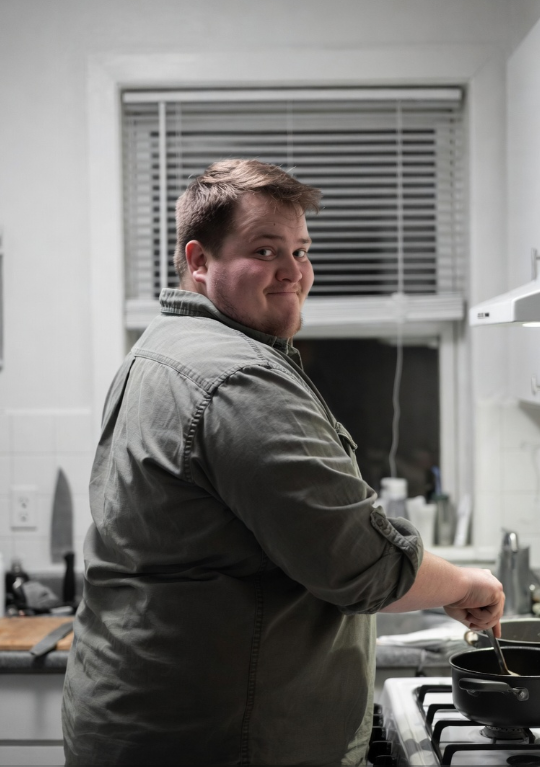
Jake is a twenty-nine-year-old brewery worker, newlywed, and proud Polish-American from Milwaukee's Bay View neighborhood. He didn't start cooking until his grandmother Babcia Helen passed away and left behind a stack of grease-stained recipe cards. Now he makes pierogi from scratch, smokes meats on a balcony smoker his landlord pretends not to notice, and writes for guys who want to cook good food but don't know a roux from a rub.
