The Lockdown Kitchen series is taking off. Five videos in, and the follower count has crossed forty thousand. People are cooking along — I can see it in the tags, the DMs, the comments. A teenager in Kenosha made pierogi for the first time. A grandma in Waukesha made my bigos and said it reminded her of her mother's. A college kid in Madison made my chili and set his smoke detector off. ("Good sign," I replied. "It means the pan was hot enough.")
This is what I was meant to do. Not the Instagram specifically — the teaching. The sharing. The passing of recipes from hands to hands across the distance that COVID has forced between us. Babcia did this at her kitchen table, one person at a time. I'm doing it on a screen, a thousand people at a time. The medium changed. The mission didn't.
Made a video this week about bread. Simple white bread: flour, water, yeast, salt, olive oil. The recipe I've been working on since last year, refined through twenty attempts until the crumb is soft, the crust is golden, and the whole apartment smells like a bakery. I shot the video at 6 AM, while the bread was rising, with the early light coming through the kitchen window. The video is quiet — no talking, just the sounds of hands in dough, the scrape of a bench scraper, the thud of the loaf on the counter. It got thirty thousand views. Sometimes the most powerful content is the silence.
At the brewery, production is steady. Marcus and I work three days a week, mostly packaging and shipping. The brewhouse feels empty without the full crew, without the taproom buzz, without the Saturday afternoon regulars. But the beer is still good. The beer doesn't know there's a pandemic.
I've been reading about the 1918 flu pandemic — the last time the world did this. Milwaukee was hit hard: fifteen hundred dead in a city of four hundred thousand. They closed the churches, the schools, the saloons. The Polish community, packed into small houses on the south side, was devastated. But they kept cooking. The women kept making pierogi. They kept the kitchens open. They fed each other through the worst of it.
History repeats. The kitchens stay open. The pierogi persist.
I made Babcia's bread this week — a dense, dark rye that she baked every Saturday. It requires a sourdough starter, which I've been maintaining since March, feeding it flour and water every day like a pet that demands consistency. The bread is sour, hearty, the kind that sustains you. I sliced it thick and ate it with butter and salt and a bowl of soup and felt connected to every Polish woman who ever baked bread in a crisis.
Between the rye I bake for Babcia’s memory and the simple white loaf I shot at 6 AM with the early light, bread has become the throughline of this whole pandemic chapter for me — and this Gift of the Magi Bread is the one I keep coming back to when I want something a little more celebratory, a little more gift-like, something that says I made this for you even when “you” is a thousand strangers watching on a screen. It’s enriched and slightly sweet, braided and burnished, the kind of bread that feels like it means something — which, right now, is exactly what I need it to be.
Gift of the Magi Bread
Prep Time: 30 min | Cook Time: 35 min | Total Time: 3 hr (includes rise time) | Servings: 12 slices
Ingredients
- 3 1/4 cups all-purpose flour, plus more for dusting
- 2 1/4 tsp active dry yeast (1 standard packet)
- 1/2 cup whole milk, warmed to 110°F
- 1/4 cup warm water (110°F)
- 3 tbsp granulated sugar
- 1 tsp fine sea salt
- 2 large eggs, divided (1 for dough, 1 for egg wash)
- 4 tbsp unsalted butter, softened
- 1/2 cup dried cranberries
- 1/3 cup golden raisins
- 1/3 cup chopped walnuts or pecans
- 1 tsp orange zest
- 1 tsp pure vanilla extract
- 1 tbsp water (for egg wash)
Instructions
- Activate the yeast. Combine warm milk, warm water, and sugar in a large bowl. Sprinkle yeast over the top and let sit for 5–8 minutes until foamy and fragrant.
- Mix the dough. Add 1 egg, softened butter, vanilla extract, and orange zest to the yeast mixture. Stir to combine. Add salt and flour one cup at a time, mixing until a shaggy dough forms.
- Knead. Turn dough onto a lightly floured surface and knead for 8–10 minutes until smooth and elastic, incorporating the dried cranberries, raisins, and chopped nuts during the last 2 minutes of kneading. The dough should be slightly tacky but not sticky.
- First rise. Shape the dough into a ball and place in a lightly oiled bowl, turning once to coat. Cover with a clean kitchen towel and let rise in a warm spot for 1 hour to 1 hour 30 minutes, until doubled in size.
- Shape the loaf. Punch down the dough and divide it into three equal pieces. Roll each piece into a 16-inch rope. Pinch the three ropes together at one end and braid them loosely, then pinch the other end to seal. Transfer to a parchment-lined baking sheet.
- Second rise. Cover loosely with a towel and let rise for 30–45 minutes, until noticeably puffed.
- Preheat and egg wash. Preheat oven to 350°F. Whisk together the remaining egg and 1 tbsp water, then brush gently over the entire surface of the braid.
- Bake. Bake for 30–35 minutes until deep golden brown and the loaf sounds hollow when tapped on the bottom. An instant-read thermometer should read 190°F in the center. Cool on a wire rack for at least 20 minutes before slicing.
Nutrition (per serving)
Calories: 230 | Protein: 6g | Fat: 8g | Carbs: 35g | Fiber: 2g | Sodium: 195mg
About the cook who shared this
Jake Kowalski
Week 213 of Jake’s 30-year story
· Milwaukee, Wisconsin
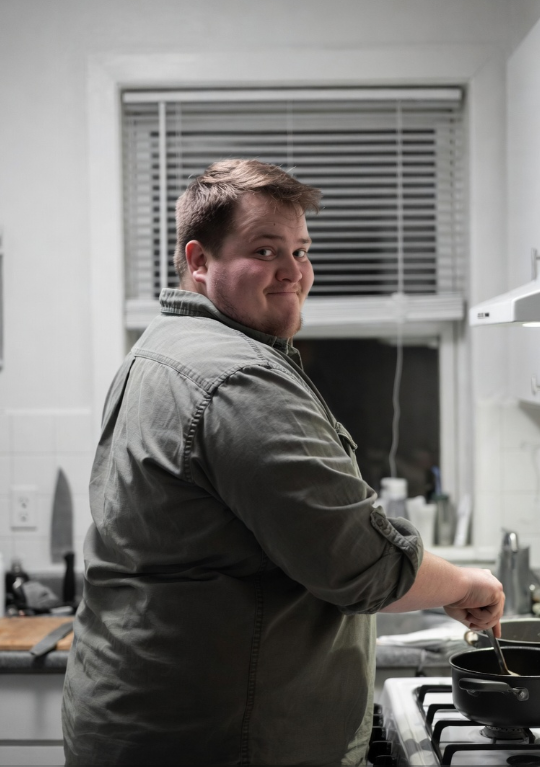
Jake is a twenty-nine-year-old brewery worker, newlywed, and proud Polish-American from Milwaukee's Bay View neighborhood. He didn't start cooking until his grandmother Babcia Helen passed away and left behind a stack of grease-stained recipe cards. Now he makes pierogi from scratch, smokes meats on a balcony smoker his landlord pretends not to notice, and writes for guys who want to cook good food but don't know a roux from a rub.
