New Year. 2023. The year after Marc. Midnight biscuits. Year five. The kids are asleep. The apartment is quiet. I eat biscuits at midnight and think about the year behind me — the worst year of my life, the year that took my brother and left a hole in the family and a flavor in the food that I will taste forever.
But I also think about what survived. The cooking survived. The coaching survived. The kids survived (they are resilient in ways that humble me — Aiden processes grief through questions, Zaria processes it through activity, both of them are growing through it instead of being crushed by it). The dream survived — Carter's Kitchen is still on the refrigerator, still in the savings account, still in the notebook with the business plan. The dream did not die with Marc. The dream absorbed Marc, the way the food absorbs everything — the joy and the grief and the love and the loss.
Sunday dinner at Mama's: black-eyed peas. Year twenty-three of Dad's prophecy: "Good year coming." He said it, and his voice cracked on "coming," and Mama put her hand on his arm, and I realized that "good year coming" is not a prediction — it is a prayer. Dad has been praying the same prayer for twenty-three years, and this year, the prayer has a new urgency, because this year, "good" means surviving, and surviving means showing up to the table, and showing up is the thing Carters do.
I ate the peas. I ate the greens. I ate the cornbread. I looked at the table — Mama, Dad, Keisha, Darius — and I thought: we are still here. We are smaller. We are damaged. We are missing the person who made every room louder and every meal bigger. But we are here. And the peas are for luck. And luck is what we need.
Good year coming. I choose to believe it. For Marc. For all of us.
The peas are for luck and the greens are for money and the cornbread is for gold—but every New Year’s table at Mama’s needs a centerpiece, something golden and warm sitting in the middle of it all, holding the plate together the way Dad’s prayer holds the family together. These glazed ham steaks are that anchor. Simple enough that you can make them while the kids are finally asleep and the apartment is quiet, sweet enough to remind you that surviving is its own kind of sweetness. I made these the night I chose to believe “good year coming”—for Marc, for all of us—and the glaze caught the light like something worth hoping for.
Glazed Ham Steaks
Prep Time: 5 minutes | Cook Time: 15 minutes | Total Time: 20 minutes | Servings: 4
Ingredients
- 2 bone-in ham steaks, about 1 lb each, 1/2 inch thick
- 1/3 cup packed brown sugar
- 2 tablespoons honey
- 1 tablespoon Dijon mustard
- 1 tablespoon apple cider vinegar
- 1/4 teaspoon ground cloves
- 1/4 teaspoon ground cinnamon
- 1 tablespoon unsalted butter
- Pinch of black pepper
Instructions
- Score the ham. Pat the ham steaks dry with paper towels. Using a sharp knife, score shallow cuts in a crosshatch pattern on both sides to help the glaze penetrate.
- Make the glaze. In a small bowl, whisk together the brown sugar, honey, Dijon mustard, apple cider vinegar, ground cloves, and cinnamon until smooth.
- Sear the ham steaks. Melt the butter in a large skillet over medium-high heat. Add the ham steaks and cook for 3 to 4 minutes per side until golden brown. Work in batches if needed to avoid crowding the pan.
- Glaze and finish. Reduce the heat to medium-low. Pour the glaze mixture over the ham steaks. Cook for 3 to 4 minutes, spooning the glaze over the ham repeatedly, until the sauce thickens into a sticky, caramelized coating and the ham is heated through.
- Rest and serve. Transfer the ham steaks to a cutting board and let rest for 2 minutes. Slice into portions, spoon any remaining glaze from the skillet over the top, and finish with a pinch of black pepper.
Nutrition (per serving)
Calories: 310 | Protein: 28g | Fat: 12g | Carbs: 22g | Fiber: 0g | Sodium: 1480mg
About the cook who shared this
DeShawn Carter
Week 331 of DeShawn’s 30-year story
· Detroit, Michigan
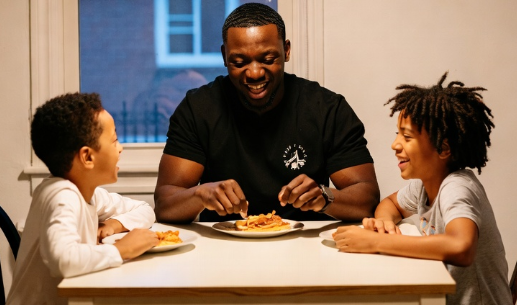
DeShawn is a thirty-six-year-old single dad, auto plant worker, and a man who didn't learn to cook until his wife left and his five-year-old asked, "Daddy, can you cook something?" He called his mama, who came over with two bags of groceries and spent six months teaching him the basics. Now he's the dad at the cookout who brings the ribs, the guy at the plant whose leftover gumbo starts fights, and living proof that it's never too late to learn.
