
 By
By August 2030. The Cherokee Nation events had transitioned fully to my management by summer's end. Art and I had spent three months handing over the relationships carefully—introductions to the cultural programming staff, to the event coordinators, to the officials who made the booking decisions. Each introduction came with context I provided and endorsement Art provided, which together made the transition smooth in a way that solo handoffs often aren't.
The first event I ran entirely under my own name was a language revitalization symposium in August, three hundred people, full traditional menu. I'd cooked for this event before under Art's umbrella. This time my name was on the contract. The food was the same as it had always been. The relationship to the work was different—not better or worse, but mine in a different way than it had been before.
Madison assisted and we ran it the way we'd been running them together for three years. Afterward she asked me: how does it feel different? I said: like the last thing I was carrying for someone else has been returned to me. She said she didn't know I'd been carrying it for someone else. I said I hadn't known either until I got it back.
Made a long dinner at the house that evening—no particular occasion, just the end of the work week and the need to cook something that took time. Braised venison with dried chiles and winter squash, cornbread, a pot of the Stilwell beans slow-cooked with smoke. Three hours of kitchen work while the light went out of the sky. The house holding the smells. That's what the kitchen was built for.
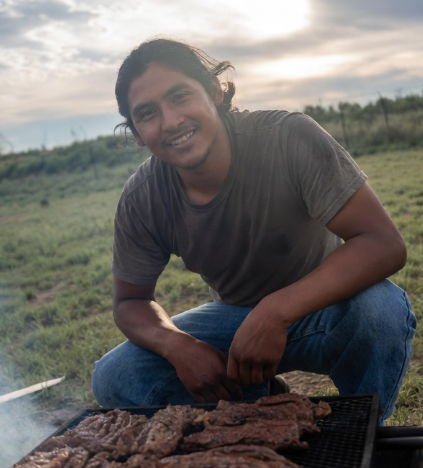
That evening I didn’t want anything quick — I wanted cooking that took time, the kind where you tend to something and it gives back slowly. A pork roast over indirect heat does exactly that: it asks you to stay present, to check in, to let the smoke do what it knows how to do. After a day that felt like a closing and an opening at once, that was exactly the kitchen I needed to be in.
Grilled Pork Roast
Prep Time: 20 min | Cook Time: 2 hr 30 min | Total Time: 2 hr 50 min | Servings: 8
Ingredients
- 1 boneless pork shoulder roast (3 to 4 lbs)
- 2 tablespoons olive oil
- 4 cloves garlic, minced
- 2 teaspoons smoked paprika
- 1 teaspoon dried thyme
- 1 teaspoon dried oregano
- 1 teaspoon kosher salt
- 1/2 teaspoon freshly ground black pepper
- 1/2 teaspoon onion powder
- 1/4 teaspoon cayenne pepper
- 2 cups wood chips (hickory or oak), soaked 30 minutes and drained
Instructions
- Make the rub. Combine olive oil, garlic, smoked paprika, thyme, oregano, salt, black pepper, onion powder, and cayenne in a small bowl. Mix into a paste.
- Season the roast. Pat the pork roast dry with paper towels. Rub the spice paste evenly over all surfaces. Let it rest at room temperature for 30 minutes while you prepare the grill.
- Set up indirect heat. For a charcoal grill, bank coals to one side and place a drip pan on the other. For a gas grill, heat one side to medium-high and leave the other side off. Target an internal grill temperature of 325—350°F.
- Add the smoke. Place drained wood chips directly on the coals or in a smoker box for a gas grill. Allow smoke to establish before placing the roast.
- Grill the roast. Place the pork over indirect heat, fat side up. Cover and cook for 2 to 2 1/2 hours, or until an instant-read thermometer inserted in the thickest part reads 195—200°F for pull-apart tenderness. Rotate once halfway through.
- Rest and serve. Transfer the roast to a cutting board and tent loosely with foil. Rest for 20 minutes before slicing or pulling. Serve with pan juices spooned over the top.
Nutrition (per serving)
Calories: 340 | Protein: 38g | Fat: 19g | Carbs: 2g | Fiber: 0g | Sodium: 390mg