Paul finished the school year on Friday. He walked in the door at 3:45 PM with a box of papers, a gift card from his students (Caribou Coffee, $25), and the look of a man who has been released from pleasant captivity. "Summer," he said, setting the box down. "Summer, Linda." As if I might not have noticed.
Paul has taught American history at East High School for thirty-one years. He loves it the way I love nursing — completely, exhaustingly, with the full knowledge that it's slowly wearing him down and he wouldn't trade it for anything. His students love him because he makes history into stories. He doesn't teach the War of 1812; he tells them about the people who fought it, the letters they wrote home, the food they ate, the weather on the day of the battle. He makes dead people real. It's a gift.
Summer for Paul means three things: walking, reading, and Lake Superior. He walks five miles every morning instead of three. He reads shipwreck books, obviously, but also biographies and histories and whatever Erik lends him, which is usually Scandinavian crime fiction that Paul reads with the intensity of a man solving the crime himself. And he spends hours at the lake — sitting on the rocks at Brighton Beach, watching the ships, being quiet in the way that Paul is quiet, which is not empty but full.
I'm still working, of course. Nurses don't get summer break. But I like having Paul home when I get back from my shift. The house feels different when he's in it — warmer, more occupied, like the rooms remember what they're for.
I planted the garden this weekend. Tomatoes, peppers, cucumbers, lettuce, dill, and the rhubarb is already going strong — the stalks are thick and pink and ready for pie in about two weeks. I grow the same things Mamma grows, in the same order, in roughly the same arrangement. I don't know if this is tradition or lack of imagination. Maybe there's no difference.
Mamma called to tell me her rhubarb is ahead of mine, which is her gentle way of saying she's a better gardener than I am, which she is, and I accept this the way I accept gravity — as an unchangeable fact of the natural world.
I made macaroni and cheese from scratch tonight — not Swedish, not Scandinavian, completely American, and one of Paul's great loves. It's a béchamel sauce with sharp cheddar and a little Gruyère, mixed with elbow noodles, topped with buttered breadcrumbs, and baked until it's golden and bubbling. It's the food equivalent of a hug. Paul had three helpings. I don't judge. Actually, I judge a little, but I do it silently, which is the Scandinavian way.
Summer. The light lasts until nine-thirty now. The garden is planted. Paul is home. There are worse things than this.
Some nights call for comfort over ambition, and a long-light summer evening with Paul finally home was exactly that kind of night — not a night for impressing anyone, just a night for feeding someone you love until they have three helpings and you pretend not to notice. Macaroni and cheese from scratch is the one recipe I make that has nothing to do with Sweden, nothing to do with my mother’s garden or my grandmother’s kitchen, and I think that’s precisely why it works — it belongs entirely to this life, this house, this person I married. Here’s how I make it.
Homemade Baked Macaroni and Cheese
Prep Time: 20 minutes | Cook Time: 35 minutes | Total Time: 55 minutes | Servings: 6
Ingredients
- 1 lb elbow macaroni
- 4 tablespoons unsalted butter
- 1/4 cup all-purpose flour
- 3 cups whole milk, warmed
- 1 cup heavy cream
- 2 cups sharp cheddar cheese, freshly shredded
- 1 cup Gruyère cheese, freshly shredded
- 1 teaspoon dry mustard powder
- 1/2 teaspoon kosher salt, plus more for pasta water
- 1/4 teaspoon black pepper
- 1/8 teaspoon ground nutmeg
- For the topping:
- 2 tablespoons unsalted butter, melted
- 1 cup plain breadcrumbs (panko or fresh)
- Pinch of salt
Instructions
- Heat the oven. Preheat your oven to 375°F. Butter a 9x13-inch baking dish and set aside.
- Cook the pasta. Bring a large pot of well-salted water to a boil. Cook elbow macaroni until just barely al dente, about 1 to 2 minutes less than package directions. Drain and set aside. The pasta will finish cooking in the oven.
- Make the béchamel. In a large heavy-bottomed saucepan or Dutch oven, melt 4 tablespoons butter over medium heat. Whisk in the flour and cook, whisking constantly, for 1 to 2 minutes until the mixture smells faintly nutty but has not browned.
- Build the sauce. Gradually pour in the warmed milk, whisking steadily to prevent lumps. Add the heavy cream. Continue whisking over medium heat until the sauce thickens enough to coat the back of a spoon, about 6 to 8 minutes.
- Add cheese and seasoning. Remove the pan from heat. Stir in the dry mustard, salt, pepper, and nutmeg. Add the shredded cheddar and Gruyère in two or three additions, stirring until fully melted and smooth after each addition.
- Combine. Add the drained pasta to the cheese sauce and stir well to coat every noodle. Pour the mixture into the prepared baking dish and spread evenly.
- Prepare the breadcrumb topping. In a small bowl, toss the breadcrumbs with the 2 tablespoons melted butter and a pinch of salt until evenly coated. Scatter over the top of the pasta in an even layer.
- Bake. Bake uncovered for 25 to 30 minutes, until the top is deep golden and the edges are bubbling. If you want the crust a little darker, run it under the broiler for 1 to 2 minutes — watch it closely.
- Rest and serve. Let the dish rest for 5 minutes before serving. This helps it set slightly so it scoops cleanly. Serve warm, with the understanding that leftovers, if there are any, reheat beautifully.
Nutrition (per serving)
Calories: 610 | Protein: 24g | Fat: 30g | Carbs: 62g | Fiber: 2g | Sodium: 520mg
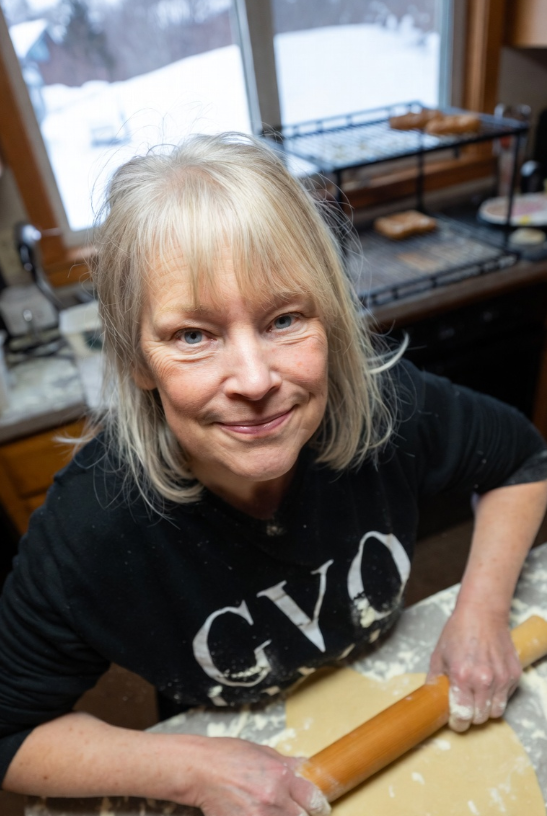
About the cook who shared this
Linda Johansson
Week 10 of Linda’s 30-year story
· Duluth, Minnesota
Linda is a sixty-three-year-old retired nurse from Duluth, Minnesota, living alone in the house where she raised her children and said goodbye to her husband. She lost Paul to ALS in 2020 after two years of watching the kindest man she'd ever known lose everything but his dignity. She cooks Scandinavian comfort food and Minnesota hotdish and the pot roast Paul loved, and she sets two places at the table out of habit because it makes her feel less alone. Every recipe she writes is a person she's loved.
