
 By
By Luis Jr. turns sixteen on November 18. Sixteen. My firstborn. The baby I held in a hospital in El Paso twenty-six months after crossing the bridge, the baby who made me a mother, the baby who gave me a reason to stay when the fear of staying and the fear of leaving were equal and the tiebreaker was a six-pound boy with Luis's face and my stubbornness. He is sixteen and he is taller than me and his voice is deep and his hands are bigger than mine and when did this happen? When did the baby become a man? I was watching the whole time and I still missed it.
We had a birthday dinner. Nothing fancy — carne asada in the backyard, with rice and beans and tortillas and the guacamole that Luis Jr. likes, the chunky kind with tomato and onion and too much lime, the way teenagers like everything, excessive and unapologetic. Carmen came. The bakery employees came — Graciela and Maricela, who have become part of the family in the way that employees of small businesses do, through proximity and shared labor and the particular bond of people who have seen each other at 4 AM. I made a cake — chocolate, three layers, with the chocolate buttercream that Luis Jr. has requested every year since he was eight. He blew out the candles and did not make a wish, or if he did he hid it inside the stoic mask he has been building since he was fourteen, the mask that all teenage boys build to hide the fact that they still feel everything, still want everything, still need their mothers more than they will ever admit.
I gave him Rosa's rosary. The one she prayed with every night, the wooden beads worn smooth by sixty years of fingers, the crucifix dark with the oil of a lifetime of devotion. Beatriz had sent it from Juárez — mailed it in a padded envelope with no note, because the Delgados and the Gutierrezes communicate through objects, not words. I put it in Luis Jr.'s hand and said, "This was your abuela's. She prayed for you with this every night." He looked at the rosary and his jaw tightened and his eyes filled and he put it in his pocket and said, "Thank you, Mom," and walked away, because he is sixteen and sixteen-year-old boys walk away from feelings the way they walk away from everything — quickly, before the feelings catch them.
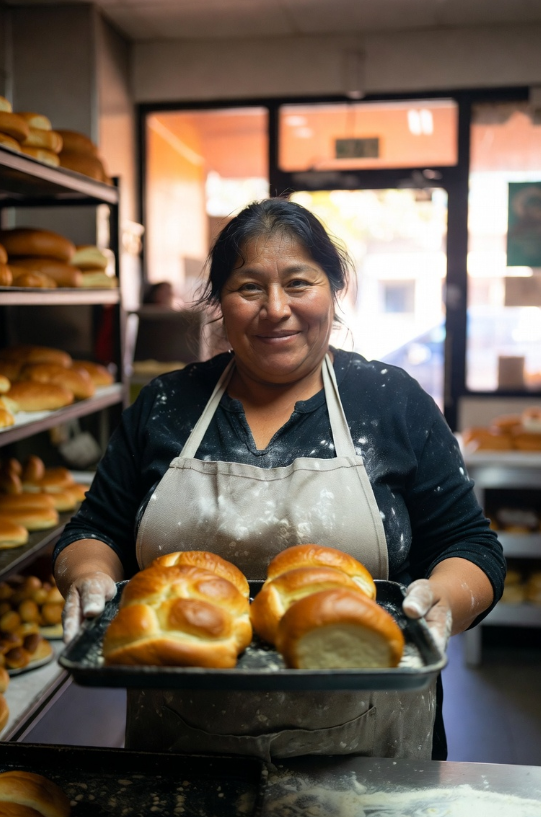
Sofia asked me if she could develop a new bakery item for the holiday season. She is eleven. She presented her idea like a business pitch — standing in the bakery kitchen with a notepad she had prepared, outlining the concept (Mexican hot chocolate conchas, with a chocolate-cinnamon dough and a dark chocolate shell), the estimated cost per unit, and the potential sell-through rate. I stared at her. I said: "Where did you learn the words sell-through rate?" She said: "The internet." She is eleven and she is studying bakery economics on the internet and she already knows more about margins than I did at thirty and I am simultaneously proud and terrified.
I made tamales this week — a practice batch for Christmas, because Christmas tamales take planning and practice and the kind of organizational precision that would make Isabella proud. I made chile colorado pork and green chile chicken, Rosa's two standards, and I spread the masa on the husks and filled them and folded them and steamed them and the kitchen smelled like Christmas in November, which felt premature and necessary, because this will be our first Christmas without Rosa and I need to practice not just the tamales but the feeling — the feeling of making Rosa's Christmas food in a kitchen Rosa will never enter.
The tamales were good. Not Rosa's. Not yet. The masa was slightly thick and the filling ratio was off — too much masa, not enough chile — and I could hear Rosa in my head saying, "Más chile, mija, más chile," and I added more, and the second batch was better, and I know that by December, by the time it matters, they will be right. They will be Rosa's. I will make them Rosa's if it takes every hour between now and Nochebuena.
The carne asada and the guacamole and the rice and beans get all the credit at a backyard birthday dinner, but I know the truth: it is the tortillas that hold the meal together, the way they hold everything else, quietly, without ceremony. I have been making tortillas by hand since before Luis Jr. was born — Rosa taught me, standing in her kitchen in Juárez, telling me my circles were not circles — and making them for his sixteenth birthday felt like the most honest thing I could offer him: not just food, but the particular love that lives inside repeated, familiar work. If you have never made them from scratch, this is the week to start. Rosa would insist.
Homemade Tortillas (White & Whole Wheat Versions)
Prep Time: 15 min + 30 min rest | Cook Time: 20 min | Total Time: 1 hr 5 min | Servings: 12 tortillas
Ingredients
- 2 cups all-purpose flour (or whole wheat flour, or a 50/50 blend)
- 1/2 tsp fine salt
- 1/2 tsp baking powder
- 3 tbsp vegetable oil, lard, or softened butter
- 3/4 cup warm water (more as needed, 1 tbsp at a time)
Instructions
- Combine the dry ingredients. In a large mixing bowl, whisk together the flour, salt, and baking powder until evenly combined.
- Add the fat. Add the oil or lard to the flour mixture. Use your fingers or a pastry cutter to rub the fat into the flour until the mixture resembles coarse, slightly damp sand.
- Form the dough. Pour in the warm water and stir with a fork until a shaggy dough forms. Turn out onto a lightly floured surface and knead for 2—3 minutes until the dough is smooth and no longer sticky. If the dough feels dry, add warm water one tablespoon at a time.
- Rest the dough. Divide the dough into 12 equal balls (about the size of a golf ball). Place on a lightly floured surface, cover with a clean kitchen towel or plastic wrap, and let rest for at least 30 minutes. Do not skip this step — the rest relaxes the gluten and makes rolling far easier.
- Roll the tortillas. Working one at a time, use a rolling pin to roll each dough ball into a thin, roughly 8-inch circle on a lightly floured surface. They do not need to be perfect circles. Rosa’s never were either.
- Cook on a dry skillet. Heat a cast-iron skillet or heavy griddle over medium-high heat until very hot. Cook each tortilla for 30—45 seconds per side, until light golden-brown spots appear and the surface puffs slightly. Stack cooked tortillas under a clean towel to keep them soft and pliable.
- Serve immediately or store. Tortillas are best fresh and warm. To store, let cool completely, then wrap tightly in plastic wrap or place in a zip-top bag. They keep at room temperature for 2 days or refrigerated for up to 1 week. Reheat in a dry skillet or wrapped in a damp paper towel in the microwave for 20—30 seconds.
Nutrition (per serving)
Calories: 115 | Protein: 3g | Fat: 4g | Carbs: 18g | Fiber: 1g | Sodium: 105mg