
 By
By Father's Day. I drove to Grinnell with the full arsenal — meatloaf (Dad's favorite, always), mashed potatoes, green beans from last year's canning, an apple pie, and two loaves of fresh bread because Dad has developed a taste for my homemade bread that borders on dependency and I am not above enabling a sixty-eight-year-old man's bread habit.
Dad was in the garden. The strawberries were ripe — Marlene's strawberries, the ones Roger planted for her, red and sweet and warm from the sun. Mom was picking them when we arrived, crouched between the rows with a bowl in her hand and a look on her face that I recognized: the look of a woman receiving exactly the gift she wanted from the man who knew what it was without asking. Strawberries. He planted strawberries for her. She's picking them. The love story of Roger and Marlene Weber, told in fruit.
Jack gave Dad the updated garden journal — mid-season report, complete with watermelon progress, corn height charts, and a section titled "Lessons From Grandpa" where he'd transcribed their Wednesday phone calls verbatim. Roger read every page. Again. The way he reads it every Father's Day. The journal is becoming an annual document, a living record of a boy and his grandfather and the soil between them.
Mom gave me the recipe cards. She'd packed them in a wooden box — the box, the original, the one that's been in the Weber kitchen since before I was born. Handwritten cards, some in Marlene's writing, some in Grandma Weber's fading script. The tater tot hotdish. The cinnamon rolls. The chocolate chip cookies. The pot roast. The bread-and-butter pickles. The sweet corn casserole. Every recipe I've been making since I was twelve, now in my hands, in the original handwriting, with the butter stains and the turmeric marks and the margin notes: "Roger likes extra cheese." "More frosting." "Don't overbake."
I held the box and I stood in Dad's kitchen and I didn't speak because there were no words for what I was holding. History. Love. Instruction. The entire Weber women's library, in a box that smelled like cinnamon and was heavy with the weight of hands that had held it before mine.
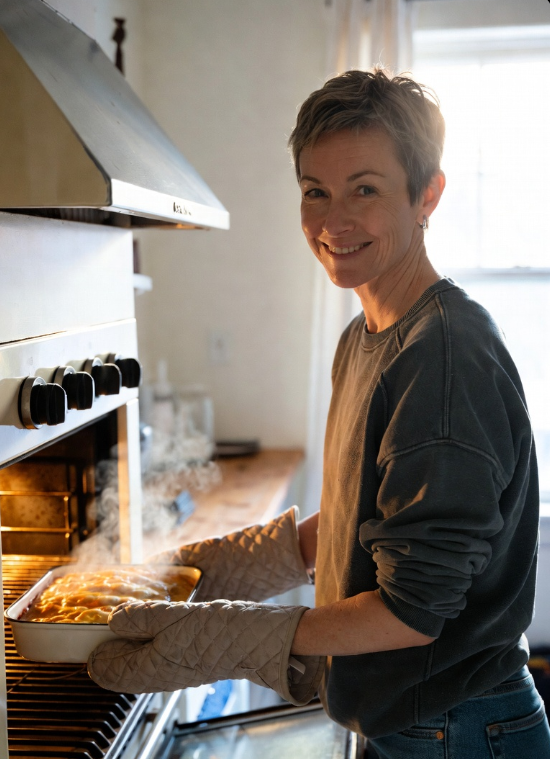
When I stood in Dad’s kitchen holding that wooden recipe box — Grandma Weber’s handwriting, Mom’s margin notes, sixty years of butter stains and love — I thought about the two loaves I’d set on the counter an hour before. I didn’t inherit the bread from the box. I found it myself, and then Dad decided it was his. This Honey Oat Bread is the one I’ve been bringing to Grinnell ever since — soft, a little sweet, with that hearty oat crumb that holds up to a generous spread of butter. Some recipes earn their way into a family. This one did.
Honey Oat Bread
Prep Time: 20 minutes + 1 hr 30 min rise | Cook Time: 35 minutes | Total Time: ~2 hours 25 minutes | Servings: 16 slices (1 loaf)
Ingredients
- 1 cup old-fashioned rolled oats, plus extra for topping
- 1 1/2 cups boiling water
- 2 1/4 teaspoons active dry yeast (1 packet)
- 1/4 cup warm water (105–115°F)
- 1/3 cup honey
- 2 tablespoons unsalted butter, softened
- 1 1/2 teaspoons salt
- 3 to 3 1/2 cups all-purpose flour (or bread flour)
- 1 egg, beaten (for egg wash)
Instructions
- Soak the oats. Place 1 cup rolled oats in a large mixing bowl and pour the boiling water over them. Stir briefly, then let stand for 20 minutes until the oats have softened and the mixture has cooled to lukewarm.
- Proof the yeast. In a small bowl, combine the warm water and yeast. Let sit for 5–10 minutes until foamy. This confirms your yeast is active.
- Build the dough. To the cooled oat mixture, add the honey, butter, and salt. Stir to combine. Add the proofed yeast mixture, then add the flour 1 cup at a time, stirring until a shaggy dough forms. Turn out onto a lightly floured surface.
- Knead. Knead the dough for 8–10 minutes, adding flour a tablespoon at a time as needed, until smooth, slightly tacky, and elastic. The dough should spring back when poked.
- First rise. Place the dough in a lightly oiled bowl, turning once to coat. Cover with a clean towel or plastic wrap and let rise in a warm spot for 1 hour, or until doubled in size.
- Shape. Punch the dough down gently. Shape into a loaf and place in a greased 9x5-inch loaf pan. Cover and let rise again for 30–45 minutes, until the dough crowns about 1 inch above the rim of the pan.
- Top and bake. Preheat oven to 350°F. Brush the top of the loaf gently with the beaten egg and sprinkle a small handful of rolled oats over the top. Bake for 30–35 minutes, until the crust is deep golden and the loaf sounds hollow when tapped on the bottom.
- Cool. Transfer to a wire rack and cool for at least 20 minutes before slicing. Resist the urge to cut in too early — the crumb sets as it cools.
Nutrition (per serving)
Calories: 145 | Protein: 4g | Fat: 2g | Carbs: 28g | Fiber: 1g | Sodium: 220mg