
 By
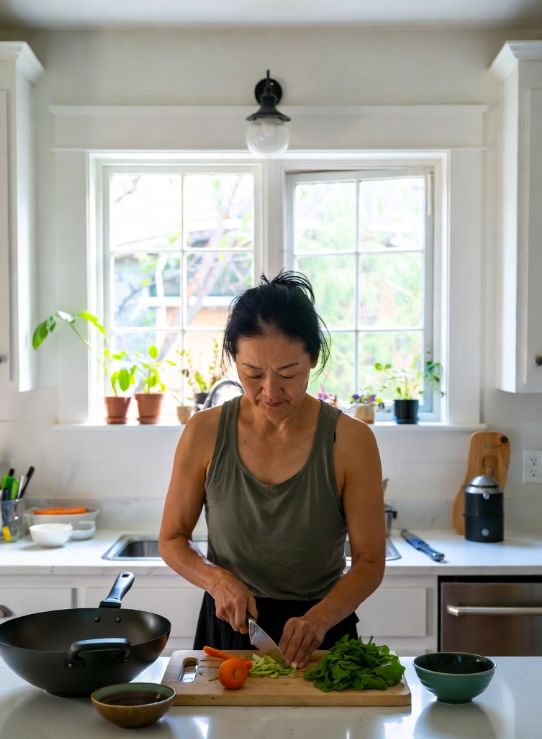
By I am learning to cook without Fumiko on the other end of the phone. This is harder than I expected, which is to say: it is the hardest thing. Not the cooking itself — the cooking is muscle memory, the hands knowing what to do — but the absence of the corrective voice, the loss of the person who could tell me "more ginger" or "less water" or "the miso is not right." The voice is gone. The corrections are gone. I am alone in the kitchen with the recipes and the memory and the terrifying freedom of cooking without oversight.
I hired a Japanese tutor this week. Her name is Yuki, a graduate student at Portland State, and she will come once a week for three months to help me read Fumiko's recipe cards. The first session was Tuesday. We sat at the kitchen table and Yuki spread out the cards and read them to me, one by one, and the sound of the Japanese words — words I cannot read but can almost hear in Fumiko's voice — filled the kitchen with a ghost language, a shadow tongue, the echo of a woman who wrote these words decades ago with the expectation that someone, someday, would need to read them.
The first card we translated was the miso soup recipe. It was, as I suspected, simpler than I had imagined — three lines of instruction, no measurements, no times, just the ingredients and the order and a final note that said, in Fumiko's hand: "The dashi must smell like the ocean. If it does not, start again." The ocean. She was telling me to taste the sea in my soup. She was telling me that the standard is not adequacy but transcendence, that the soup must contain the ocean or it is not soup, it is water with paste. Start again.
I made the miso soup that night, following the card. The dashi smelled like the ocean. The soup was better than it has ever been — not because the recipe was different (I have been making this soup for years) but because I was paying attention in a new way, the way you pay attention when the teacher is gone and the attention is the only tribute you have left. I drank it from the chipped bowl. The chip fit my lip. The soup tasted like Fumiko. The soup tasted like the ocean. I did not start again.
Translating Fumiko’s miso card with Yuki reminded me that every good Asian soup begins with the same act of faith: you commit to the broth, fully, or you commit to nothing. The night after that first session, once the miso was finished and the bowl was empty, I found myself wanting to cook again—not to mourn, but to practice the attention she demanded of me. Hot and sour soup is not miso, but it asks the same question: are you paying attention? Are you tasting as you go? It felt like the right next step.
Hot and Sour Soup
Prep Time: 15 min | Cook Time: 20 min | Total Time: 35 min | Servings: 4
Ingredients
- 6 cups low-sodium chicken or vegetable broth
- 1/2 cup canned bamboo shoots, drained and julienned
- 1/2 cup dried wood ear or shiitake mushrooms, rehydrated and sliced
- 4 oz firm tofu, cut into 1/4-inch strips
- 3 tablespoons rice vinegar, plus more to taste
- 2 tablespoons soy sauce
- 1 teaspoon chili garlic sauce or white pepper, plus more to taste
- 1 teaspoon sesame oil
- 3 tablespoons cornstarch mixed with 3 tablespoons cold water
- 2 large eggs, lightly beaten
- 2 green onions, thinly sliced, for serving
- 1 teaspoon fresh ginger, grated
Instructions
- Build the broth. Pour the broth into a medium saucepan over medium-high heat. Add the ginger and bring to a gentle boil. This is the moment to pay attention—the broth should smell clean and savory before anything else goes in.
- Add the solids. Stir in the bamboo shoots, mushrooms, and tofu. Reduce heat to medium and simmer for 5 minutes, until the mushrooms are fully tender and the tofu has absorbed some of the broth’s flavor.
- Season the soup. Add the soy sauce, rice vinegar, and chili garlic sauce or white pepper. Stir and taste. Adjust the balance—more vinegar for sour, more chili for heat—until the broth tastes intentional, not accidental.
- Thicken the broth. Give the cornstarch slurry a quick stir to recombine, then pour it slowly into the soup while stirring in a steady circular motion. Continue stirring for 1—2 minutes until the broth turns silky and just coats the back of a spoon.
- Add the egg ribbons. With the soup at a gentle simmer, slowly drizzle the beaten eggs in a thin stream while stirring the broth in a wide, slow circle. The eggs will bloom into delicate ribbons. Do not rush this step.
- Finish and serve. Remove from heat. Drizzle with sesame oil and stir once. Ladle into bowls and top with sliced green onions. Serve immediately while the broth is still alive with heat.
Nutrition (per serving)
Calories: 145 | Protein: 10g | Fat: 6g | Carbs: 13g | Fiber: 1g | Sodium: 780mg