May. Mother's Day approaching. The fifth where I'm both daughter and mother. The second since the Alzheimer's diagnosis became real.
Anaya made me a card at school: her handprint (bigger each year — the hands grow, the tradition holds) and a drawing of our kitchen. Not a stick figure at a stove — a detailed rendering, by four-year-old standards, of the counter, the range, the wet grinder. She drew the wet grinder. She labeled it: "Paati masheen."
Paati masheen. Paati's machine. The wet grinder that is now known in Anaya's vocabulary as Paati's machine, because it came from Paati's kitchen and it sounds like Paati's voice — loud, persistent, impossible to ignore.
For Amma's Mother's Day, I did what I did last year: cooked in her kitchen. Her recipes, her pots, her stove. Idli sambar, the Mother's Day menu.
But this year, Anaya helped. Standing on the step stool, dropping urad dal into the wet grinder, making the batter that would become idli that would be served to Paati on Mother's Day.
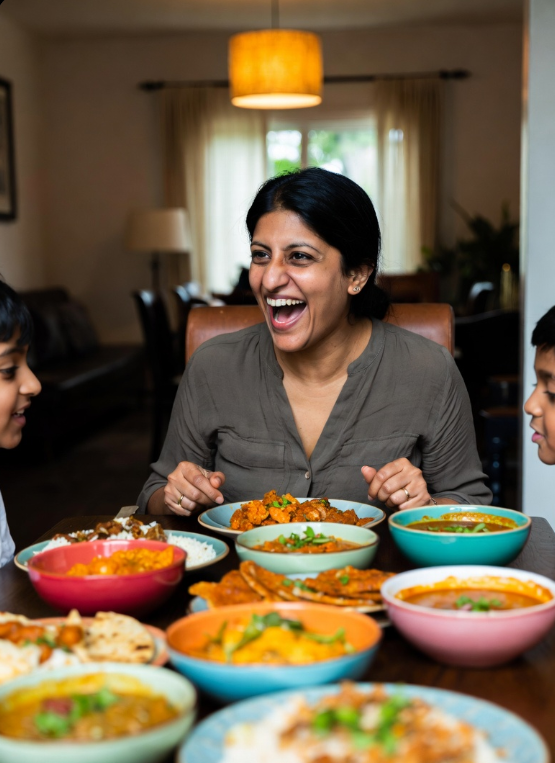
Three generations: Amma's recipe, Priya's execution, Anaya's hands. The idli were soft. The sambar was right. The three of us sat at Amma's table and ate — Amma, Anaya, and me — and Rohan sat in the high chair eating mashed idli with his fists.
"Happy Mother's Day, Amma."
"Happy Mother's Day, Priya."
"Happy Mother's Day, AMMA!" (Anaya, shouting, because everything she says to me is at maximum volume.)
Amma looked at us — her daughter, her granddaughter, her grandson. She looked at the table of food made from her recipes by hands that are not hers but carry her knowledge.
"This is good," she said. Not the food — the everything. This. All of this. The table, the children, the Mother's Day that is about three mothers at once.
This is good. The simplest review. The most complete.
I didn't cry until the car ride home. The tradition holds.
The idli and sambar belong to Amma’s kitchen, but the lesson I carried home—the one Anaya taught me without knowing it—is that the simplest food, made with care and passed between hands, is always enough. On the mornings that follow days like that Mother’s Day, I reach for something that asks very little and gives a great deal: hummus toast, quietly nourishing, ready in minutes, the kind of thing you can make with a four-year-old standing on a step stool beside you. It’s not Paati’s recipe, but it carries the same spirit—legumes, simplicity, goodness without fuss—and some mornings, that’s exactly the point.
Hummus Toast
Prep Time: 5 minutes | Cook Time: 5 minutes | Total Time: 10 minutes | Servings: 2
Ingredients
- 2 slices whole grain or sourdough bread
- 1/2 cup hummus (store-bought or homemade)
- 1/4 English cucumber, thinly sliced
- 1/2 cup cherry tomatoes, halved
- 2 radishes, thinly sliced
- 1 tablespoon extra-virgin olive oil
- 1 teaspoon lemon juice
- 1/4 teaspoon flaky sea salt
- 1/4 teaspoon red pepper flakes (optional)
- 1 tablespoon fresh parsley or za’atar, for garnish
Instructions
- Toast the bread. Place bread slices in a toaster or under the broiler for 2—3 minutes, until golden and crisp at the edges but still slightly chewy in the center.
- Spread the hummus. Spoon a generous 1/4 cup of hummus onto each slice and spread it all the way to the edges using the back of the spoon.
- Layer the vegetables. Arrange cucumber slices, halved cherry tomatoes, and radish slices over the hummus in an even, overlapping layer.
- Dress and season. Drizzle olive oil and lemon juice evenly over both toasts. Sprinkle with flaky sea salt and red pepper flakes if using.
- Garnish and serve. Finish with fresh parsley or a pinch of za’atar. Serve immediately while the toast is still warm.
Nutrition (per serving)
Calories: 275 | Protein: 10g | Fat: 13g | Carbs: 30g | Fiber: 7g | Sodium: 390mg
About the cook who shared this
Priya Krishnamurthy
Week 318 of Priya’s 30-year story
· Edison, New Jersey
Priya is a pharmacist, wife, and mom of two in Edison, New Jersey — the town she grew up in, surrounded by the sights and smells of her mother's South Indian kitchen. These days, she splits her time between the hospital pharmacy, school pickups, and her own kitchen, where she cooks nearly every night. Her style is a blend of the Tamil recipes her mother taught her and the American comfort food her kids actually want to eat. She writes about the beautiful mess of balancing two cultures on one plate — and she wants you to know that ordering pizza is also an act of love.
