
 By
By Dad's been having chest pains. He called Monday, which means it's been happening for days and he finally admitted it, because Roger Weber does not call about health problems unless the health problem has outlasted his capacity to ignore it, which for Roger is approximately the duration of the Cold War. I made him see a doctor. I drove to Grinnell, picked him up, drove him to the clinic, and sat in the waiting room while they ran tests.
The doctor said his heart is working too hard. The bypass surgery from — no, wait, the bypass hasn't happened yet. The doctor said there are blockages. That his heart has been under strain for years. That stress and age and genetics have conspired to make his arteries narrow and his future uncertain. The doctor used words like "intervention" and "catheterization" and "lifestyle changes." Dad sat there and nodded and said, "I eat fine." He does not eat fine. He eats toast and whatever I bring him. I held his hand in the car on the way home and didn't say any of the things I was thinking because Roger doesn't want my fear, he wants my steady. So I was steady.
I went home and made pot roast. Not for Dad — for my family, for dinner, for the act of feeding that calms me when nothing else can. Three-pound chuck, carrots, potatoes, onions. Four hours in the oven. The house filled with the smell of something slow and reliable and certain, and I needed certainty because my father's heart is failing and I can't fix it with food and I can't fix it with visits and I can't fix it with forty quarts of anything.
I told Kevin after the kids went to bed. He held me in the kitchen and didn't say anything because Kevin knows that some moments don't need words, they need arms. We stood in the kitchen with the pot roast dishes still in the sink and the light above the stove making that circle of warm yellow that is the exact radius of safety, and I leaned into him and I cried and he held me and the kitchen held us both.
I called Mom. She already knew. She'd been monitoring, the way Marlene monitors everything — quietly, thoroughly, without broadcasting the results. She said they'd get through it. She said the doctor was good. She said, "Eat something." That's how Marlene says I love you across phone lines and distance and fear.
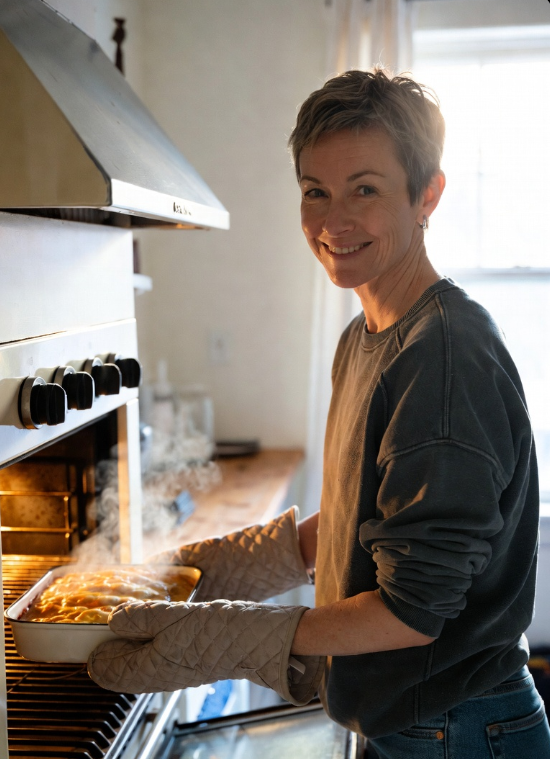
Pot roast got me through that night, but it’s Lasagna Cordon Bleu that I come back to when I need a meal that asks something of me — something layered and deliberate and worth the time. Chicken, ham, Swiss, a sauce you have to stand over and stir: it’s the kind of cooking that keeps your hands busy and your mind just far enough from what it’s afraid of. I made this the following Sunday, with the kids around the table and Kevin pouring wine and the phone quiet, and I let the hour it takes be the hour I needed.
Lasagna Cordon Bleu
Prep Time: 30 minutes | Cook Time: 50 minutes | Total Time: 1 hour 20 minutes | Servings: 10
Ingredients
- 12 lasagna noodles, cooked al dente and drained
- 3 cups cooked chicken breast, shredded or diced
- 2 cups deli ham, roughly chopped
- 2 cups Swiss cheese, shredded
- 1 1/2 cups whole-milk mozzarella, shredded
- 1/2 cup Parmesan cheese, grated
- 4 tablespoons unsalted butter
- 1/4 cup all-purpose flour
- 3 cups whole milk, warmed
- 2 teaspoons Dijon mustard
- 1/2 teaspoon garlic powder
- 1/2 teaspoon onion powder
- Salt and black pepper to taste
- Fresh parsley, chopped, for garnish
Instructions
- Preheat and prep. Preheat your oven to 375°F. Grease a 9x13-inch baking dish and set aside. Cook lasagna noodles according to package directions, drain, and lay flat on a lightly oiled sheet of foil to prevent sticking.
- Make the bechamel. In a medium saucepan over medium heat, melt butter. Whisk in flour and cook, stirring constantly, for about 2 minutes until the mixture is pale golden and smells slightly nutty. Slowly pour in the warmed milk, whisking continuously to prevent lumps. Cook, stirring, until the sauce thickens enough to coat the back of a spoon, about 6–8 minutes.
- Season the sauce. Remove from heat and stir in Dijon mustard, garlic powder, and onion powder. Season generously with salt and black pepper. The sauce should be creamy and smooth.
- Layer the lasagna. Spread a thin layer of bechamel across the bottom of the prepared baking dish. Lay 3–4 noodles over the sauce, slightly overlapping. Spread one-third of the remaining bechamel over the noodles, then scatter one-third of the chicken and ham evenly across the top. Sprinkle with one-third of the Swiss and mozzarella cheeses. Repeat layers twice more, finishing with noodles topped by the final bechamel and remaining cheeses.
- Top and bake. Sprinkle the Parmesan evenly over the top layer. Cover tightly with foil and bake for 30 minutes. Remove foil and bake an additional 15–20 minutes until the top is bubbling and golden brown at the edges.
- Rest before serving. Remove from the oven and let the lasagna rest, uncovered, for at least 10 minutes before cutting. This helps the layers hold together when sliced. Garnish with fresh parsley and serve warm.
Nutrition (per serving)
Calories: 485 | Protein: 36g | Fat: 22g | Carbs: 37g | Fiber: 2g | Sodium: 740mg