I told Anna in person. I drove to Minneapolis on Saturday and sat at her kitchen table while David took the kids out and I told her. The full truth. The word. The prognosis. Everything.
Anna didn't cry immediately. She's like me — the tears come later, in private, after the facts have been absorbed and the plans have been made. She asked questions: What medication is he on? What's the timeline? What's the care plan? She asked them the way a teacher asks — organized, sequential, looking for the lesson plan in the chaos.
Then she stopped asking questions and she put her head on the table and she cried. My forty-seven-year-old daughter put her head on the table in her kitchen and cried for her father, and I sat across from her and put my hand on her hair and let her cry and I didn't cry because one of us needed to not cry and it was going to be me because it's always me.
She said, "What does Dad need?" I said, "Right now, normalcy. He needs us to be normal." She said, "How do I be normal?" I said, "You call him. You talk about school. You talk about the kids. You don't treat him like he's dying. You treat him like he's Paul." She said, "He is Paul." I said, "Exactly."
I drove home. Four hours. I thought about the conversation the entire time. I thought about Anna's head on the table and her hair under my hand and the sound of a daughter crying for a father who is still alive but who won't be, eventually, and the word "eventually" is the cruelest word in the English language because it means "later" and later means it's coming and it's coming means you can't stop it.
I still haven't told Peter or Elsa. Peter is carrying enough — his marriage, his silence, whatever he's drinking in Chicago. I need to tell him. I will tell him. But the timing — when do you add weight to someone who's already sinking? When is it a kindness to tell the truth and when is it an act of destruction?
Elsa: she's in the woods. She's tracking wolves. She's the freest of my children. I will tell her and the freedom will shrink.
I made Mamma's meatballs when I got home. Again. The meatballs are becoming my answer to everything — grief, fear, love, Tuesday. I roll them and the rolling steadies me and the meatballs are round and the roundness is a shape that has no edges and no edges means nothing to cut yourself on.
Paul ate them and said, "You've been making a lot of meatballs lately." I said, "You love meatballs." He said, "I do. But you're making them because you're scared." He sees me. After thirty years, he still sees me.
I said, "I told Anna today." He said, "How did she take it?" I said, "Like a Johansson. She cried, then she made a plan." He smiled. "That's my girl."
His girl. His Anna. His Sophie, his Jakob, his Lena. His Peter. His Elsa. His Linda.
His. Still his. For now.
When I got home from Minneapolis, my hands needed something to do. They needed the steadying rhythm of portioning meat, the soft press-and-roll of forming each ball, the quiet sizzle of the pan. Mamma’s meatballs are never just dinner in this house — they’re what I make when I need the world to feel round and smooth and without edges. Paul was right: I make them because I’m scared. But I also make them because they work. Here’s how I make them, the way Mamma taught me.
Mamma’s Swedish Meatballs
Prep Time: 25 minutes | Cook Time: 30 minutes | Total Time: 55 minutes | Servings: 6
Ingredients
- 1 lb ground beef (80/20)
- 1/2 lb ground pork
- 1/3 cup plain breadcrumbs
- 1/4 cup whole milk
- 1 large egg
- 1/4 cup finely minced yellow onion
- 1/2 teaspoon ground allspice
- 1/4 teaspoon ground nutmeg
- 1 teaspoon salt
- 1/2 teaspoon black pepper
- 2 tablespoons butter
- 2 tablespoons olive oil
For the Cream Sauce
- 3 tablespoons butter
- 3 tablespoons all-purpose flour
- 2 cups beef broth
- 3/4 cup heavy cream
- 2 teaspoons Worcestershire sauce
- 1 teaspoon Dijon mustard
- Salt and pepper to taste
- Fresh parsley, chopped, for serving
Instructions
- Soak the breadcrumbs. In a small bowl, combine breadcrumbs and milk. Let sit for 5 minutes until the milk is absorbed.
- Mix the meat. In a large bowl, combine the ground beef, ground pork, soaked breadcrumbs, egg, minced onion, allspice, nutmeg, salt, and pepper. Mix gently with your hands until just combined — don’t overwork the meat or the meatballs will be tough.
- Roll the meatballs. Using about 1 tablespoon of mixture per meatball, roll into smooth, round balls. You should get about 35-40 meatballs. Place them on a parchment-lined baking sheet.
- Brown the meatballs. Heat butter and olive oil in a large skillet over medium heat. Working in batches so you don’t crowd the pan, brown the meatballs on all sides, about 5-6 minutes per batch. They don’t need to be cooked through — they’ll finish in the sauce. Transfer to a plate.
- Make the cream sauce. In the same skillet, melt 3 tablespoons butter over medium heat. Whisk in the flour and cook for 1 minute, stirring constantly. Slowly pour in the beef broth, whisking to prevent lumps. Add the heavy cream, Worcestershire sauce, and Dijon mustard. Bring to a gentle simmer and stir until the sauce thickens, about 3-4 minutes.
- Simmer the meatballs. Return the meatballs to the skillet. Reduce heat to low, cover, and simmer for 15 minutes, stirring gently once or twice, until the meatballs are cooked through and the sauce is velvety.
- Serve. Taste the sauce and adjust salt and pepper. Spoon the meatballs and sauce over egg noodles, mashed potatoes, or lingonberry jam on the side. Garnish with fresh parsley.
Nutrition (per serving)
Calories: 420 | Protein: 25g | Fat: 31g | Carbs: 10g | Fiber: 1g | Sodium: 780mg
About the cook who shared this
Linda Johansson
Week 98 of Linda’s 30-year story
· Duluth, Minnesota
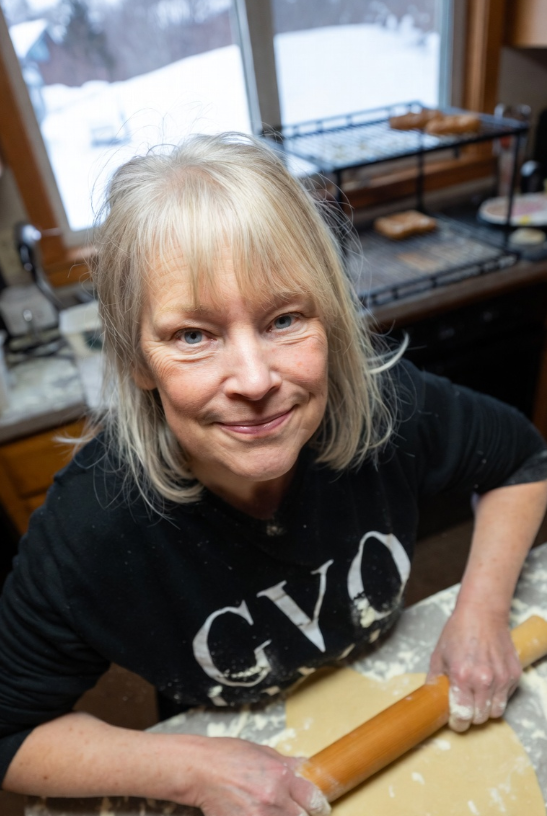
Linda is a sixty-three-year-old retired nurse from Duluth, Minnesota, living alone in the house where she raised her children and said goodbye to her husband. She lost Paul to ALS in 2020 after two years of watching the kindest man she'd ever known lose everything but his dignity. She cooks Scandinavian comfort food and Minnesota hotdish and the pot roast Paul loved, and she sets two places at the table out of habit because it makes her feel less alone. Every recipe she writes is a person she's loved.
