
 By
By It’s 4:47 in the morning and Miya is finally asleep.
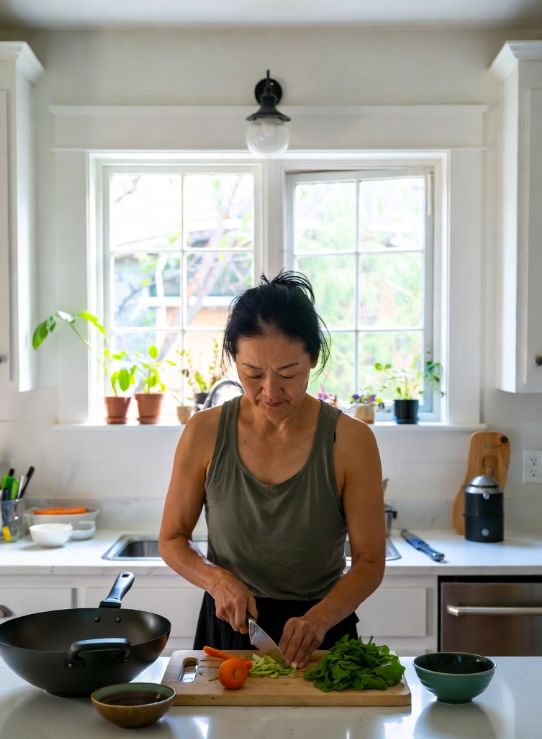
I know I should sleep too. Every book, every well-meaning friend, every postpartum pamphlet with the pastel font tells me to sleep when the baby sleeps. But my brain doesn’t work that way — it never has — and after three months of learning this the hard way, I’ve stopped fighting it. So I’m standing in my kitchen in Southeast Portland in the gray early-morning light, wearing a nursing bra and my ex-boyfriend’s college sweatshirt, and I’m making a miso glaze.
This is who I am. My name is Jen Nakamura. I’m thirty years old, I teach yoga, I have generalized anxiety disorder, and I have a three-month-old daughter named Miya who is the most terrifying and astonishing thing that has ever happened to me. My husband Brian is asleep in the other room. The cat, Mochi, is watching me from the counter with the specific look cats give you when they suspect you’re falling apart.
He’s not wrong, exactly. But I’m also cooking, which means I’m managing.
I want to tell you about this recipe, but first I need to tell you about my grandmother.
Fumiko Nakamura — I called her Obachan, the way you call your grandmother in Japanese — lived in a small apartment in Sacramento’s Japantown for as long as I can remember. She was a small woman with very precise hands and an absolute refusal to do anything in the kitchen carelessly. Her miso soup took an hour. Her gyoza pleating was architectural. She grew shiso on her windowsill and talked to it, I think, though she’d never admit it. She is eighty-seven years old and alive right now and I love her more than I have words for in either of the languages that live in me.
I grew up in Sacramento, the only child of Ken and Barbara Nakamura, who were both good people and a terrible match for each other. My father is Sansei — third-generation Japanese American — quiet and meticulous, a man who grows daikon with the same precision his grandfather brought to farming before the government took everything. My mother is white, from Fresno, and taught high school biology with the kind of cheerful competence that made her excellent at her job and occasionally exhausting at home. They divorced when I was twelve. It was the quietest divorce in history. Nobody screamed. There was just a conversation at the kitchen table and then my father moved to a condo in Midtown and I learned to be two different daughters in two different houses.
What stayed constant was Obachan’s kitchen.
Every Saturday she’d make me lunch: usually rice, some kind of nimono, miso soup with whatever vegetables she had. She didn’t hug — physical affection was not her language — but she fed me with a focus that felt like devotion. She’d set the bowl in front of me and watch me take the first sip and only then would she sit down, satisfied, like my eating was proof of something she’d needed to confirm. I understood later that this was how she loved. I understand now, standing in my own kitchen at 4:47 in the morning, that it’s how I love too.
I moved to Portland in 2007, after college, and the city fit me the way Sacramento never had. Portland is weird and rainy and full of people who are also anxious and also coping and also eating really good food, and for the first time I felt like I belonged somewhere. I got my yoga certification, I started teaching, I found the farmers market at PSU and the Japanese grocery at Uwajimaya and I started cooking seriously. Not just following recipes — thinking about food, the way Obachan thought about it. What goes together and why. What a dish is actually for.
I’ve had anxiety since I was fourteen. I had my first panic attack in the school cafeteria — I thought I was dying, which sounds dramatic until you’ve had one, at which point it sounds exactly right. I’ve been on medication, off medication, and back on medication. I’ve been in therapy for twelve years. Yoga helped. Cooking helped. The quiet ritual of it — the measuring, the chopping, the attention it demands — has always been one of the things that can cut through the noise when my brain decides to be unlivable.
And then I had a baby, and my brain decided to be its most unlivable self yet.
I knew postpartum anxiety was a possibility. My doctor warned me, my therapist warned me, I’d read about it. None of that prepared me for the way it arrived: not as sadness but as a roar. Everything was a threat. Every time Miya made a sound I was certain something was wrong; every time she was silent I was certain something was more wrong. Brian — who I love, who I know loves me, who is genuinely trying — kept telling me I was overthinking it. Brian has never had to think very hard about what his brain is doing, which I both envy and find, some mornings, impossible to forgive.
But I have my coping mechanisms. I have my therapist, whom I’m seeing twice a week right now. I have my medication, which I stayed on through the pregnancy at low dose after a careful conversation with my OB and my psychiatrist, and which I’m back to full dose now. And I have my kitchen.
This miso salmon bowl is the thing I make when my brain won’t stop. Not because it’s complicated enough to distract me — it’s not, it’s actually quite simple — but because every step of it is deliberate, and deliberate is the opposite of spiral. You make the glaze: white miso, which is Obachan’s miso, the kind she kept in a ceramic crock in her refrigerator, the one that smelled exactly like her kitchen. You add mirin and rice vinegar and a little sesame oil, and you whisk it until it’s smooth, and the whisking requires your hands and your attention and that’s the point. You cook the rice, which takes twenty minutes of your stove doing the work while you do something else, which is its own kind of relief. You roast the salmon, and the smell of miso caramelizing in a hot oven is one of the best smells I know — savory and slightly sweet, the smell of Obachan’s kitchen transplanted to my cramped apartment, the smell of being taken care of.
I talked to her on the phone last week. She asked about Miya — “Is she eating? Is she strong?” — and I said yes, she’s eating, she’s strong, and Obachan made a satisfied sound that was exactly the sound she made when I finished my lunch at her table. I started crying after we hung up, which is the kind of thing that happens when you’re postpartum and also just when you love someone that much.
I put the bowl together in layers: rice, a handful of shredded cucumber, some sliced avocado, the salmon broken into pieces over the top. A drizzle of the leftover glaze. Sesame seeds, a pinch of furikake if I have it. I make it for Brian and me, usually, though lately I’ve been making it just for myself, at 4:47 in the morning, standing at the counter while the baby sleeps.
There’s something that happens when I eat it. The noise doesn’t stop exactly, but it recedes. I’m tasting something instead of thinking something. I’m in my body, which is where I need to be.
Miya will wake up in an hour, maybe less. She’ll need to eat, and I’ll feed her, and we’ll sit together in the chair by the window while Portland turns gray and then pale gold outside, and I’ll watch her face while she eats the way Obachan watched my face at her kitchen table. Checking. Satisfied. This is how we love. This is what I have to give her.
But first: salmon, miso, rice. First: this bowl, and the quiet it carries with it.
Here’s how I make it.
This is the bowl I keep coming back to—not because it’s complicated, but because it isn’t. When Miya finally sleeps and the house goes quiet enough that I can hear my own thoughts again, I don’t want a project; I want something that knows what it’s doing, something that asks nothing of me except to stand there and watch it come together. Miso and salmon have been doing this longer than I’ve been alive, and there’s comfort in that. Here’s how I make it.
Miso Glazed Salmon Bowls
Prep Time: 15 minutes | Cook Time: 25 minutes | Total Time: 40 minutes | Servings: 2
Ingredients
For the miso glaze:- 3 tablespoons white miso paste (shiro miso)
- 2 tablespoons mirin
- 1 tablespoon rice vinegar
- 1 tablespoon soy sauce
- 1 teaspoon sesame oil
- 1 teaspoon honey
- 1 teaspoon freshly grated ginger
- 2 salmon fillets (about 6 oz each), skin-on or skinless
- 1 cup short-grain white rice, rinsed
- 1 Persian cucumber, thinly sliced or shredded
- 1 ripe avocado, sliced
- 2 teaspoons sesame seeds (white or black)
- 1 teaspoon furikake (optional but wonderful)
- 1 scallion, thinly sliced
- Rice vinegar and a pinch of salt, for the cucumber
Instructions
- Cook the rice. Combine the rinsed rice with 1 and 1/2 cups cold water in a small saucepan. Bring to a boil over medium-high heat, then reduce to the lowest possible simmer, cover, and cook for 18 minutes. Remove from heat and let it steam, covered, for 10 more minutes. Do not lift the lid. Trust the rice.
- Make the miso glaze. Whisk together the miso paste, mirin, rice vinegar, soy sauce, sesame oil, honey, and ginger in a small bowl until completely smooth. Take your time here. The whisking is part of the point.
- Marinate the salmon. Pat the salmon fillets dry and place them in a shallow dish. Spoon about half the glaze over them, turning to coat both sides. Let them sit for at least 10 minutes while you prepare everything else. The remaining glaze is for drizzling at the end.
- Quick-pickle the cucumber. Toss the sliced cucumber with a small splash of rice vinegar and a pinch of salt. Let it sit while the salmon cooks. It will soften slightly and take on a bright, clean flavor that cuts through the richness of the fish.
- Roast the salmon. Heat your oven to 400°F. Line a small baking sheet with foil and lightly oil it. Place the marinated salmon skin-side down on the pan. Roast for 12–14 minutes, until the glaze is caramelized at the edges and the fish flakes easily with a fork. Watch it toward the end — the miso sugars can go from beautiful to burnt quickly.
- Build the bowls. Divide the rice between two bowls. Arrange the pickled cucumber and avocado slices alongside. Break the salmon into large pieces and place it over the rice. Drizzle with the reserved miso glaze. Top with sesame seeds, furikake if using, and sliced scallion.
- Eat slowly. This is not optional. This is the whole point.
Nutrition (per serving)
Calories: 620 | Protein: 42g | Fat: 24g | Carbs: 58g | Fiber: 6g | Sodium: 890mg