
 By
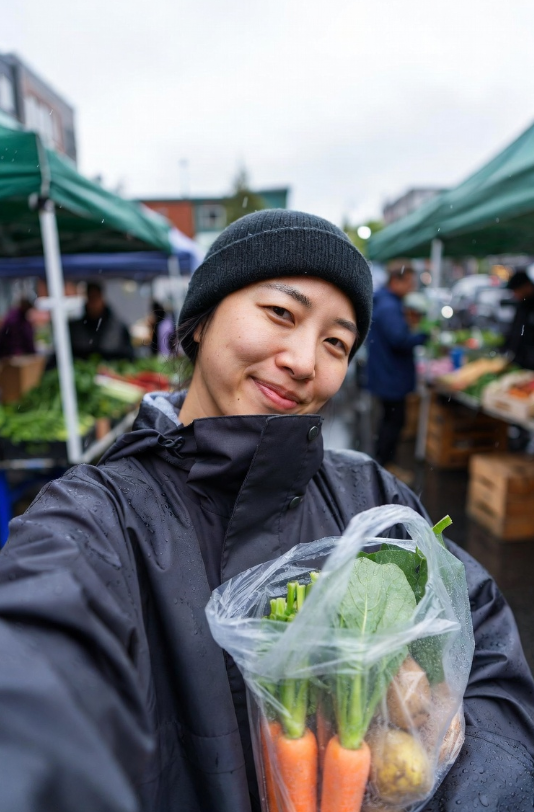
By Last week in Korea. The countdown now goes the other direction — not toward Korea but away from it, back to Seattle, back to the life that contains Korea now in a way it didn't before. I've been eating with urgency, the urgency of someone who knows the meals are finite, that in seven days this will be memory instead of experience, and I want to eat everything one more time, taste everything one more time, stand in the market one more time with my face invisible and my heart full and my stomach holding the flavors of a country I'm from.
Busan's last days: I went back to Jagalchi alone, without Daniel, and wandered the stalls and ate whatever looked interesting. Grilled shellfish from a cart. Raw sea urchin, bright orange and briny, scooped from the shell. Eomuk — fish cake — on a stick, dipped in the hot broth it was cooked in. Tteokbokki from a street vendor, the sauce darker and sweeter than my version, the rice cakes softer. Hotteok from a cart, the brown sugar filling oozing and caramelizing on the griddle. I ate standing, walking, sitting on curbs, the way Koreans eat street food — casually, socially, without ceremony. The lack of ceremony. I keep coming back to that. In Seattle, my Korean cooking is always ceremonial — weighted with meaning, heavy with identity. In Korea, food is just food. It's lunch. It's a snack. It's what you eat while walking to the subway. The lightness of that. I want that lightness. I want to carry it back to Seattle.
On Wednesday I did something unplanned: I visited the area near the Eastern Social Welfare Society. Not the actual building — I couldn't bring myself to go that close — but the neighborhood in Seoul where the adoption agency is. I took the subway alone. I walked the streets. The buildings were modern, the streets busy with traffic and people and the ordinary noise of a Korean city. I stood on a corner and thought: this is where it happened. This is where I started. A building somewhere in this neighborhood held a three-day-old baby girl who would grow up to be me — to be a software engineer in Seattle who makes kimchi from scratch and is standing on this corner twenty-four years later, looking for something she can't name and finding something she didn't expect, which is: ordinariness. The neighborhood is ordinary. The building is ordinary. The story that started here is extraordinary, but the place itself is just a place, a corner, a Seoul neighborhood with a convenience store and a bus stop and people going about their lives, and my beginning was here, among these buildings, under this sky, and the sky is ordinary and the buildings are ordinary and I am ordinary too — an ordinary Korean woman standing on an ordinary Korean corner, and the ordinariness is the gift.
I didn't tell Daniel about the adoption agency neighborhood. Some pilgrimages are private. I wrote about it in Karen's journal, though: "I went to the neighborhood where I was left. It's just a neighborhood. That's the whole story. It's just a neighborhood, and I'm just a person, and Korea is just a country, and the just is what I came here to find."
The flight home was Saturday. Korean Air, Incheon to Sea-Tac, fourteen hours over the Pacific. I slept for ten of them — the deep, spent sleep of someone who has been processing at maximum capacity for three weeks. Daniel slept too. We woke up over Oregon and he said, "We did it." I said, "We did." He said, "How do you feel?" I said, "Korean." He said, "Me too." Korean. Not Korean-American, not adopted Korean, not Korean-learning or Korean-becoming or Korean-adjacent. Korean. The word without qualifiers. The word earned by three weeks of eating and walking and crying and being, in the country where the word was born.
Karen and David picked me up at Sea-Tac. Karen hugged me at arrivals and said, "Tell me everything." I said, "I will. But first, can we go to H Mart? I need gochugaru. I'm making kimchi jjigae tonight." She laughed. David drove to H Mart. I bought gochugaru. I went home and made kimchi jjigae in my Capitol Hill kitchen at 11 PM, jet-lagged and exhausted and changed, and the jjigae tasted different. Not better. Not worse. Different. Because I'm different. I've been to Korea now. The jjigae knows.
The kimchi jjigae I made that first night back was right — it was exactly what I needed — but it was also the most I could manage in that state of jet-lagged, changed exhaustion. In the days that followed, I kept returning to the same instinct: broth, noodles, something warm that asked almost nothing of me. This miso noodle soup became my second-week-home ritual, and then my third, and then just a permanent fixture in the rotation. It doesn’t carry the weight that kimchi jjigae carries for me now, and that’s the point — I learned in Korea that food doesn’t always have to mean something. Sometimes it’s just lunch. Sometimes it’s just a bowl you make because you’re hungry and the broth is hot and that’s enough.
Miso Noodle Soup
Prep Time: 10 minutes | Cook Time: 20 minutes | Total Time: 30 minutes | Servings: 4
Ingredients
- 6 cups dashi broth or low-sodium vegetable broth
- 3 tablespoons white (shiro) miso paste
- 2 tablespoons soy sauce
- 1 tablespoon toasted sesame oil, divided
- 1 teaspoon fresh ginger, grated
- 3 garlic cloves, minced
- 8 oz ramen, udon, or soba noodles
- 2 cups baby bok choy, halved lengthwise
- 1 1/2 cups shiitake mushrooms, stems removed and sliced
- 4 soft-boiled eggs, halved
- 3 green onions, thinly sliced
- 1 sheet nori, cut into thin strips (optional)
- 1 teaspoon sesame seeds, for garnish
- Chili oil or togarashi, for serving
Instructions
- Cook the noodles. Bring a large pot of water to a boil. Cook noodles according to package directions until just tender. Drain, rinse under cold water to stop cooking, and set aside. Toss with 1/2 teaspoon sesame oil to prevent sticking.
- Build the broth base. In a medium saucepan or Dutch oven, heat the remaining sesame oil over medium heat. Add the garlic and ginger and cook, stirring constantly, for about 60 seconds until fragrant but not browned.
- Add the broth. Pour in the dashi or vegetable broth and bring to a gentle simmer over medium-high heat. Do not let it reach a rolling boil once you add the miso.
- Whisk in the miso. Ladle about 1/2 cup of the warm broth into a small bowl. Add the miso paste and whisk until completely dissolved and smooth. Pour the mixture back into the pot. Add the soy sauce. Taste and adjust seasoning — add more miso for depth or soy sauce for salt. Keep the broth at a gentle simmer; boiling will dull the miso’s flavor.
- Cook the vegetables. Add the shiitake mushrooms to the simmering broth and cook for 3 to 4 minutes until just tender. Add the bok choy and cook an additional 2 minutes until the leaves are wilted and the stems are crisp-tender.
- Assemble the bowls. Divide the cooked noodles among four bowls. Ladle the hot broth and vegetables over the noodles. Top each bowl with two soft-boiled egg halves, a scatter of green onions, nori strips if using, and a pinch of sesame seeds.
- Serve immediately. Finish with a drizzle of chili oil or a shake of togarashi for heat. The soup is best eaten right away, before the noodles absorb the broth.
Nutrition (per serving)
Calories: 340 | Protein: 16g | Fat: 11g | Carbs: 44g | Fiber: 4g | Sodium: 980mg