Navaratri began this week — nine nights of celebration, which in the Krishnamurthy household means nine nights of Amma cooking increasingly elaborate meals and Appa being voluntold into various temple duties.
Amma takes Navaratri seriously. Each day has a prescribed color, a prescribed puja, and — most importantly to Amma — a prescribed menu. The first three days honor Durga (spicy, bold foods). The middle three honor Lakshmi (sweet, rich foods). The last three honor Saraswati (simple, sattvic foods). Whether the goddess actually mandated this menu structure is debatable, but in Amma's kitchen, it is law.
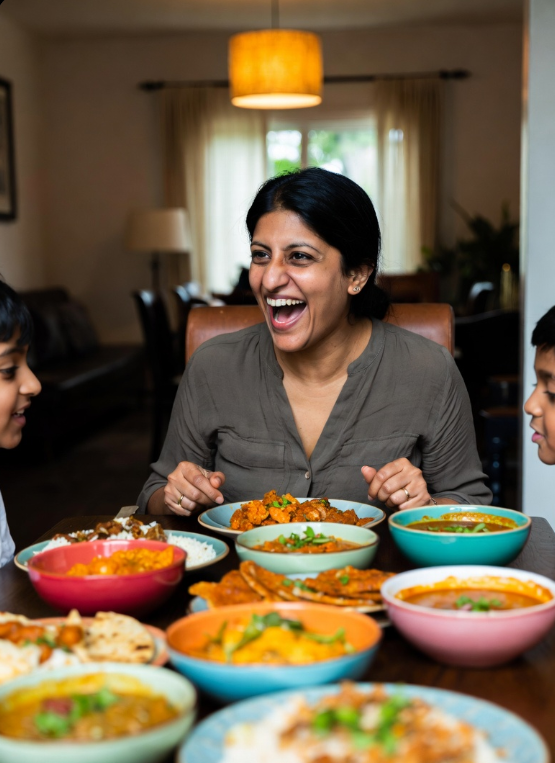
I went to their house after work on Tuesday — day two, Durga's domain — and found Amma making a spread that would feed twenty people despite there being four of us. Spicy sundal (chickpeas tempered with red chilies and curry leaves), drumstick sambar, curry leaf rice, and vadai so crispy they shattered when you bit into them. The kitchen smelled like a temple — camphor and ghee and roasting spices.
Amma was in her element. There's a version of my mother that only appears during festivals — a version that is joyful and commanding and absolutely certain of her purpose. She moves through the kitchen like a dancer, each motion precise and practiced, and the food that comes from this state is transcendent. It's the difference between someone who cooks and someone who is called to it.
I watched her make the sundal. She didn't measure the chickpeas or the spices or the coconut. She moved by feel — a handful of this, a pinch of that, the chickpeas going into the pan at exactly the moment the oil shimmered. I wrote it all down, estimating quantities, noting the color of the oil, the sound of the mustard seeds, the exact shade of brown the curry leaves turned before she added the chickpeas.
She caught me writing and said, "Are you still doing that?"
"Still doing what?"
"Writing down my cooking like it's a textbook."
"It's important, Amma."
"It's just food, Priya."
It's never just food. She knows that. She's the one who taught me that. But admitting that your cooking is worth preserving would require a kind of self-regard that Lakshmi Krishnamurthy does not permit herself.
I brought the sundal recipe home and made it for Raj, who is Gujarati and therefore observes Navaratri differently (they do garba — the folk dance — and eat fasting foods). He ate the sundal and said, "This is your mom's." Not a question. He can tell. Amma's food has a signature — a depth of flavor that comes from decades of practice — and mine is close but not there yet.
"Getting closer," I said.
"You always say that."
"Because it's always true."
I came home from Amma’s kitchen thinking about legumes and patience and the particular kind of knowledge that lives in someone’s hands. Sundal is hers to carry; this is mine to practice with—mujadarra, a dish from a different tradition entirely, but built on the same philosophy: simple ingredients, unhurried heat, and the faith that something humble can become something worth savoring. Like Amma’s sundal, it asks you to slow down and pay attention. Like Amma’s cooking, it rewards you when you do.
Mujadarra
Prep Time: 10 min | Cook Time: 50 min | Total Time: 1 hr | Servings: 4–6
Ingredients
- 1 cup green or brown lentils, rinsed and picked over
- 1/2 cup long-grain white rice, rinsed
- 3 large yellow onions, halved and thinly sliced
- 1/3 cup olive oil, divided
- 3 cups water or vegetable broth, plus more as needed
- 1 teaspoon ground cumin
- 1/2 teaspoon ground coriander
- 1/4 teaspoon ground cinnamon
- 1 teaspoon kosher salt, plus more to taste
- 1/2 teaspoon freshly ground black pepper
- Fresh flat-leaf parsley, roughly chopped, for serving
- Plain yogurt or lemon wedges, for serving (optional)
Instructions
- Caramelize the onions. Heat 1/4 cup of the olive oil in a large heavy-bottomed skillet or Dutch oven over medium heat. Add the sliced onions and a pinch of salt. Cook, stirring occasionally, for 35–45 minutes until the onions are deeply golden brown and jammy. Do not rush this step—the sweetness they develop is the backbone of the dish. Set aside half the onions on a paper-towel-lined plate for topping.
- Bloom the spices. To the remaining onions still in the pot, add the remaining olive oil, cumin, coriander, cinnamon, salt, and pepper. Stir over medium heat for 1–2 minutes until fragrant.
- Cook the lentils. Add the rinsed lentils and 3 cups of water or broth to the pot. Bring to a boil, then reduce heat to a gentle simmer. Cook uncovered for 15 minutes, stirring occasionally, until lentils are just beginning to soften.
- Add the rice. Stir in the rinsed rice and add a splash more liquid if the pot looks dry. Cover and cook on low heat for 15–18 minutes, until the rice is tender and has absorbed the liquid. Remove from heat and let steam, covered, for 5 minutes.
- Finish and serve. Fluff gently with a fork and taste for seasoning. Transfer to a serving platter and top with the reserved caramelized onions and a generous handful of fresh parsley. Serve warm with yogurt or lemon wedges alongside.
Nutrition (per serving)
Calories: 310 | Protein: 11g | Fat: 13g | Carbs: 40g | Fiber: 9g | Sodium: 290mg
About the cook who shared this
Priya Krishnamurthy
Week 27 of Priya’s 30-year story
· Edison, New Jersey
Priya is a pharmacist, wife, and mom of two in Edison, New Jersey — the town she grew up in, surrounded by the sights and smells of her mother's South Indian kitchen. These days, she splits her time between the hospital pharmacy, school pickups, and her own kitchen, where she cooks nearly every night. Her style is a blend of the Tamil recipes her mother taught her and the American comfort food her kids actually want to eat. She writes about the beautiful mess of balancing two cultures on one plate — and she wants you to know that ordering pizza is also an act of love.
