
 By
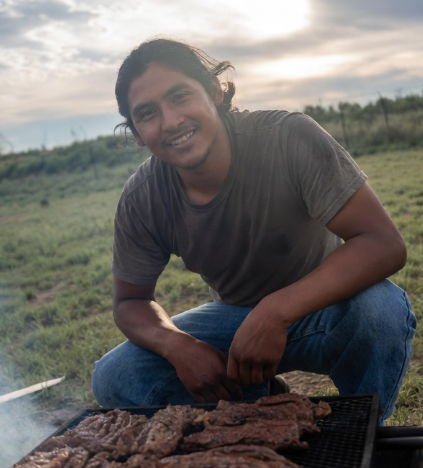
By My daughter Luna is three weeks old today. She’s asleep on my wife Hannah’s chest in the living room, and my son Kai is running laps around the coffee table the way three-year-olds do when someone tells them not to, and my mother is standing in my kitchen telling me I’m heating the oil wrong. She’s been telling me I heat the oil wrong for about fifteen years. She’s probably right.
My name is Jesse Ray Whitehawk. I’m twenty-nine years old, I’m Cherokee and Mexican and Oklahoma-born, and I make fry bread tacos on Sundays the way my mother made them when I was growing up in Turley—a neighborhood in North Tulsa that most people in south Tulsa have never heard of and wouldn’t recognize if they drove through it. We lived in a small house on a street where everybody’s truck was ten years old and nobody locked their doors. It was a good place to grow up, which I know because I didn’t appreciate it until I was old enough to understand what we had.
My father was Danny Whitehawk—Cherokee Nation citizen, Sinclair refinery worker, the best pitmaster in a four-block radius. My mother was Teresa Morales, who everybody called Terry, a certified nursing assistant who worked doubles more often than not and still somehow had dinner on the table every night of my childhood. They were two people who had no business working as well together as they did, and their kitchen was the proof. My dad’s people were Cherokee going back further than records exist—Whitehawks who walked the Trail of Tears and came out the other side and kept going, generation after generation, refusing to stop. My mother’s family came up from Texas in the 1950s, following agricultural work, landing in McAlester, and eventually landing in Turley when Terry met Danny at a community dance and decided she was staying.
What they created in that kitchen was something I didn’t have a name for until Hannah gave me one. She calls it survivance food—food that carries the history of people who weren’t supposed to make it. My dad would have just called it dinner.
My mother made fry bread stuffed with seasoned ground beef and beans, topped with shredded cheese and tomatoes and whatever else was in the refrigerator. She made it the same way her mother-in-law had made it, which was probably the same way her mother-in-law had made it, a chain of women frying dough in cast iron going back to when the U.S. government handed out flour and lard to Cherokee families whose food systems had been deliberately destroyed. Fry bread is not ancient. It was born from deprivation—from commodity rations, from reservation life, from the federal government deciding what Native people would eat because it had already decided everything else about their lives.
Hannah taught me that. She works for the Cherokee Nation’s nutrition program, and when we started dating she had a lot of opinions about fry bread that she shared with the particular intensity of someone who has done the reading and cannot unknow what she knows. She wasn’t wrong. Fry bread is flour and fat and the grief of colonization, and you can write a dissertation about what it means that it became one of the most recognizable “Indian foods” in America. A lot of people have written that dissertation.
I love fry bread anyway. My dad loved fry bread. That’s tradition enough for me.
There’s a version of this story where I apologize for that. Where I spend three paragraphs explaining the complicated politics and footnoting every claim and performing the correct ambivalence. Hannah is much better at that version than I am, and if you want it, she writes about traditional Cherokee foodways and indigenous food sovereignty in ways that will actually teach you something. What I can tell you is what it was like to be twelve years old in a North Tulsa kitchen watching my mother fry bread while my dad sat at the table with his oxygen tank—he’d had the accident at the refinery that year, the chemical leak that wrecked his lungs and ended his career—and the smell of hot oil and cumin filled the house and for an hour nothing was wrong. The refinery hadn’t poisoned him. The workers’ comp settlement wasn’t insultingly small. We weren’t figuring out how to be a working-class family on one income instead of two. It was just dinner. It was just my mother’s hands pressing dough.
My dad died some. Not completely. He kept going, the way Whitehawks keep going. He sat at that table for years, watching my mother cook, and when his lungs allowed it he’d give instructions. More cumin. The oil’s too hot, Terry. Let the dough rest longer. He was a man who had opinions about everything and who expressed most of them at low volume, quietly, the way Cherokee men often do—not cold, just considered. He was the best person I knew. I’m still figuring out how to be half the father he was, and he did it half-broken.
I became a welder after high school—practical decision, the Cherokee Nation’s education program helped cover tuition at Tulsa Community College, welders make good money in Oklahoma. I work pipeline now, which is its own kind of complicated when you’re a Cherokee man and you’ve had that conversation with your wife more than once. But the pay is solid and the benefits cover a newborn daughter and a three-year-old son and a family that needs feeding. I work with fire all day. I come home and I cook with fire at night. There’s something in that I haven’t fully worked out yet.
Hannah and I got married in 2011. She’s full-blood Cherokee, from Jay, and she’s spent years teaching me about the traditional foods I should have grown up knowing—kanuchi, which is a hickory nut soup, and corn soup, and bean bread, and the wild onions that Cherokee families harvest every spring from the creek banks and the designated gathering areas. I’ve been learning. I’m slower at it than I wish I was. But I know that food is memory, and memory is survival, and survival is what my family has always been about.
So I make kanuchi now. I make wild onion dishes in the spring. I smoke venison the way my dad would have if his lungs had held out. And on Sundays, I make fry bread tacos, because my mother is standing in my kitchen telling me the oil is wrong and Kai is running circles around everything and there’s a baby asleep on her mother’s chest who I want to know where she comes from. This is where she comes from. This dough, this oil, this cast iron pan that was my mother’s before it was mine.
My mother’s version uses ground beef seasoned with cumin, chili powder, and garlic—flavors that are more Mexican than Cherokee, but that’s the point. Her kitchen was never one thing. She added a can of pinto beans to the meat because beans stretch a pound of beef when money is tight and you have three kids and a husband who can’t work. She topped it with shredded cheddar and diced tomatoes and shredded lettuce and a spoonful of sour cream. You could call it a taco. You could call it an Indian taco. You could call it the thing that made Sundays survivable for a family that needed something to survive for. All three are correct.
The bread itself is the thing. You have to respect the bread. It wants a soft, pillowy interior and an exterior with some gold to it—not dark, not pale, but that particular amber that means the oil was right and the time was right and you didn’t rush it. My mother can tell by sound. I’m getting there. The dough is forgiving in the way that working-class food tends to be—it doesn’t require precision so much as presence. You have to be in the kitchen. You have to be paying attention. That’s the recipe, really. The rest is just measurements.
Kai just ran into the kitchen and told me his tummy is loud. Luna woke up and is making the small sounds that mean she’s working up to something bigger. My mother is still standing by the stove and I am still, apparently, heating the oil wrong.
Let’s eat.
But before the oil heats and the dough hits the pan and the whole house smells like what Sundays are supposed to smell like, there’s this: a cup. Just espresso and oat milk, nothing fancy, made in the five minutes before Kai starts pulling at my sleeve and my mother starts telling me what I’m doing wrong. It’s the only quiet I get, and I guard it. Here’s how I make it.
Oat Milk Latte
Prep Time: 5 min | Cook Time: — | Total Time: 5 min | Servings: 1
Ingredients
- 2 espresso shots (2 ounces or 1/2 cup, or substitute strong coffee)
- 4 ounces (1/2 cup) oat milk (double for two servings when steaming)
Instructions
- Make the espresso using an espresso machine, manual espresso maker, French press, or Moka Pot. Go to How to Make Espresso for instructions.
- Steam the milk with an espresso machine, or heat and then froth the milk using your method of choice (milk frother, French press, whisk or covered jar). It’s easiest to steam or froth 1 cup of milk for 2 drinks. Go to How to Steam Milk or How to Froth Milk for details on each.
- Pour the milk into the center of the espresso, ending with light foam (using half the steamed or frothed milk for 1 drink).
Nutrition (per serving)
Not available for this recipe.