
 By
By The third week, and the house has found its grooves — not comfortable ones, but grooves, the channels that routine carves when you repeat something enough times that it stops feeling wrong and starts feeling inevitable. Kevin at the table by eight. Noah in his room by eight-thirty, headphones on, school through a screen. Emma at the kitchen counter (she moved from her room — "better light," she said, which means better access to snacks). Jack in the garden by nine, because school for Jack happens in two-hour bursts between agricultural operations and nobody is going to argue with a nine-year-old who can calculate germination rates but finds fractions "unnecessary."
I'm working from home too — crop insurance can be done remotely for now, the assessments paused, the paperwork continuing, the phone calls with farmers who are worried about planting season and market prices and whether the world is ending replacing the kitchen-table visits that are my actual job. I miss the visits. I miss sitting across from a farmer and looking him in the eye and delivering numbers that mean something to someone who works the land. The phone is not the same. The phone doesn't let you put a hand on someone's arm when the numbers are bad.
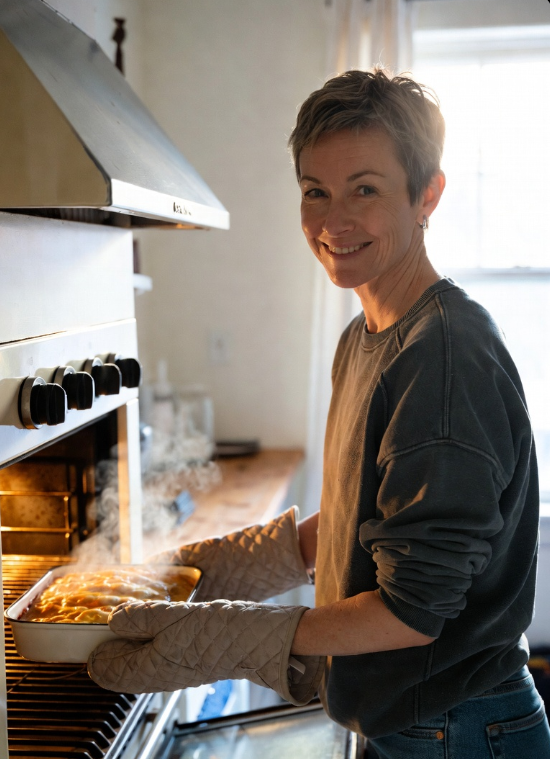
I baked my first sourdough loaf. Marlene the starter was ready — bubbly, active, doubled in four hours, the sign that the wild yeast has colonized the jar and is ready to work. The bread took two days: mix, fold, rest, fold, rest, shape, proof overnight in the refrigerator, bake in the Dutch oven at 450 degrees with the lid on for thirty minutes, lid off for fifteen. The loaf that came out was — I don't have the right word. It was round and golden and cracked on top, the crust dark and crunchy, the crumb open and airy with holes that meant the yeast had worked, that the time had worked, that the waiting had worked. I cut it. The knife made the sound that good bread makes — the crackle, the resistance, the surrender. I ate a slice with butter and salt. The taste was sour and deep and alive, and I stood in my kitchen during a pandemic eating bread made from wild yeast and I thought: this is what I know how to do. This is what my mother taught me. You take what you have. You feed it. You wait. Something grows.
Kevin tried the bread and said, "This is the best bread you've made." He's right. It is. The sourdough is better than the yeasted bread because the sourdough required more patience and more faith and more time, and the things that require more of you always taste better than the things that don't.
Marlene the starter taught me something I already knew but had forgotten: that waiting is not wasted time, it’s the work. The sourdough proved overnight in the refrigerator, and the loaf that came out the next morning was evidence that patience compounds. When I had a thick heel of that first golden loaf left over two days later — too good to waste, too sturdy to eat plain — I built this French toast around it, because it deserved one more night of slow transformation. You can use any good bread here, but if you happen to have a homemade sourdough loaf on hand, use it: it will do exactly what good bread always does, which is get better the more you ask of it.
Overnight Apple French Toast
Prep Time: 20 min | Cook Time: 55 min | Total Time: 8 hr 15 min (includes overnight rest) | Servings: 8
Ingredients
- 1 loaf (about 1 lb) thick-sliced sourdough or sturdy white bread, cut into 1-inch cubes (about 10 cups)
- 3 medium apples, peeled, cored, and thinly sliced
- 1/2 cup packed brown sugar, divided
- 1 teaspoon ground cinnamon, divided
- 1/4 teaspoon ground nutmeg
- 6 large eggs
- 2 cups whole milk
- 1/2 cup heavy cream
- 2 tablespoons pure maple syrup, plus more for serving
- 1 teaspoon pure vanilla extract
- 4 tablespoons unsalted butter, cut into small pieces, divided
- 1/4 teaspoon fine salt
Instructions
- Prepare the pan. Butter a 9x13-inch baking dish generously. Arrange the bread cubes in an even layer in the prepared dish.
- Cook the apples. In a medium skillet over medium heat, melt 2 tablespoons of the butter. Add the apple slices, 1/4 cup of the brown sugar, 1/2 teaspoon cinnamon, and the nutmeg. Cook, stirring occasionally, for 5 to 7 minutes until the apples are just tender and the sugar has melted into a light syrup. Scatter the apple mixture evenly over the bread cubes.
- Make the custard. In a large bowl, whisk together the eggs, milk, heavy cream, maple syrup, vanilla, salt, remaining 1/2 teaspoon cinnamon, and remaining 1/4 cup brown sugar until smooth and fully combined.
- Soak overnight. Pour the custard evenly over the bread and apples, pressing the bread gently to help it absorb the liquid. Scatter the remaining 2 tablespoons of butter pieces over the top. Cover tightly with plastic wrap and refrigerate for at least 8 hours or overnight.
- Bake. When ready to bake, remove the dish from the refrigerator and let it sit at room temperature for 20 minutes while you preheat the oven to 350°F. Uncover the dish and bake for 50 to 55 minutes, until the top is deep golden brown and the custard is fully set in the center. A knife inserted in the middle should come out clean.
- Rest and serve. Let the French toast rest for 5 minutes before cutting. Serve warm, drizzled with additional maple syrup.
Nutrition (per serving)
Calories: 390 | Protein: 12g | Fat: 16g | Carbs: 51g | Fiber: 3g | Sodium: 370mg