Paul finished the school year. His last school year, though he doesn't know that yet — or maybe he does, and we're both pretending he might teach again in the fall because the pretending is a kindness we give each other.
He came home Friday with the box of papers and the gift card and the look. But the look was different this year. Not liberation — something softer. Something that looked like goodbye, even if he called it "see you in September."
The students gave him a card — one big card, signed by every sophomore in his American history classes. I read it while he was in the shower. The messages: "Best teacher ever." "You made history real." "I'll never forget the Fitzgerald story." "Thank you, Mr. Johansson." Two hundred names. Two hundred goodbyes disguised as thank-yous.
Paul doesn't know if he'll go back in the fall. His right arm is weaker. Writing on the whiteboard is harder. Standing for an hour-long lecture is still possible but tiring. The principal has been accommodating — a teaching assistant for the physical tasks, a stool at the front of the room — but Paul is a man who teaches with his whole body, who paces, who gestures, who writes on the board with the sweeping strokes of a man who believes that handwriting matters, and the body that does those things is changing faster than the accommodations can keep up.
We'll decide in August. That's what we said. We'll decide in August. The August decision sits on the horizon like a storm — visible, approaching, unavoidable.
I made a last-day-of-school dinner: macaroni and cheese, Paul's comfort food, baked with sharp cheddar and breadcrumbs, golden and bubbling. Not Swedish. Not health food. Not anything except warm and filling and the kind of food that says: you made it through another year. Rest now.
Paul ate a large portion and said, "Thirty-three years, Linda." I said, "I know." He said, "That's a lot of sophomores." I said, "That's a lot of shipwreck lessons." He smiled. "They love the shipwrecks." They do. They always have. Because Paul doesn't teach shipwrecks. He teaches loss and courage and Lake Superior's indifference and the human insistence on sailing into it anyway.
Summer. His possibly last summer as a teacher. The light is long. The garden is growing. The ore boats are running. Paul is home.
For now, that's enough.
When Paul walked through the door with that box of papers, I already knew what dinner had to be — no deliberation, no recipe search, just the certainty that only his comfort food would do. Baked macaroni and cheese has been his since long before I knew him, and on a night that felt like both an ending and a not-quite-ending, I wanted something that asked nothing of him except to sit down and eat. This is the version I make when the occasion is too large for words: sharp cheddar melted into a creamy sauce, topped with buttered breadcrumbs that go golden in the oven, warm and filling and exactly enough.
Baked Macaroni and Cheese
Prep Time: 20 minutes | Cook Time: 30 minutes | Total Time: 50 minutes | Servings: 6
Ingredients
- 1 lb elbow macaroni
- 4 tablespoons unsalted butter, divided
- 3 tablespoons all-purpose flour
- 2 1/2 cups whole milk, warmed
- 1/2 cup heavy cream
- 2 1/2 cups sharp cheddar cheese, freshly shredded, divided
- 1/2 cup Gruyère cheese, shredded
- 1 teaspoon Dijon mustard
- 1/2 teaspoon garlic powder
- 1/2 teaspoon onion powder
- 1/4 teaspoon cayenne pepper
- 3/4 teaspoon kosher salt, plus more for pasta water
- 1/4 teaspoon black pepper
- 3/4 cup panko breadcrumbs
- 2 tablespoons fresh parsley, chopped (optional)
Instructions
- Preheat and prep. Preheat your oven to 375°F. Grease a 9x13-inch baking dish and set aside.
- Cook the pasta. Bring a large pot of salted water to a boil. Cook elbow macaroni 2 minutes less than package directions (it will finish cooking in the oven). Drain and set aside.
- Build the roux. In a large saucepan over medium heat, melt 3 tablespoons of butter. Whisk in the flour and cook, stirring constantly, for 1—2 minutes until the mixture turns lightly golden and smells nutty.
- Make the béchamel. Gradually whisk in the warmed milk and heavy cream, pouring in a slow, steady stream. Continue whisking over medium heat for 4—5 minutes until the sauce thickens enough to coat the back of a spoon.
- Add the cheese. Remove the saucepan from heat. Stir in 2 cups of the sharp cheddar and all of the Gruyère until fully melted and smooth. Season with Dijon mustard, garlic powder, onion powder, cayenne, salt, and pepper.
- Combine. Add the drained macaroni to the cheese sauce and stir until every piece is evenly coated. Pour the mixture into the prepared baking dish and spread into an even layer.
- Top it. In a small bowl, melt the remaining 1 tablespoon of butter and toss with the panko breadcrumbs until coated. Scatter the remaining 1/2 cup of shredded cheddar evenly over the pasta, then top with the buttered breadcrumbs.
- Bake. Bake uncovered for 25—30 minutes, until the top is deep golden brown and the edges are bubbling. Let rest 5 minutes before serving. Scatter fresh parsley over the top if desired.
Nutrition (per serving)
Calories: 620 | Protein: 26g | Fat: 28g | Carbs: 66g | Fiber: 3g | Sodium: 540mg
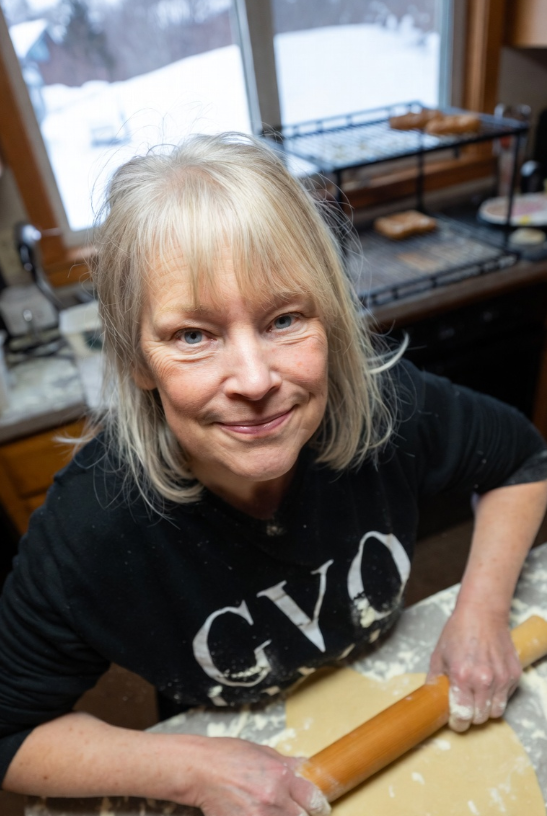
About the cook who shared this
Linda Johansson
Week 118 of Linda’s 30-year story
· Duluth, Minnesota
Linda is a sixty-three-year-old retired nurse from Duluth, Minnesota, living alone in the house where she raised her children and said goodbye to her husband. She lost Paul to ALS in 2020 after two years of watching the kindest man she'd ever known lose everything but his dignity. She cooks Scandinavian comfort food and Minnesota hotdish and the pot roast Paul loved, and she sets two places at the table out of habit because it makes her feel less alone. Every recipe she writes is a person she's loved.
