I lost a patient this week. I won't use her name — that's hers, not mine — but I'll say she was sixty, and she was funny, and she had ovarian cancer that had spread everywhere, and she fought it for eighteen months with the kind of fierce stubbornness that I recognized because I'm Scandinavian and we practically invented fierce stubbornness.
She died on a Tuesday afternoon with her daughter holding her left hand and me holding her right. The daughter looked at me afterward and said, "Thank you for making it not terrible." I said, "You made it not terrible. I was just here." Both of these things were true.
I went to the break room afterward and sat for five minutes and then I went back to work because that's what nurses do. We sit with death for five minutes and then we check on the living. It's not callousness. It's the opposite. It's knowing that the living need you now and the dead don't, and you serve the living by getting up.
Paul knows when I've lost someone. He reads it on my face the way a sailor reads clouds — subtle signs that most people miss but that he's been studying for twenty-eight years. He didn't say anything when I got home. He had Sven and a pot of coffee waiting and he let me sit in the kitchen in silence until I was ready to talk, which was about forty-five minutes, and then I said, "It was a bad one," and he said, "I'm sorry," and that was the whole conversation and it was exactly enough.
I cooked. Not immediately — I needed the silence first — but later, around seven, I stood in the kitchen and made beef stew. Paul's beef stew, the one I make when I need to stand at the stove for two hours and do something with my hands. Chuck roast, browned in batches because you don't crowd the pot (this is the rule, and I will fight anyone who says otherwise). Onions, carrots, celery, potatoes, beef stock, a splash of red wine, thyme, bay leaves. It simmers for two hours and the house fills with a smell that is so fundamentally "home" that it pushes everything else out.
Paul had two bowls with thick slices of bread — not my rye bread, just good bakery bread from Positively Third Street — and he sopped up the gravy the way his father used to, which I know because Paul's father did the same thing at every family dinner until he died in 2002, and Paul inherited the gesture the way you inherit eye color or a tendency toward bad jokes.
Some weeks are hard. Some weeks the weight of what I carry at work — other people's pain, other people's endings — sits on my shoulders like a second coat. And some weeks the stew and the bread and the man at the table are enough to lift it. This was one of those weeks. Not because the grief went away, but because the stew and Paul and Sven and the sound of the house at night reminded me that I'm not just a nurse. I'm a wife and a mother and a woman who makes very good beef stew, and those things count too.
Weeks like this one — the kind where work follows you home and sits down at the table with you — call for something slow and certain, something that doesn’t require decisions so much as patience. Paul’s beef stew is exactly that: it’s been on our stove more times than I can count, and every time it does the same quiet work of making the house smell like itself again. Here’s how I make it.
Paul’s Beef Stew
Prep Time: 20 minutes | Cook Time: 2 hours 15 minutes | Total Time: 2 hours 35 minutes | Servings: 6
Ingredients
- 2 1/2 lbs chuck roast, cut into 1 1/2-inch cubes
- 2 tablespoons vegetable oil, divided
- 1 1/2 teaspoons kosher salt, plus more to taste
- 1/2 teaspoon black pepper
- 2 tablespoons all-purpose flour
- 1 large yellow onion, roughly chopped
- 3 medium carrots, cut into 1-inch pieces
- 3 celery stalks, sliced 1/2 inch thick
- 2 tablespoons tomato paste
- 1/2 cup dry red wine
- 3 cups beef stock
- 1 lb Yukon Gold potatoes, cut into 1-inch cubes
- 3 sprigs fresh thyme (or 1 teaspoon dried)
- 2 bay leaves
Instructions
- Season and coat the beef. Pat the chuck roast cubes dry with paper towels — this is not optional; moisture is the enemy of a good sear. Toss with salt, pepper, and flour until lightly coated on all sides.
- Brown in batches — do not crowd the pot. Heat 1 tablespoon of oil in a large Dutch oven or heavy-bottomed pot over medium-high heat until shimmering. Add the beef in a single layer, leaving space between pieces. Sear without moving for 3 to 4 minutes per side until deeply browned. Work in 2 to 3 batches, adding more oil as needed. Transfer browned beef to a plate and set aside.
- Build the base. Reduce heat to medium. Add the onion, carrots, and celery to the pot. Cook, stirring occasionally and scraping up any browned bits from the bottom, for 5 minutes until the onion is softened. Stir in the tomato paste and cook for 1 minute.
- Deglaze with wine. Pour in the red wine and stir, scraping the bottom of the pot clean. Let it bubble and reduce for 2 minutes.
- Simmer low and slow. Return the beef and any accumulated juices to the pot. Add the beef stock, thyme, and bay leaves. The liquid should just barely cover the meat — add a splash more stock if needed. Bring to a gentle boil, then reduce heat to low, cover, and simmer for 1 hour 30 minutes.
- Add the potatoes. Stir in the potatoes. Cover and continue simmering for 30 to 35 minutes, until the potatoes are tender and the beef yields easily when pressed with a spoon.
- Finish and serve. Remove the thyme sprigs and bay leaves. Taste and adjust salt. The broth should be slightly thickened from the flour and the long simmer. Serve in deep bowls with thick slices of good bread alongside for sopping up the gravy.
Nutrition (per serving)
Calories: 430 | Protein: 36g | Fat: 19g | Carbs: 24g | Fiber: 3g | Sodium: 670mg
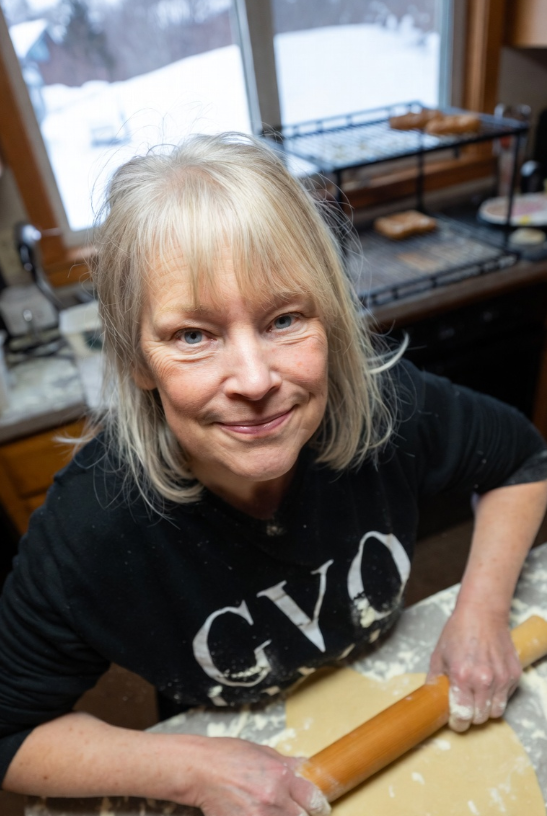
About the cook who shared this
Linda Johansson
Week 18 of Linda’s 30-year story
· Duluth, Minnesota
Linda is a sixty-three-year-old retired nurse from Duluth, Minnesota, living alone in the house where she raised her children and said goodbye to her husband. She lost Paul to ALS in 2020 after two years of watching the kindest man she'd ever known lose everything but his dignity. She cooks Scandinavian comfort food and Minnesota hotdish and the pot roast Paul loved, and she sets two places at the table out of habit because it makes her feel less alone. Every recipe she writes is a person she's loved.
