Amma's cognitive follow-up. The number I've been dreading.
Thirteen out of thirty.
The decline is accelerating. From fifteen to thirteen in six months. The donepezil and memantine are doing what they can — Dr. Anand says without them the score might be single digits — but the disease is advancing.
Thirteen means: she forgets Arvind's name sometimes (she recovers, but the forgetting is more frequent). She asks what day it is multiple times. She puts dishes in the washing machine instead of the dishwasher. She gets confused in stores, in parking lots, in places that aren't her kitchen.
But she still cooks. At thirteen out of thirty, she still makes sambar. The fortress holds. The procedural memory — the deep, ancient, body-knowing — is the last territory, and it's holding.
Dr. Anand discussed long-term care options. "We should start planning," he said. "Not because she needs it now, but because the day may come."
Memory care. The words sat in the room like a cold draft.
Arvind and I talked in the parking lot. "Not yet," he said, the same thing he said last time.
"Not yet," I agreed. "But soon, Arvind. We have to plan."
"I know. I just — I can't think about Amma in a place that isn't her kitchen."
"Neither can I."
We stood in the parking lot — the sister and the brother, the good daughter and the prodigal son — and we didn't cry because we've done that already and now we plan. We plan because planning is the alternative to breaking.
I made her sambar. The Sunday version. The anchor. The sambar that doesn't know about thirteen, that doesn't know about memory care, that doesn't know about anything except: toor dal, tamarind, tomato, drumstick, the pop of mustard seeds, the sizzle of curry leaves.
The sambar doesn't know. The sambar is right. That has to be enough.
Thirteen. The fortress holds. The planning begins.
Arvind and I drove separately back to Amma’s house that afternoon, and I made her sambar — but I also made this for us, because the sambar was hers and we needed something that was ours. There are days when you need a recipe that asks nothing of you emotionally, that rewards you with something nourishing and green and quietly good, and that afternoon in her kitchen was one of those days. Pesto quinoa is what I reach for when I need to feel capable of feeding someone I love without falling apart doing it — it’s steady, it’s simple, and it holds.
Pesto Quinoa Recipe
Prep Time: 10 minutes | Cook Time: 20 minutes | Total Time: 30 minutes | Servings: 4
Ingredients
- 1 1/2 cups quinoa, rinsed
- 2 3/4 cups low-sodium vegetable broth
- 1/2 cup prepared basil pesto (store-bought or homemade)
- 1 cup cherry tomatoes, halved
- 1/2 cup canned chickpeas, drained and rinsed
- 1/4 cup toasted pine nuts
- 2 tablespoons fresh lemon juice
- 1/4 cup freshly grated Parmesan cheese (optional)
- Salt and black pepper to taste
- Fresh basil leaves, for garnish
Instructions
- Cook the quinoa. Combine rinsed quinoa and vegetable broth in a medium saucepan. Bring to a boil over medium-high heat, then reduce heat to low, cover, and simmer for 15 minutes until liquid is absorbed and quinoa tails have unfurled. Remove from heat and let steam, covered, for 5 minutes.
- Fluff and cool slightly. Uncover the quinoa and fluff with a fork. Let it rest for 3–4 minutes so it is warm but not steaming.
- Add the pesto. Stir in the basil pesto and lemon juice, folding gently until every grain is coated. Taste and adjust seasoning with salt and black pepper.
- Fold in the mix-ins. Add the cherry tomatoes, chickpeas, and pine nuts, folding gently to distribute throughout the quinoa.
- Finish and serve. Transfer to a serving bowl or individual plates. Top with Parmesan if using and a scattering of fresh basil leaves. Serve warm or at room temperature.
Nutrition (per serving)
Calories: 420 | Protein: 14g | Fat: 18g | Carbs: 52g | Fiber: 6g | Sodium: 390mg
About the cook who shared this
Priya Krishnamurthy
Week 319 of Priya’s 30-year story
· Edison, New Jersey
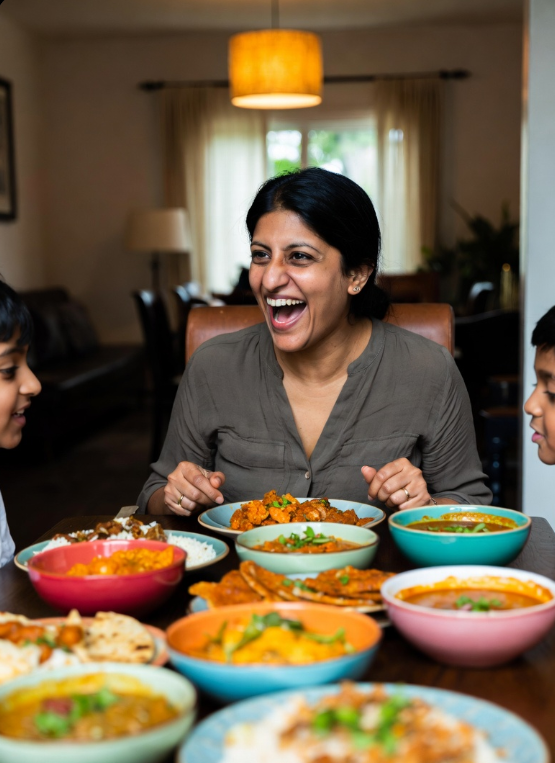
Priya is a pharmacist, wife, and mom of two in Edison, New Jersey — the town she grew up in, surrounded by the sights and smells of her mother's South Indian kitchen. These days, she splits her time between the hospital pharmacy, school pickups, and her own kitchen, where she cooks nearly every night. Her style is a blend of the Tamil recipes her mother taught her and the American comfort food her kids actually want to eat. She writes about the beautiful mess of balancing two cultures on one plate — and she wants you to know that ordering pizza is also an act of love.
