The week after Christmas. The house emptied, as it does. Anna's family drove back on the 27th. Peter stayed until the 28th — two extra days, which I counted like coins. Elsa went home to her apartment. Erik took Mamma to Fifth Street. The house that held twelve held two, plus a dog.
Paul was tired after Christmas. Not just the regular tired — a deeper fatigue, the kind that comes from a body working harder to do less. He slept until nine on the 26th, which is unprecedented for a man who has woken at six his entire adult life. I let him sleep. I sat in the kitchen with coffee and the monitor beeping from the bedroom and I listened to him breathe and the breathing was the best sound in the house.
New Year's Eve: just us. No hot toddies this year — Paul can't hold a glass and I didn't feel like drinking alone. We sat in the living room — Paul in his wheelchair, me on the couch, Sven between us on the floor — and watched the countdown on television and at midnight I leaned over and kissed him and said, "Another year, Paul." He said, "Another year, Linda."
The same words. Every year. But this year his voice cracked on "Linda" and my lips trembled on "Paul" and the words were heavier than they've ever been because "another year" used to mean continuation and now it means: how many more? How many more "another years" do we have? The math is cruel. Two to five years from diagnosis. We're at year one. The math says one to four more.
I won't do the math. I said I wouldn't do the math. I won't.
New Year's Day: I took down the Christmas decorations. Not the advent star — the star stays, always, it's permanent now — but the tree and the ornaments and the garland. The tree was dry and shedding needles and Paul said, "That tree lasted longer than expected." I said, "So do most of us."
I made a New Year's dinner: roast pork with crackling. The same meal I made last year and the year before. Paul ate pureed pork — blended with the pan juices and a little cream, smooth enough to swallow without chewing, because chewing is getting harder, the jaw muscles weakening, and the nurse in me adapts and the cook in me adapts and the food changes shape to match the body.
Pureed pork with crackling. It sounds wrong. It tasted right. Paul said, "Happy new year, Linda." I said, "Happy new year, Paul."
2019. The year ahead. I don't know what it holds. I know what the disease holds — more loss, more adaptation, more equipment, more caring. But I also know what I hold: the recipes, the kitchen, the family, the dog, the lake, the man in the wheelchair who still knows the name of every ship on the horizon.
Another year. Together. Into the storm.
I have always believed that a recipe is not a fixed thing — it is a living instruction, and it bends when the people at the table need it to. This year, roast pork became pureed pork, blended smooth with pan juices and a pour of cream, and it was still a New Year’s dinner, still an act of love. Pheasant in Cream Sauce is the recipe that lives closest to that spirit in my kitchen: it is already halfway there, already rich and soft and yielding, the kind of dish that asks almost nothing of the person eating it. It is what I reach for when the food needs to do the holding.
Pheasant in Cream Sauce
Prep Time: 15 min | Cook Time: 50 min | Total Time: 1 hr 5 min | Servings: 4
Ingredients
- 1 whole pheasant (about 2 1/2 lbs), cut into pieces (or 4 bone-in pheasant thighs)
- 2 tablespoons unsalted butter
- 1 tablespoon olive oil
- 1 medium yellow onion, finely diced
- 2 cloves garlic, minced
- 1/2 cup dry white wine
- 3/4 cup chicken broth
- 1 cup heavy cream
- 1 teaspoon fresh thyme leaves (or 1/2 teaspoon dried)
- 1 teaspoon Dijon mustard
- Salt and white pepper to taste
- Fresh flat-leaf parsley, chopped, for serving
Instructions
- Season and sear. Pat pheasant pieces dry and season generously with salt and white pepper. In a large heavy skillet or Dutch oven, melt butter with olive oil over medium-high heat. Add pheasant pieces skin-side down and sear without moving for 4–5 minutes until deep golden. Flip and sear the other side for 3 minutes. Transfer to a plate and set aside.
- Build the base. Reduce heat to medium. In the same pan, add the diced onion and cook, stirring occasionally, for 5 minutes until softened and translucent. Add garlic and thyme and stir for 1 minute until fragrant.
- Deglaze. Pour in the white wine, scraping up any browned bits from the bottom of the pan. Let it bubble and reduce by half, about 2 minutes.
- Add liquids and simmer. Pour in the chicken broth and stir in the Dijon mustard. Return the seared pheasant pieces to the pan, nestling them into the liquid. Bring to a gentle simmer, cover, and cook over low heat for 25–30 minutes, until the pheasant is cooked through and tender.
- Finish the sauce. Transfer pheasant pieces back to the plate. Pour the heavy cream into the pan and increase heat to medium. Simmer uncovered for 5–7 minutes, stirring occasionally, until the sauce thickens enough to coat a spoon. Taste and adjust seasoning.
- Serve. Return pheasant to the sauce and warm through for 2 minutes. Spoon generously over egg noodles, mashed potatoes, or soft polenta. Scatter parsley over the top. To serve pureed, blend the cooked meat with a ladle of the cream sauce until completely smooth.
Nutrition (per serving)
Calories: 430 | Protein: 36g | Fat: 28g | Carbs: 5g | Fiber: 0g | Sodium: 390mg
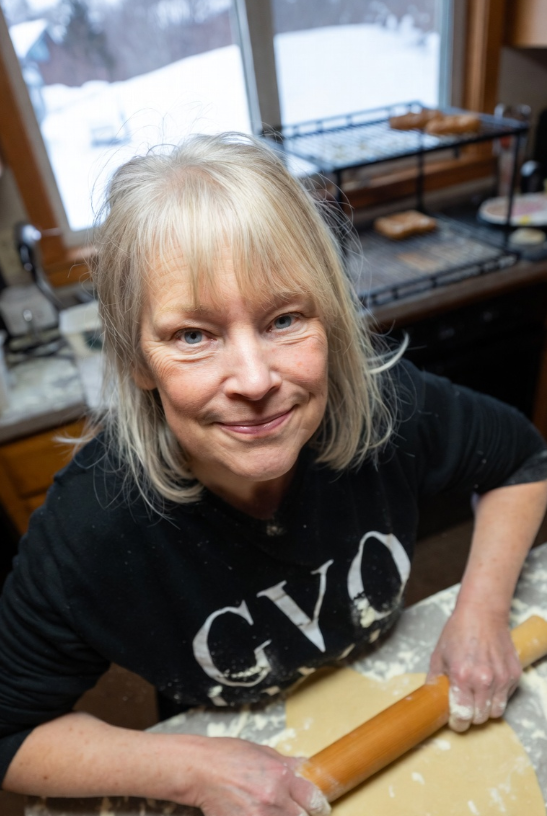
About the cook who shared this
Linda Johansson
Week 144 of Linda’s 30-year story
· Duluth, Minnesota
Linda is a sixty-three-year-old retired nurse from Duluth, Minnesota, living alone in the house where she raised her children and said goodbye to her husband. She lost Paul to ALS in 2020 after two years of watching the kindest man she'd ever known lose everything but his dignity. She cooks Scandinavian comfort food and Minnesota hotdish and the pot roast Paul loved, and she sets two places at the table out of habit because it makes her feel less alone. Every recipe she writes is a person she's loved.
