
 By
By Pasteles week. The official launch of the December work, which at the Delgado-Ortiz house begins the first weekend after Thanksgiving and continues through Christmas Eve in a rolling operation of making, freezing, thawing, boiling, and serving. Pasteles. The dish that defines my Christmas. The dish that for generations of Puerto Rican women has been the crown of the holiday and the most laborious single food object in any diaspora kitchen.
The process, briefly: you grate green bananas and yautía and potato and calabaza into a fine mash, you season it with sofrito and milk and achiote oil, you spread the mash on a square of parchment paper that has been greased with achiote, you top it with a spoonful of seasoned meat (pork, usually, with capers and olives and raisins), you fold the parchment into a packet, you tie it with string, you wrap the packet inside a banana leaf, you tie that with string, and you stack the packets until you have made enough for December. They freeze. They boil. They are unwrapped at the table with ceremony. They are a food that is older than the idea of a refrigerator.
Saturday was pasteles day one. Rosa drove up from New Haven with Camila. Jenny came over with Lucas. Isabella was home with Miguel Jr. — too young for pasteles day, still needing a nap schedule — and Camila, at thirteen months, was less a participant than a spectator, sitting in the high chair at the edge of the kitchen and watching us work. Lucas, at four and a half, was a participant: I put him in charge of taring the scale and handing me the parchment squares and announcing "ready!" when I needed one. He took the job seriously.
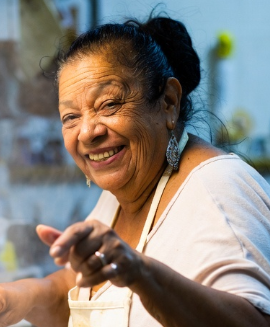
Rosa and Jenny graded green bananas and yautía at the counter. I made the sofrito base and browned the pork. Mami sat on her stool and watched and criticized — "too much achiote, Carmen," "not enough capers, Carmen" — and I mostly ignored her but sometimes obeyed. She was sharp Saturday. Her kind of day. She remembered everyone's name. She told Lucas he was "tall for a four-year-old," which he repeated to Jenny for the rest of the weekend.
We made twenty-four pasteles on Saturday. Twenty-four. In one day. This is respectable but not heroic. I will make forty more between now and Christmas Eve. The freezer has room. The banana leaves came in an Amazon shipment on Friday (and yes, I order banana leaves on Amazon, and no, I do not feel bad about it, and no, Abuela Consuelo did not do this, and yes, Abuela Consuelo would have done it if she could, she was a practical woman).
Eduardo spent the day at Home Depot and came home with a new set of tongs. Marriage is support in the ways you can offer it. His way was tongs. I accepted them. Wepa.
Here’s the thing about pasteles week that nobody warns you about: you still have to feed people on the nights you’re not making pasteles. Twenty-four parcels on Saturday, pork browning, sofrito simmering, banana leaves everywhere—and then Sunday rolls around and everyone’s hungry again and the kitchen still smells like achiote. This sheet-pan pork supper is what I turn to on those in-between nights, because it uses one pan, asks almost nothing of me, and gives Eduardo something to slice with his new tongs.
Sheet-Pan Pork Supper
Prep Time: 15 minutes | Cook Time: 45 minutes | Total Time: 1 hour | Servings: 4
Ingredients
- 1 1/2 pounds pork tenderloin
- 1 pound baby potatoes, halved
- 2 medium apples, cored and cut into wedges
- 1 large red onion, cut into wedges
- 2 tablespoons olive oil
- 1 tablespoon Dijon mustard
- 2 teaspoons fresh rosemary, chopped
- 1 teaspoon fresh thyme leaves
- 3/4 teaspoon salt
- 1/2 teaspoon black pepper
- 1/2 teaspoon garlic powder
- 1 tablespoon apple cider vinegar
- 1 tablespoon honey
Instructions
- Preheat the oven. Heat oven to 425°F. Line a large rimmed sheet pan with parchment paper.
- Season the pork. Pat the tenderloin dry. In a small bowl, mix the Dijon mustard, 1 tablespoon olive oil, garlic powder, rosemary, thyme, salt, and pepper. Rub the mixture all over the pork.
- Prep the vegetables and fruit. In a large bowl, toss the halved potatoes, apple wedges, and red onion with the remaining 1 tablespoon olive oil, apple cider vinegar, and honey. Season with a pinch of salt and pepper.
- Arrange the pan. Place the pork tenderloin in the center of the prepared sheet pan. Scatter the potato, apple, and onion mixture around it in a single layer.
- Roast. Bake for 25 minutes. Toss the vegetables and fruit gently, then continue roasting until the pork reaches an internal temperature of 145°F and the potatoes are golden and tender, about 15 to 20 minutes more.
- Rest and serve. Transfer the pork to a cutting board and let it rest for 5 minutes. Slice into 1/2-inch rounds and serve on the sheet pan or a platter alongside the roasted vegetables and apples.
Nutrition (per serving)
Calories: 380 | Protein: 36g | Fat: 11g | Carbs: 35g | Fiber: 4g | Sodium: 520mg