Paul's voice changed this week. Not dramatically — he still talks, still communicates, still tells me about shipwrecks — but the volume is lower and the effort is higher. I notice it the way I notice everything: clinically first, emotionally second. The clinical assessment: the muscles controlling voice production are weakening. The emotional assessment: my husband's voice, the voice that taught thirty-three years of American history, the voice that read me shipwreck passages at bedtime, the voice that said "another year, Linda" at midnight — that voice is getting quieter.
Dr. Andersen mentioned a communication device at the last clinic visit. A tablet with text-to-speech. A machine that talks when the mouth can't. Paul said, "Not yet." I said, "We should have it ready." He said, "Not yet, Linda." His voice was firm. Quieter, but firm. The stubbornness of a Scandinavian man, married to the stubbornness of a Scandinavian woman, in a house full of Scandinavian stubbornness.
I ordered the device anyway. It's in the closet. Ready when he's ready.
Elsa came every day this week. She's been promoted at Jay Cooke — she's leading the winter programming now, snowshoe hikes and naturalist talks — and she comes to the house after work, still in her ranger uniform, smelling of pine and cold, bringing the outside world into this inside life.
She reads to Paul. Every evening. Whoever is there — me or Elsa — reads to Paul, because his hands can't hold books anymore (even with the reading stand, the page-turning has become too difficult for his weakened right hand) and the reading is what keeps him connected to the world of his mind, which is the world that matters most.
Elsa reads differently than I do. I read carefully, pacing the words, modulating the volume — the nurse reading. Elsa reads with enthusiasm, with character voices, with the dramatic flair of a park ranger who gives talks about wolves to school groups. Paul laughs at Elsa's readings. He laughs and the laughing takes breath and the breath is precious but the laughing is worth it.
I made soup. Always soup now. Today: wild rice soup, my recipe, the Damiano Center recipe scaled down for two. The wild rice from last year's harvest, stored in the pantry. The cream, the butter, the stock. The soup that tastes like Minnesota and like home and like the answer to every question the cold and the dark and the disease can ask.
Paul drank it from a cup I held. He said, "This is the soup." I said, "Which soup?" He said, "The one that holds." He's right. It's the one that holds. It's always been the one that holds.
His voice is softer but his words are the same. The same words. The same meaning. The same Paul, speaking from a quieter place, saying the same true things.
Wild rice was the soul of the soup I made that day, but the bones — the long-cooked bones that give broth its body — are what make any soup truly hold. This short rib soup is the version I turn to when the wild rice runs low and the cold runs deep; it simmers for hours, which is exactly what a house like ours has now: hours, and the patience to fill them with something warm. If you have a cup to hold it to someone’s lips, this is the soup worth holding.
Short Rib Soup
Prep Time: 20 minutes | Cook Time: 2 hours 30 minutes | Total Time: 2 hours 50 minutes | Servings: 6
Ingredients
- 2 lbs bone-in beef short ribs
- 1 tablespoon olive oil
- 1 teaspoon salt
- 1/2 teaspoon black pepper
- 1 medium yellow onion, diced
- 3 cloves garlic, minced
- 3 medium carrots, sliced into rounds
- 3 stalks celery, sliced
- 2 medium potatoes, peeled and cubed
- 6 cups beef broth
- 1 can (14.5 oz) diced tomatoes, undrained
- 1 teaspoon dried thyme
- 1 bay leaf
- 1 tablespoon Worcestershire sauce
- 2 tablespoons fresh parsley, chopped (for garnish)
Instructions
- Sear the ribs. Pat short ribs dry and season generously with salt and pepper. Heat olive oil in a large Dutch oven or heavy pot over medium-high heat. Sear ribs on all sides until deeply browned, about 3–4 minutes per side. Transfer to a plate.
- Build the base. Reduce heat to medium. In the same pot, add onion and celery and cook until softened, about 5 minutes. Add garlic and cook 1 minute more, stirring constantly.
- Add liquids and aromatics. Return the short ribs to the pot. Pour in the beef broth, diced tomatoes, and Worcestershire sauce. Add thyme and bay leaf. Stir to combine.
- Simmer low and long. Bring to a boil, then reduce heat to low. Cover and simmer for 1 hour 45 minutes, until the meat is very tender and beginning to fall from the bone.
- Add vegetables. Remove the short ribs with tongs and set aside to cool slightly. Add carrots and potatoes to the pot. Increase heat to medium-low and cook uncovered for 20–25 minutes, until vegetables are fork-tender.
- Shred and return. Pull the short rib meat from the bones, discarding bones and any large pieces of fat. Shred the meat and return it to the soup. Discard the bay leaf.
- Finish and serve. Taste and adjust seasoning with salt and pepper. Ladle into bowls or cups, garnish with fresh parsley, and serve hot.
Nutrition (per serving)
Calories: 390 | Protein: 28g | Fat: 22g | Carbs: 18g | Fiber: 3g | Sodium: 720mg
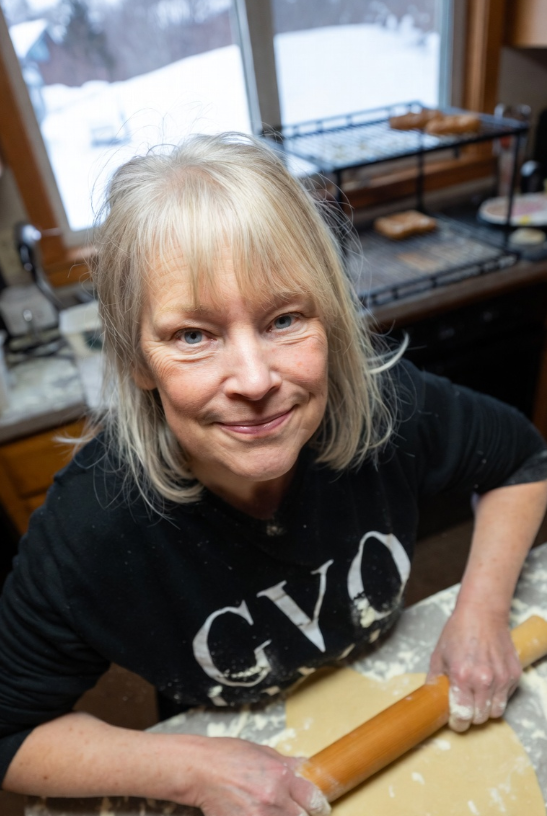
About the cook who shared this
Linda Johansson
Week 146 of Linda’s 30-year story
· Duluth, Minnesota
Linda is a sixty-three-year-old retired nurse from Duluth, Minnesota, living alone in the house where she raised her children and said goodbye to her husband. She lost Paul to ALS in 2020 after two years of watching the kindest man she'd ever known lose everything but his dignity. She cooks Scandinavian comfort food and Minnesota hotdish and the pot roast Paul loved, and she sets two places at the table out of habit because it makes her feel less alone. Every recipe she writes is a person she's loved.
