The ice caves are forming at the Apostle Islands. Paul heard about it from a colleague and was packed and in the car before I could say "wear layers." We drove to Bayfield on Saturday — two hours along the lake — and hiked out to the ice caves on the frozen shoreline of Lake Superior.
I need to describe what ice caves look like because words aren't enough but words are what I have. Imagine the lake freezing against the sandstone cliffs, the waves captured mid-crash, turned into ice curtains and ice pillars and ice walls that glow blue and white and amber in the winter light. Imagine standing inside a cave made entirely of ice, the ceiling dripping with frozen stalactites, the floor polished smooth, the sound of your breath echoing back to you from walls that won't be here in April.
Paul was ecstatic in the quiet way he gets ecstatic — standing still, looking up, taking it in with the reverence he usually reserves for shipwreck sites. He took photographs. He read the informational plaques. He told me about the geological history of the Apostle Islands, which he knows because Paul knows the history of everything within a hundred miles of Lake Superior.
I was cold. My toes were cold, my fingers were cold, my nose was running. I'm a Duluth woman and I can handle cold but ice caves are a different level of cold — you're standing inside frozen water, surrounded by frozen water, and the cold doesn't come from outside, it comes from everywhere.
But it was beautiful. There's no other word. Beautiful in the way that nature is beautiful when it's doing something temporary and extravagant and doesn't care if you're watching. The ice will melt. The caves will disappear. And next winter they might form again, or they might not, and that impermanence is part of the beauty.
We drove home with the heater on full blast and stopped in Bayfield for coffee and a pasty — a Cornish meat pie that somehow became a northern Wisconsin staple, probably because the miners brought them and the cold kept them relevant. Paul had two. I had one and a cup of hot chocolate and I held the mug between my hands and the warmth went through me like a blessing.
I made fish chowder when we got home — hot, creamy, thick with potatoes and smoked fish, because after a day spent inside frozen water, you need something that fights back against the cold from the inside. Paul ate a large bowl while still wearing his coat because he was too cold to take it off and too hungry to wait. Marriage: eating chowder in a winter coat while your wife pretends this is normal.
The ice caves won't last. February won't last. Nothing lasts. But the fish chowder was very, very good.
Fish chowder felt inevitable after a day like that — not a choice so much as a reflex, the body knowing what it needed before the mind caught up. I’ve made variations of this one for years, but I keep coming back to smoked fish because the smokiness does something a plain fillet can’t: it carries warmth in the flavor itself, not just the temperature. This version leans into that with bacon too, because Paul was still in his coat and we needed every bit of help we could get.
Smoky Corn Chowder with Smoked Fish
Prep Time: 15 minutes | Cook Time: 35 minutes | Total Time: 50 minutes | Servings: 6
Ingredients
- 4 strips thick-cut bacon, chopped
- 1 medium yellow onion, diced
- 3 cloves garlic, minced
- 2 stalks celery, sliced
- 1 1/2 lbs Yukon Gold potatoes, cut into 3/4-inch cubes
- 3 cups frozen or fresh corn kernels
- 3 cups low-sodium chicken or fish broth
- 1 1/2 cups whole milk
- 3/4 cup heavy cream
- 8 oz smoked whitefish (or smoked trout), skin removed, flaked into chunks
- 1 tsp smoked paprika
- 1/2 tsp dried thyme
- 1/4 tsp cayenne pepper
- Salt and black pepper to taste
- 2 tbsp unsalted butter
- 2 tbsp all-purpose flour
- Fresh chives or flat-leaf parsley, chopped, for serving
- Oyster crackers or crusty bread, for serving
Instructions
- Render the bacon. In a large Dutch oven or heavy pot over medium heat, cook the chopped bacon until crisp, about 6–8 minutes. Transfer bacon to a paper-towel-lined plate. Leave about 2 tablespoons of drippings in the pot.
- Soften the aromatics. Add the onion and celery to the pot and cook over medium heat, stirring occasionally, until softened, about 5 minutes. Add garlic and cook 1 minute more.
- Build the roux. Add butter to the pot. Once melted, sprinkle in the flour and stir constantly for 1–2 minutes until the mixture is golden and smells slightly nutty.
- Add broth and potatoes. Slowly pour in the broth, whisking to prevent lumps. Add the cubed potatoes, smoked paprika, thyme, and cayenne. Bring to a boil, then reduce heat and simmer uncovered for 12–15 minutes, until potatoes are just tender when pierced with a fork.
- Stir in the corn and dairy. Add the corn, whole milk, and heavy cream. Simmer gently (do not boil) for 5 minutes, stirring occasionally, until the chowder is thick and creamy.
- Fold in the smoked fish. Gently stir in the flaked smoked whitefish. Simmer 3–4 minutes more, just until the fish is warmed through. Season generously with salt and black pepper.
- Serve. Ladle into deep bowls. Top with reserved crispy bacon, fresh chives or parsley, and oyster crackers or a thick slice of crusty bread alongside.
Nutrition (per serving)
Calories: 420 | Protein: 24g | Fat: 22g | Carbs: 34g | Fiber: 3g | Sodium: 680mg
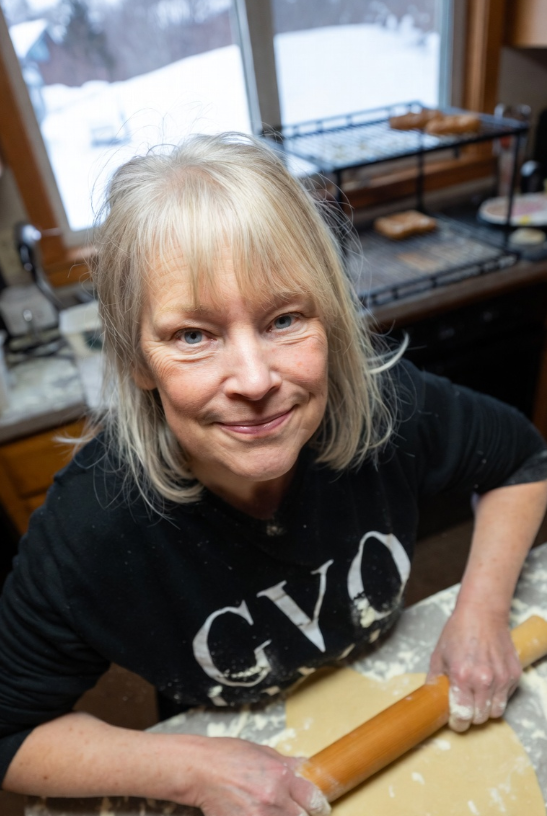
About the cook who shared this
Linda Johansson
Week 48 of Linda’s 30-year story
· Duluth, Minnesota
Linda is a sixty-three-year-old retired nurse from Duluth, Minnesota, living alone in the house where she raised her children and said goodbye to her husband. She lost Paul to ALS in 2020 after two years of watching the kindest man she'd ever known lose everything but his dignity. She cooks Scandinavian comfort food and Minnesota hotdish and the pot roast Paul loved, and she sets two places at the table out of habit because it makes her feel less alone. Every recipe she writes is a person she's loved.
