
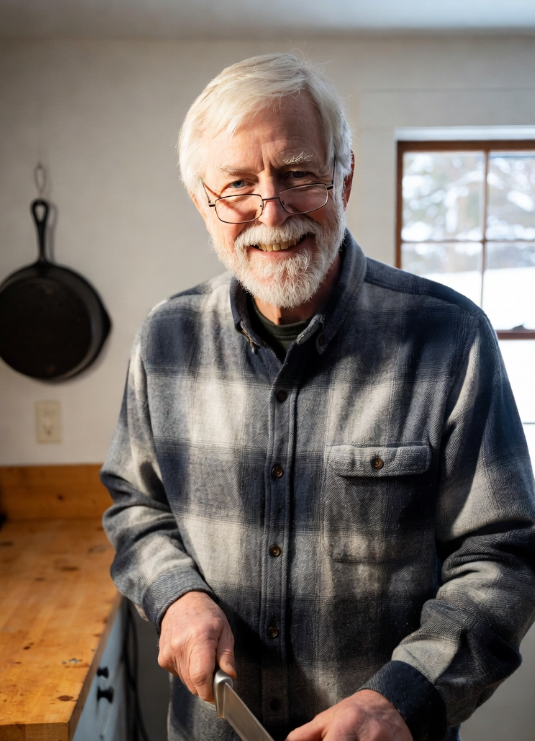
 By
By Spring has arrived, decisively and without apology. Sixty-five degrees on Wednesday, which in Vermont in late April feels like the tropics. I worked in the garden all day — peas in, lettuce in, spinach in, the radishes that Helen insists on even though nobody in this family eats radishes except Helen, who eats exactly three before declaring the season complete. We grow radishes for Helen's three radishes. That's farming.
The daffodils are up. Helen planted them along the front walk twenty years ago, and they come back every April like clockwork, yellow and ridiculous and exactly what the brown lawn needs after five months of snow. I don't have strong feelings about daffodils. Helen does. She stands at the window and looks at them with an expression I usually only see directed at grandchildren. The woman loves her daffodils. I love the woman. Transitive property applies.
I made a spring vegetable frittata for the blog. Eggs — six, from the farm stand — beaten with cream, mixed with the first asparagus from the fence row, sautéed ramps from the woods behind the sugarhouse, and a handful of chives from the pot by the back door. Pour into a hot, buttered cast-iron skillet, cook until the bottom sets, slide under the broiler until the top puffs and browns. Cut into wedges. Eat with good bread and the conviction that spring is the best thing that ever happened to a kitchen.
Ramps are a Vermont obsession. They grow wild in the woods — small, garlicky, smelling like the forest floor decided to cook Italian. You pull them carefully, never all of them, because ramps grow slowly and a person who strips a ramp patch is a person who doesn't understand the first thing about stewardship. I take six or eight at a time, from a patch that's been in the woods behind our property since before I was born. The ramps and the maples and the asparagus — they've been here longer than the Bergstroms, which is saying something.
Sarah's due in three weeks. She sounds enormous, which she informed me is not the word a father should use to describe his pregnant daughter. I apologized. I did not retract the observation. She laughed. Tom made a noise in the background that suggested he agreed with me but was too smart to say so. Smart man, Tom.
The garden is planted. The ramps are picked. The frittata is eaten. April is ending. May is coming. A baby is coming. The kitchen is ready.
The frittata I made for the blog came straight from that morning in the garden — dirt under my fingernails, ramps on the cutting board, six eggs from the farm stand sitting on the counter like they knew what was coming. If you don’t have ramps where you are (or if your woods haven’t offered them up yet), this spinach scrambled eggs recipe captures the same spirit: fresh greens, good eggs, a little richness from cheese, and about fifteen minutes between you and something worth eating. It’s the dish I’d make on any morning that smells like mud and possibility.
Spinach Scrambled Eggs with Goat Cheese
Prep Time: 5 minutes | Cook Time: 10 minutes | Total Time: 15 minutes | Servings: 2
Ingredients
- 6 large eggs
- 2 tablespoons heavy cream or whole milk
- 1/4 teaspoon kosher salt
- 1/4 teaspoon black pepper
- 1 tablespoon unsalted butter
- 2 cups fresh baby spinach, roughly chopped
- 1 clove garlic, minced (or 2 ramp bulbs, thinly sliced, if you’re lucky)
- 2 tablespoons fresh chives, snipped
- 2 ounces soft goat cheese, crumbled
- Crusty bread or toast, for serving
Instructions
- Whisk the eggs. Crack the eggs into a medium bowl. Add the cream, salt, and pepper and whisk vigorously until the yolks and whites are fully combined and the mixture is slightly frothy. Set aside.
- Wilt the greens. Melt the butter in a medium non-stick or cast-iron skillet over medium heat. Add the garlic (or ramp bulbs) and cook for 30 seconds, stirring, until fragrant. Add the spinach and cook, tossing with tongs, for 1–2 minutes until just wilted. Spread evenly across the pan.
- Cook the eggs low and slow. Reduce heat to medium-low. Pour the egg mixture over the spinach. Let it sit undisturbed for 20–30 seconds until the edges begin to set, then use a rubber spatula to gently fold the eggs from the edges toward the center. Continue folding slowly every 30 seconds, allowing soft curds to form. Remove from heat when the eggs are just barely set — they will finish cooking from residual heat.
- Finish and serve. Scatter the crumbled goat cheese and snipped chives over the top. Serve immediately with good crusty bread.
Nutrition (per serving)
Calories: 340 | Protein: 23g | Fat: 25g | Carbs: 4g | Fiber: 1g | Sodium: 480mg