
 By
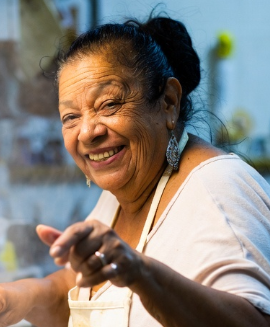
By Mother's Day, on the mainland, is the second Sunday of May. Puerto Rico also celebrates Mother's Day on the second Sunday of May. My mother is Puerto Rican. I am Puerto Rican. I have four children who range from Americanized (Sofía) to old-soul-Boricua (David, who speaks better Spanish than he did at twenty and who makes sofrito at his restaurant), but they all remember Mother's Day, because I trained them to, because a mother who has trained her children to remember Mother's Day has done her job.
The children: Miguel Jr. brought roses. Rosa brought herself and Camila — she made the drive with a four-month-old, which is a love-offering more significant than roses. David called at 8 AM from Brooklyn, before his brunch shift, and spoke for eighteen minutes. Sofía made me breakfast — scrambled eggs, sort of, with a little salsa — and I ate every bite and I told her the eggs were perfect, and they were not perfect, and it did not matter.
And Mami. I went to Mami's apartment in the afternoon with a container of arroz con leche — the Puerto Rican rice pudding, creamy, cinnamon-dusted, with raisins if you like them (I do not — I am in the no-raisin camp; Mami is in the yes-raisin camp; I made her a small separate portion with raisins, which is what a good daughter does on Mother's Day). She was dressed. She had put on lipstick, which she had not done in a month, and her best cardigan, the red one. She was expecting me.
I fed her the arroz con leche and she ate it slowly, deliberately, the way she eats everything now, and she said, "My mother made this for me on Mother's Day." Abuela Consuelo. My grandmother, dead since 1991, thirty-one years gone, and she was in the kitchen with us on Sunday afternoon in Hartford in 2022, because Mami said her name and the name summoned her. I thought about how I am the bridge between my grandmother and my granddaughter — Camila, who will never meet either of them, but who will eat this same arroz con leche when I teach it to her, and maybe her children, and maybe theirs, and the name Consuelo will be spoken at future tables where I will not be sitting.
I kissed Mami on the forehead when I left. She held my hand a little too long. She said, "Happy Mother's Day, Carmen." I said, "You too, Mami." Then I cried in the car in the parking lot for fifteen minutes. Then I drove home. Eduardo had made dinner, which he does on Mother's Day because it is the one day he absolutely must. It was not good. It was not bad. It was made with love, and made with love is always the best seasoning. Wepa.
The arroz con leche I brought Mami that Sunday is hers — hers and Abuela Consuelo’s — and I am not ready to write it down yet, because some recipes need to live in your hands before they live on a page. What I can give you is this stone fruit pie, the one I started making the summer Camila was born, the one I bring to every family table where I need to say I love you without saying it out loud. It is forgiving the way mothers are forgiving — you can use peaches or plums or nectarines or whatever the market gives you — and it fills the kitchen with a smell that makes everyone come find you. That’s enough. That’s always been enough.
Stone Fruit Pie
Prep Time: 25 minutes | Cook Time: 55 minutes | Total Time: 1 hour 20 minutes | Servings: 8
Ingredients
- 2 1/2 cups all-purpose flour, plus more for dusting
- 1 tablespoon granulated sugar, plus 1 tablespoon for topping
- 1 teaspoon fine sea salt
- 1 cup (2 sticks) cold unsalted butter, cut into 1/2-inch cubes
- 6–8 tablespoons ice water
- 2 1/2 pounds ripe stone fruit (peaches, plums, nectarines, or a mix), pitted and sliced 1/2-inch thick
- 1/2 cup granulated sugar
- 3 tablespoons cornstarch
- 1 tablespoon fresh lemon juice
- 1/2 teaspoon ground cinnamon
- 1/4 teaspoon ground nutmeg
- 1 egg, beaten (for egg wash)
Instructions
- Make the pie dough. In a large bowl, whisk together the flour, 1 tablespoon sugar, and salt. Add the cold butter cubes and use your fingertips to work them into the flour until the mixture resembles coarse crumbs with some pea-sized pieces remaining. Drizzle in ice water one tablespoon at a time, stirring gently with a fork, until the dough just comes together. Divide in half, shape each half into a disk, wrap in plastic, and refrigerate at least 30 minutes.
- Prepare the filling. In a large bowl, combine the sliced stone fruit, 1/2 cup sugar, cornstarch, lemon juice, cinnamon, and nutmeg. Toss gently to coat and let sit for 10 minutes while you roll out the dough.
- Roll and fit the bottom crust. Preheat your oven to 400°F (205°C). On a lightly floured surface, roll one dough disk into a 12-inch circle. Carefully transfer it to a 9-inch pie pan, pressing it gently into the bottom and sides. Trim any excess, leaving a 1/2-inch overhang.
- Fill the pie. Pour the fruit filling into the prepared crust, spreading it evenly. Roll out the second dough disk into another 12-inch circle. Lay it over the filling. Trim and crimp the edges together to seal. Cut 5–6 small slits in the top crust to allow steam to escape.
- Apply egg wash and bake. Brush the top crust with the beaten egg and sprinkle with the remaining 1 tablespoon of sugar. Place the pie on a rimmed baking sheet (to catch any drips) and bake for 20 minutes at 400°F, then reduce heat to 375°F (190°C) and bake for an additional 35 minutes, until the crust is deep golden and the filling is bubbling through the slits.
- Cool before slicing. Transfer the pie to a wire rack and let it cool for at least 1 hour before slicing. This allows the filling to set so it doesn’t run. Serve warm or at room temperature, plain or with a scoop of vanilla ice cream.
Nutrition (per serving)
Calories: 420 | Protein: 5g | Fat: 23g | Carbs: 52g | Fiber: 3g | Sodium: 290mg