Work is consuming me in the best possible way. The MTM program now has twenty-two patients, and I've been asked to present the outcomes data at the hospital's quarterly medical staff meeting. Twenty minutes, in front of forty doctors, explaining why a pharmacist-led program is improving their cardiac patients' medication adherence and reducing readmission rates.
I am terrified.
Not of the data — the data is solid. Medication adherence up 34%. Adverse drug events down 40%. Two patients caught with dangerous interactions that could have resulted in hospitalization. The numbers speak for themselves.
I'm terrified of the room. Forty cardiologists, internists, and hospitalists — most of them older, most of them male, most of them with the casual authority of people who are used to being the smartest person in any room. And me: thirty-year-old female pharmacist of Indian descent, standing at a podium, telling them that their prescription habits need a second set of eyes.
Raj, who will be in the audience, offered to "be supportive" which I think means he'll nod encouragingly and also be visibly anxious on my behalf, which is not helpful but is sweet.
I practiced the presentation three times. Once in the bedroom mirror (awkward). Once for Raj (he gave notes — "You say 'um' when you transition slides"). Once for Amma on FaceTime, which was a mistake because her feedback was: "You look tired. Are you sleeping? Why are you presenting to doctors? You should eat more iron."
This is not useful feedback, Amma. But thank you.
I cooked to calm my nerves. When I'm anxious about something specific — a test, a presentation, a pregnancy test that hasn't happened yet — I make complicated food. Tonight: Amma's chicken 65. The iconic South Indian appetizer: chicken marinated in yogurt, ginger, garlic, chili powder, and a disturbing amount of food coloring (Amma uses it; I substitute Kashmiri chili for the red color, which makes it marginally less terrifying). You deep-fry the marinated pieces, then toss them with curry leaves, green chilies, and a squeeze of lemon.
It's a two-step recipe that requires focus: the oil must be exactly the right temperature, the chicken must be fried in small batches, the curry leaf tempering must happen fast. No room for anxiety. No room for "um." Just the sizzle and the rhythm and the smell of something brave being made.
The chicken 65 was perfect. Crispy, spicy, red without the artificial dye. Raj ate eight pieces and said I should open a restaurant. I said I'm presenting to forty doctors on Thursday. He said those two things require the same skill: confidence in your product.
He might be right.
The night before my presentation, I made something fried, spiced, and deeply satisfying — because when anxiety spikes, I cook through it rather than around it. That same two-step logic (marinate and fry, then toss in a bright, punchy sauce) is exactly what makes this Sweet and Sour Chicken so grounding to make: you have to pay attention, work in batches, and trust that the crust will hold. Raj ate an embarrassing number of pieces, and somewhere between the first batch and the last, I stopped rehearsing my opening slide and just cooked. If you need a recipe that demands your focus and rewards you for it, this is the one.
Sweet and Sour Chicken
Prep Time: 20 minutes | Cook Time: 25 minutes | Total Time: 45 minutes | Servings: 4
Ingredients
- 1 1/2 lbs boneless, skinless chicken breasts, cut into 1-inch pieces
- 1/2 teaspoon salt
- 1/4 teaspoon black pepper
- 1/2 cup cornstarch
- 2 large eggs, beaten
- Vegetable oil, for frying (about 2 inches in a deep skillet or wok)
- Sweet and Sour Sauce:
- 1/2 cup pineapple juice
- 1/3 cup rice vinegar
- 1/4 cup ketchup
- 1/4 cup granulated sugar
- 2 tablespoons soy sauce
- 1 tablespoon cornstarch mixed with 2 tablespoons cold water
- 1 red bell pepper, cut into 1-inch pieces
- 1 green bell pepper, cut into 1-inch pieces
- 1 cup pineapple chunks (fresh or canned, drained)
- 2 cloves garlic, minced
- 1 teaspoon fresh ginger, grated
Instructions
- Season and coat the chicken. Pat chicken pieces dry and season with salt and pepper. Place cornstarch in a shallow bowl and beaten eggs in a separate bowl. Working in batches, dip each chicken piece in egg, then dredge in cornstarch until fully coated. Set aside on a plate.
- Heat the oil. Pour vegetable oil into a heavy-bottomed skillet or wok to a depth of about 2 inches. Heat over medium-high until the oil reaches 350°F. A pinch of cornstarch dropped in should sizzle immediately — this temperature is non-negotiable for a crispy crust.
- Fry the chicken in batches. Working in small batches (do not crowd the pan), fry chicken pieces for 3–4 minutes, turning once, until golden and cooked through. Transfer to a wire rack or paper-towel-lined plate. Repeat with remaining chicken, allowing the oil to return to temperature between batches.
- Make the sweet and sour sauce. In a small bowl, whisk together pineapple juice, rice vinegar, ketchup, sugar, and soy sauce. Heat 1 tablespoon of oil in a large skillet or wok over medium-high heat. Add garlic and ginger and cook 30 seconds until fragrant. Add bell peppers and stir-fry 2 minutes until just tender-crisp. Pour in the sauce mixture and bring to a simmer. Stir in the cornstarch slurry and cook 1–2 minutes until the sauce thickens and turns glossy.
- Combine and serve. Add the pineapple chunks and fried chicken to the skillet. Toss quickly to coat every piece in the sauce. Work fast — the crust stays crispier the less time it spends in liquid. Serve immediately over steamed white rice.
Nutrition (per serving)
Calories: 430 | Protein: 36g | Fat: 11g | Carbs: 46g | Fiber: 2g | Sodium: 780mg
About the cook who shared this
Priya Krishnamurthy
Week 51 of Priya’s 30-year story
· Edison, New Jersey
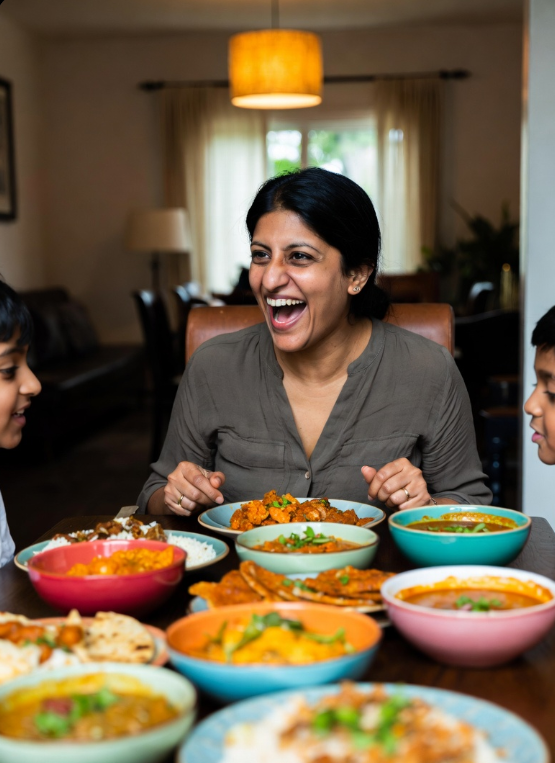
Priya is a pharmacist, wife, and mom of two in Edison, New Jersey — the town she grew up in, surrounded by the sights and smells of her mother's South Indian kitchen. These days, she splits her time between the hospital pharmacy, school pickups, and her own kitchen, where she cooks nearly every night. Her style is a blend of the Tamil recipes her mother taught her and the American comfort food her kids actually want to eat. She writes about the beautiful mess of balancing two cultures on one plate — and she wants you to know that ordering pizza is also an act of love.
