
 By
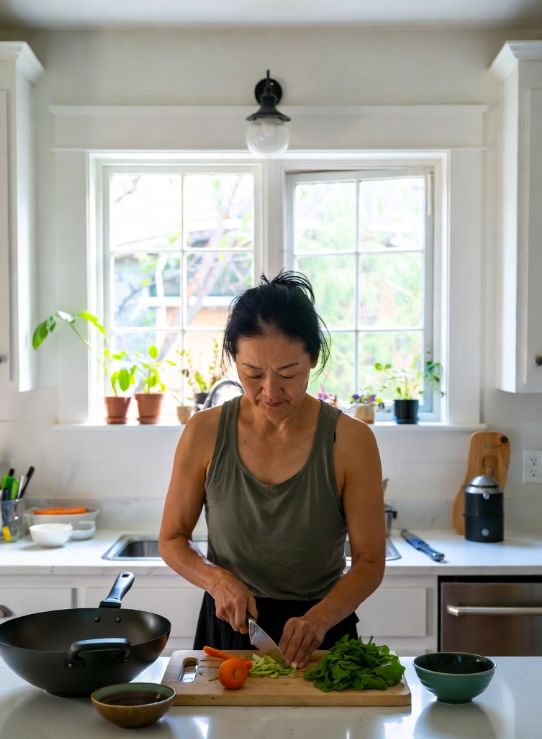
By Mid-June. The summer cooking project continues. This week: proper dashi. Not the simplified version I've been teaching Miya — "pour hot water over bonito flakes" — but the real thing. The overnight kombu soak. The precise temperature. The exact moment the bonito flakes are added. The straining. The clarity. The patience. The full Fumiko.
Miya watched the process with the attention she gives to chapter books: complete, absorbed, the world outside the kitchen disappearing. I talked her through each step the way Fumiko's recipe card describes it: "Soak the kombu in cold water overnight. In the morning, heat slowly. Do not boil. When small bubbles appear, remove the kombu. Add bonito flakes. Wait thirty seconds. Strain through cloth. The dashi is ready. The dashi is the foundation. Everything else stands on the dashi." I read the card aloud and Miya listened and I heard Fumiko's voice in my own voice and the hearing was the haunting and the comfort in the same moment.
The dashi was clear and golden and tasted like the ocean distilled. Miya tasted it — a spoonful, her first taste of pure dashi without miso — and her face went through three expressions in rapid succession: surprise, analysis, approval. "It tastes like the beach," she said. Like the beach. Like the ocean. Like the place where the onigiri has sand and the horizon points to Japan. She is right. Dashi tastes like the beach. Dashi tastes like origin. Dashi tastes like the beginning of everything.
We made miso soup together — from her dashi. Miya's hands dissolving the miso paste into the broth, the miso clouding and then integrating, the soup becoming itself. She served it in the chipped bowl and gave it to me and I drank it and the taste was — I want to say "the same" but it was not the same. It was similar. It was adjacent. It was the soup of a seven-year-old who has just made her first real dashi and dissolved her first real miso and served it to her mother in a bowl that her great-grandmother carried from a country she never returned to. The soup was not the same as mine. The soup was hers. The soup was the next link in the chain. The chain held.
Miya said the dashi tasted like the beach, and she was right — that golden, ocean-distilled broth carried something ancient and honest in every sip. After an afternoon spent honoring Fumiko’s recipe card and watching the chain hold through my daughter’s hands, I wanted dinner to stay close to that feeling — something that respected the sea without asking us to leave it. These Tuscan fish packets are nothing like miso soup, but they carry the same quiet logic: simple ingredients, careful heat, something whole that emerges from patience. That felt like the right note to end on.
Tuscan Fish Packets
Prep Time: 15 min | Cook Time: 20 min | Total Time: 35 min | Servings: 4
Ingredients
- 4 white fish fillets (cod, halibut, or tilapia), about 6 oz each
- 1 pint cherry tomatoes, halved
- 1 can (14 oz) white cannellini beans, drained and rinsed
- 1/2 cup pitted kalamata olives, roughly chopped
- 4 cloves garlic, thinly sliced
- 3 tablespoons capers, drained
- 1/4 cup fresh basil leaves, torn
- 4 tablespoons olive oil
- 1/2 teaspoon crushed red pepper flakes
- 1/2 teaspoon kosher salt
- 1/4 teaspoon black pepper
- 1 lemon, thinly sliced
- 4 large sheets of parchment paper or aluminum foil (about 15 inches each)
Instructions
- Preheat oven. Heat oven to 400°F. Set out four large sheets of parchment paper or foil on a flat surface.
- Build the base. Divide the cannellini beans evenly among the four sheets, mounding them in the center. Scatter the cherry tomatoes, olives, capers, and garlic slices over the beans.
- Add the fish. Lay one fish fillet on top of each bean-and-tomato mound. Season each fillet with salt, pepper, and a pinch of red pepper flakes. Drizzle each packet with 1 tablespoon of olive oil.
- Layer and seal. Top each fillet with 2–3 lemon slices and a few torn basil leaves. Fold the parchment or foil over the fish and crimp the edges firmly to create a sealed packet, leaving a little air space inside for steam.
- Roast. Place the packets on a large rimmed baking sheet. Roast for 18–20 minutes, until the fish is opaque and flakes easily when tested. Thicker fillets may need an extra 2–3 minutes.
- Open carefully. Let packets rest for 2 minutes before opening — steam inside will be very hot. Tear open the tops and transfer each packet directly to a plate, or slide the contents into a shallow bowl. Garnish with additional fresh basil if desired.
Nutrition (per serving)
Calories: 390 | Protein: 42g | Fat: 16g | Carbs: 22g | Fiber: 6g | Sodium: 680mg