
 By
By Last week of February. The thaw ended, as predicted, and the cold came back, as predicted, and Vermont is once again the landscape that postcards show and real life endures. Four inches of fresh snow on Tuesday. The plows came. The schools stayed open. In Vermont, school doesn't close for four inches. School barely closes for fourteen. The children of this state are raised to expect weather the way children in California are raised to expect sunshine: as a permanent condition you don't complain about.
I made a pot pie. Not chicken this time — beef. It's the same basic structure: filling in a dish, crust on top. But beef pot pie has a different character. Heavier. Darker. More serious, if a pie can be serious, and I believe it can. Chuck beef braised in wine — the same bottle Helen keeps for cooking, which is getting suspiciously low for a bottle that's only used for cooking — with onions, mushrooms, carrots, potatoes, and thyme. You braise the beef until it's tender, make the filling thick with a bit of flour, pour it into the dish, top with pastry, and bake until the crust is golden and the kitchen smells like Sunday even though it's Wednesday.
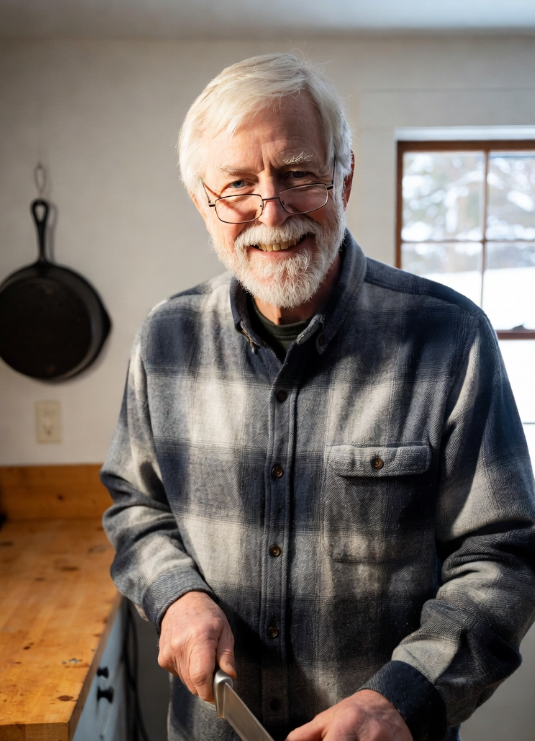
I've been thinking about why I cook. Not the practical answer — people need to eat, food requires cooking, there's no takeout delivery to a farmhouse on an unpaved road outside Burlington. The real answer. The one underneath. I cook because cooking is the one act of creation available to me every day. Teaching was creation — you built understanding, lesson by lesson, year by year, in the minds of other people. Writing is creation, but it's slower and lonelier. Cooking is immediate. You start with raw things and end with something you can eat. The transformation takes hours sometimes, minutes other times. But it always happens. Bread rises. Soup thickens. Beef softens. Every time. The kitchen doesn't lie. It doesn't grade on a curve. It gives you exactly what you put in, transformed by heat and time and attention into something that didn't exist before you started. That's creation. That's why.
Helen read this over my shoulder and said, "You're overthinking a pot pie." She's probably right. But overthinking is the privilege of a retired English teacher in February, and I'll take my privileges where I find them.
March starts next week. The equipment is ready. The trees are ready. I'm ready. One more cold week. Then the sap runs. Then spring. Then everything starts again, the way it always starts again, in Vermont, in March, in the kitchen, at the stove. Begin.
The pot pie is its own reward, but Helen’s look when I mentioned I was writing the recipe down — that particular raised eyebrow she reserves for what she calls my “production numbers” — suggested I find something slightly less demanding to share here. So I’ll give you the dish we made the following night, when the snow was still on the ground and the kitchen still smelled faintly of thyme: white cheddar mac and cheese with roasted tomatoes, which has the same quality I was going on about — raw ingredients, heat, time, and something real at the end. It’s not a pot pie, but on a cold February Wednesday, it carries its own kind of weight.
White Cheddar Mac and Cheese with Roasted Tomatoes
Prep Time: 15 min | Cook Time: 40 min | Total Time: 55 min | Servings: 6
Ingredients
- 1 lb cavatappi or elbow macaroni
- 2 cups cherry tomatoes
- 3 tablespoons olive oil, divided
- 3 cloves garlic, minced
- 3 tablespoons unsalted butter
- 3 tablespoons all-purpose flour
- 2 1/2 cups whole milk, warmed
- 1/2 cup heavy cream
- 2 1/2 cups sharp white cheddar, freshly grated
- 1/2 cup Gruyère, freshly grated
- 1 teaspoon Dijon mustard
- 1/2 teaspoon smoked paprika
- 1/2 teaspoon kosher salt, plus more to taste
- 1/4 teaspoon freshly ground black pepper
- 1/2 cup panko breadcrumbs
- 2 tablespoons unsalted butter, melted (for topping)
- Fresh thyme leaves, for garnish
Instructions
- Roast the tomatoes. Preheat oven to 400°F. Toss cherry tomatoes with 2 tablespoons olive oil, the minced garlic, a pinch of salt, and a few grinds of pepper on a rimmed baking sheet. Roast for 20–25 minutes, until blistered and beginning to collapse. Set aside.
- Cook the pasta. Bring a large pot of well-salted water to a boil. Cook pasta according to package directions until just shy of al dente — it will finish in the sauce. Drain and toss with the remaining 1 tablespoon olive oil to prevent sticking.
- Build the béchamel. In a large, heavy-bottomed saucepan or Dutch oven, melt 3 tablespoons butter over medium heat. Whisk in the flour and cook, stirring constantly, for 1 1/2 minutes until pale golden and nutty-smelling. Gradually pour in the warmed milk and cream, whisking continuously to prevent lumps. Cook over medium heat, stirring often, for 5–7 minutes until the sauce thickens enough to coat the back of a spoon.
- Add the cheese. Remove the pan from heat. Stir in the white cheddar and Gruyère a handful at a time, stirring until fully melted before adding the next. Add the Dijon mustard, smoked paprika, salt, and pepper. Taste and adjust seasoning.
- Combine and top. Fold the drained pasta into the cheese sauce until evenly coated. Transfer to a greased 9x13-inch baking dish. Scatter the roasted tomatoes — along with any juices from the pan — across the top. Mix the panko breadcrumbs with the 2 tablespoons melted butter and a pinch of salt; sprinkle evenly over the surface.
- Bake. Reduce oven temperature to 375°F. Bake uncovered for 18–22 minutes, until the breadcrumb topping is deep golden and the edges are bubbling. Let rest 5 minutes before serving. Scatter fresh thyme leaves over the top.
Nutrition (per serving)
Calories: 620 | Protein: 24g | Fat: 32g | Carbs: 58g | Fiber: 3g | Sodium: 590mg