All Saints' Day on Monday. The old church in Sweden marks it on the Saturday closest to November 1st, with candles lit at the graves of the dead, the cemeteries glowing in the dark. We do it differently here — Sunday service, names read, a candle lit for each. The Swedish Evangelical Lutheran congregation marked it this Sunday past, and I went, and I sat in my regular pew (third from the back, on the aisle, where Paul and I always sat), and I listened to Pastor Eriksson read the names of the dead.
Forty-two names this year. The congregation is small. The dead pile up. I knew thirty-eight of the forty-two. Pastor read Paul's name. He read Gunnar's name (every year, since 2001 — twenty years now, and Pastor still reads Pappa's name because the family asks). He did not read Lars's name (Lars died in 1979, and the request was made then to keep his name in the rotation, but eventually the rotation stopped and Lars's name fell off and I have not had the heart to ask for it back, though I will, this year, I think I will).
Mamma was beside me in the pew. She held my hand during the reading of Pappa's name. She squeezed when Pastor said it. She did not cry. Mamma cried at Pappa's funeral and never again, that I know of, in public. The grief lives in her, but the grief stays inside. Scandinavian discipline.
After church I went home and I lit four candles. One for Paul. One for Pappa. One for Lars. One for Ingrid the Elder, Mamma's mother, my grandmother, who died in Uppsala in 1968 and whose grave I have never visited and probably never will. The candles burned on the kitchen counter while I made dinner.
Dinner: bone broth, made over two days from a roasted beef knuckle and a chicken carcass and onions and carrots and celery and bay leaves and peppercorns. Simmered low. Strained. Salted lightly. Served in a mug, with rye crackers spread with butter on the side. The most monastic meal I make. The meal of an All Saints' Day kind of mood.
The broth was clear and golden. It smelled like a kitchen where someone has been working for two days. It tasted like the bones of the world.
I drank three mugs. I ate four crackers. The candles burned down. I let them.
The Damiano Center on Thursday: wild rice soup, plus bread, plus an extra urn of bone broth that I'd made specifically for Gerald, who said last week he hasn't been sleeping well. I told him: "Drink this at night. It's better than NyQuil." He said, "Linda, you are not a doctor." I said, "I am a nurse and that is close enough." He drank it. I do not know if it helped. He thanked me anyway.
Friday: I cleaned the dining room. I dusted the shelf with Paul's framed photograph and his glasses (his glasses are still on the shelf, where he left them the morning of March 14, 2020, and I have never moved them, and I am not going to). I dusted around the glasses. The glasses do not need to be moved. The glasses are doing their job.
The candles are out now. The names have been read. The bone broth is in the freezer. The rye crackers are in the cupboard.
The dead are remembered. The living are fed. November begins. The lake is gray.
It is enough.
The rye crackers I had that night were store-bought — thin, plain, from the Scandinavian import shelf at the co-op — and they did their job, but they were not made with any particular intention. This bread is what I make when I want something that takes time, something with heft and darkness, something that asks the kitchen to smell like effort. A Bit Nutty Boston Brown Bread has the rye, the density, the faint bitterness of molasses that sits right alongside a clear golden broth — it is not Swedish, but it carries the same sensibility: nothing wasted, nothing showy, just nourishment made slowly and eaten with gratitude. It is the bread for a Monday after a Sunday like that one.
A Bit Nutty Boston Brown Bread
Prep Time: 15 minutes | Cook Time: 1 hour | Total Time: 1 hour 15 minutes | Servings: 8
Ingredients
- 1/2 cup rye flour
- 1/2 cup whole wheat flour
- 1/2 cup yellow cornmeal
- 1 teaspoon baking soda
- 1/2 teaspoon salt
- 3/4 cup buttermilk
- 1/2 cup unsulfured molasses
- 1 large egg, lightly beaten
- 2 tablespoons melted butter, plus more for greasing
- 1/2 cup chopped walnuts or pecans
- 1/3 cup raisins (optional)
Instructions
- Prepare the vessel. Grease a 28-ounce clean tin can or a standard 8x4-inch loaf pan with butter. If using a tin can, set it inside a deep pot with a lid. If using a loaf pan, preheat your oven to 325°F.
- Combine the dry ingredients. In a large bowl, whisk together the rye flour, whole wheat flour, cornmeal, baking soda, and salt until evenly mixed.
- Combine the wet ingredients. In a separate bowl, whisk together the buttermilk, molasses, egg, and melted butter until smooth.
- Mix the batter. Pour the wet ingredients into the dry and stir just until combined — do not overmix. Fold in the chopped nuts and raisins, if using. The batter will be thick and dark.
- Fill and prepare to cook. Spoon the batter into your prepared tin can or loaf pan, filling it no more than two-thirds full. If steaming in a can: cover the top tightly with foil secured with a rubber band. Pour 2 inches of boiling water into the pot, set the can inside, cover the pot, and steam over medium-low heat for 55 to 60 minutes, replenishing water as needed. If baking in a loaf pan: bake uncovered for 50 to 55 minutes.
- Check for doneness. A toothpick inserted in the center should come out with just a few moist crumbs. The top will be firm and deep brown.
- Cool and slice. Let the bread rest in the pan or can for 10 minutes before turning out. Slice thickly. Serve warm with cold butter, alongside a mug of bone broth or a bowl of soup.
Nutrition (per serving)
Calories: 195 | Protein: 5g | Fat: 7g | Carbs: 30g | Fiber: 3g | Sodium: 285mg
About the cook who shared this
Linda Johansson
Week 292 of Linda’s 30-year story
· Duluth, Minnesota
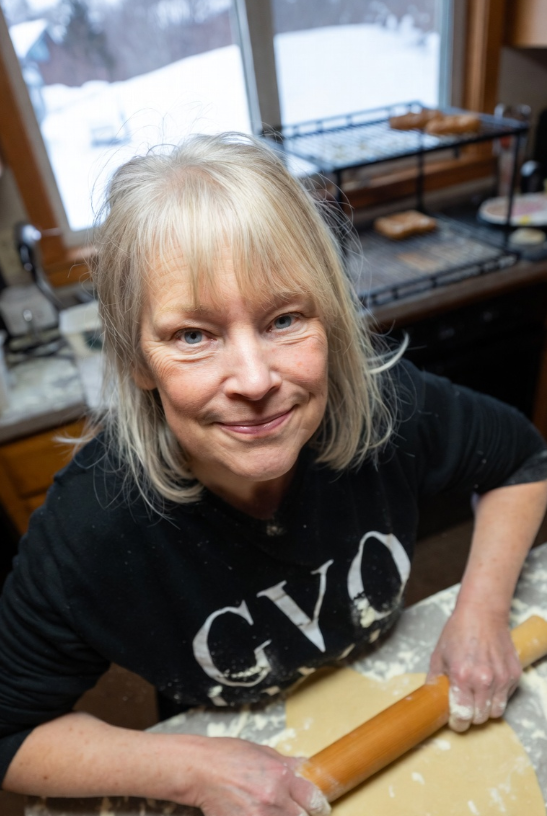
Linda is a sixty-three-year-old retired nurse from Duluth, Minnesota, living alone in the house where she raised her children and said goodbye to her husband. She lost Paul to ALS in 2020 after two years of watching the kindest man she'd ever known lose everything but his dignity. She cooks Scandinavian comfort food and Minnesota hotdish and the pot roast Paul loved, and she sets two places at the table out of habit because it makes her feel less alone. Every recipe she writes is a person she's loved.
