Another week. Another set of sunrises over Lake Superior. Another set of meals cooked for one and eaten at a table set for two. The two-place setting is the thing the kids have stopped commenting on. They used to remark when they came to visit. They used to gently suggest, in the way grown children gently suggest, that perhaps it was time to set just one. Now they set their own additional plates around mine and they let Paul's plate be Paul's plate. The setting is the love. The setting is the staying.
Elsa called from Voyageurs. She had a sighting of a wolf — a single gray adult crossing a frozen bay at dawn, fifty yards from her cabin. She had a sighting of a moose two days later. She is happy in the woods. I am glad someone in this family is happy in the woods. I have always loved Lake Superior, but the deeper woods are not for me. Elsa is for the deeper woods. The match is right.
Anna sent photos from Minneapolis — the kids in their school uniforms, David's new bookshelf, the dog (their dog, not mine; their dog is named Cooper, and Cooper is a Bernese mountain dog who weighs more than Anna and who is, by all accounts, the most relaxed dog in the upper Midwest). I printed three of the photos and put them on the fridge. The fridge holds the family that is not currently in the kitchen.
I cooked Roasted root vegetables this week. Carrots, parsnips, beets, sweet potatoes, onion. Tossed with olive oil, salt, pepper, thyme. Roasted at 425 until edges char. Served warm or cold. Eaten in handfuls when no one is watching.
Damiano Thursday: soup. The crowd was the usual size — about a hundred and twenty plates served between five and seven. Gerald and I worked side by side without talking. The not-talking was the friendship. The work has its own rhythm: ladle, hand, smile, ladle, hand, smile. The rhythm carries us through.
I sat in the kitchen at 11 PM with a glass of wine and Paul's photograph. I did not cry. I just sat. The not-crying is its own form of being with him. We did not need to talk all the time when he was alive. We do not need to talk all the time now. The companionable silence has carried over.
It is enough. Paul is not here. Mamma is not here. Pappa is not here. Erik is not here. They are all here in the kitchen, in the smell, in the taste, in the wooden spoon and the bread pans and the marble slab. The dead are not where the body went. The dead are in the kitchen.
Paul used to say that the difference between a place and a home was that a home was a place where you knew, from any room, what was happening in any other room. I knew, from the kitchen, when he was reading in the living room. I knew, from the bedroom, when he was getting coffee in the kitchen. The Kenwood house is still that kind of home. From the kitchen I know that Sven is asleep on his bed in the dining room (the small specific snore). From the kitchen I know what time the radio in the living room is set to come on. The home is the body of knowledge of itself. I still live inside that body of knowledge, even though Paul is not the one creating most of the data anymore.
I keep a small notebook on the kitchen counter — green spiral-bound, from the drugstore. I write in it most days. The notebook holds the things I do not want to forget — Erik's stories about Pappa, Karin's notes about Mormor, Sophie's first words about her babies, the recipes I have changed slightly and want to remember in their changed form. The notebook is a small museum. The museum will go to Anna eventually, and then to Sophie, and then to Sophie's daughter Ingrid, and then onward.
It is enough.
The roasted root vegetables I made this week—carrots, parsnips, beets, sweet potatoes, onion—were eaten in handfuls standing at the counter, and I will not apologize for that. But when I wanted something that required a pan, some heat, and a little more intention, I turned to these hash browns: the same humble root logic, same honest pantry, just pressed into a skillet and cooked until the edges go gold and a little fierce. It is the kind of recipe that asks nothing of you except that you stay at the stove for a few minutes, and staying is something I have gotten rather good at.
Hacienda Hash Browns
Prep Time: 10 min | Cook Time: 20 min | Total Time: 30 min | Servings: 4
Ingredients
- 3 cups russet potatoes, peeled and shredded (about 2 medium potatoes)
- 1/2 cup yellow onion, finely diced
- 1/2 cup red bell pepper, finely diced
- 1 teaspoon garlic powder
- 1 teaspoon smoked paprika
- 1/2 teaspoon ground cumin
- 1/2 teaspoon salt, plus more to taste
- 1/4 teaspoon black pepper
- 2 tablespoons olive oil or butter
- Optional: sliced scallions and sour cream for serving
Instructions
- Dry the potatoes. Place the shredded potatoes in a clean kitchen towel and wring firmly to remove as much moisture as possible. The drier the potato, the crisper the hash brown.
- Season the mixture. In a large bowl, combine the shredded potatoes, diced onion, and red bell pepper. Add the garlic powder, smoked paprika, cumin, salt, and pepper. Toss until evenly coated.
- Heat the pan. Warm the olive oil or butter in a large cast-iron or nonstick skillet over medium-high heat until shimmering.
- Press and cook. Add the potato mixture to the skillet and press it down firmly into an even layer with a spatula. Cook undisturbed for 8–10 minutes until the underside is deeply golden and crisp.
- Flip and finish. Using the spatula, divide into quarters and flip each section carefully. Cook another 7–8 minutes until the second side is equally browned and the potatoes are cooked through.
- Serve. Transfer to plates and top with sliced scallions and a spoonful of sour cream if you like. Serve warm, directly from the pan.
Nutrition (per serving)
Calories: 185 | Protein: 3g | Fat: 7g | Carbs: 28g | Fiber: 3g | Sodium: 310mg
About the cook who shared this
Linda Johansson
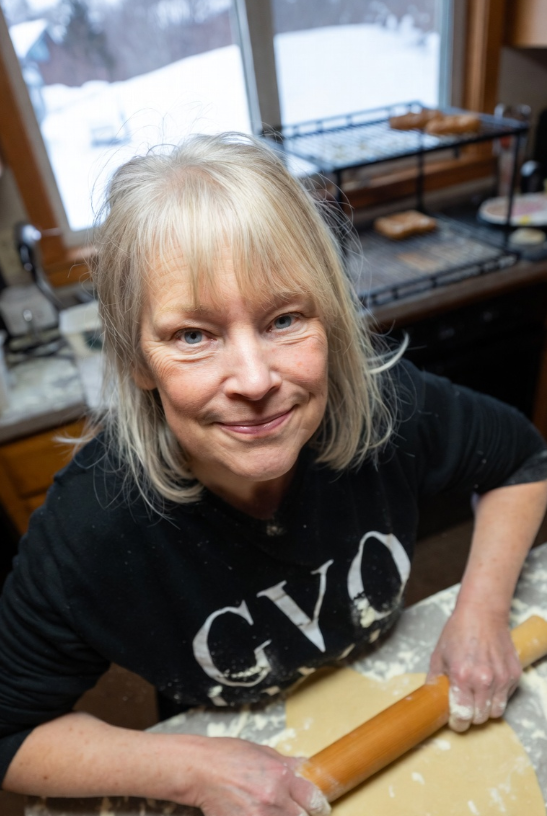
Week 311 of Linda’s 30-year story
· Duluth, Minnesota
Linda is a sixty-three-year-old retired nurse from Duluth, Minnesota, living alone in the house where she raised her children and said goodbye to her husband. She lost Paul to ALS in 2020 after two years of watching the kindest man she'd ever known lose everything but his dignity. She cooks Scandinavian comfort food and Minnesota hotdish and the pot roast Paul loved, and she sets two places at the table out of habit because it makes her feel less alone. Every recipe she writes is a person she's loved.
