
 By
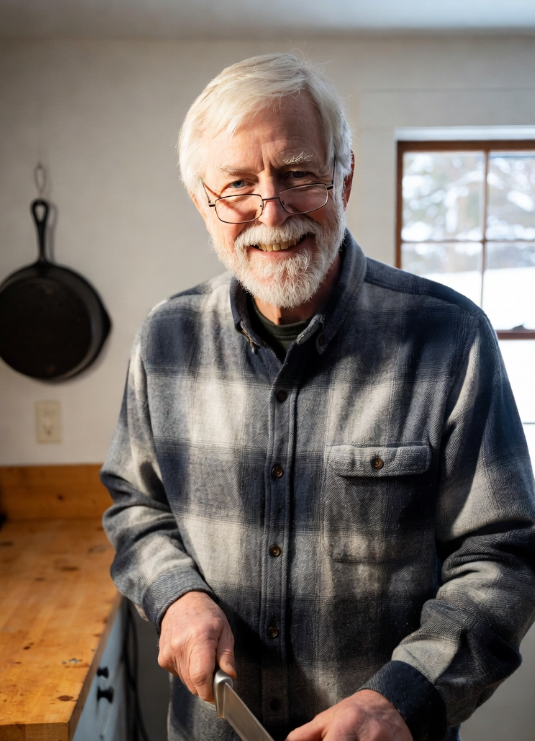
By I have been making maple candy for Christmas gifts. My grandmother's molds: small maple leaves, large stars, two shapes I have never identified definitively — one might be a tree, one might be a moose. The process requires attention to temperature: 235 degrees for soft, 245 for firm, 255 for hard. I make the hard variety. It keeps longer and ships better, which matters because some goes to Sarah in Portland and some to a former student in New Hampshire who has written every Christmas for twelve years.
The candy-making is meditative in the way that cooking from long habit becomes meditative: you know the steps so well that the mind can be elsewhere while the hands do the work. This week I found myself thinking about the forty people at the Historical Society talk, and the woman whose grandmother's candy tasted exactly like mine. She said it without emotion, just as a fact. Some facts carry their weight that way — quietly, precisely, without asking you to feel anything in particular about them. You feel it anyway.
David and Karen brought the children for the weekend. Teddy and Anna helped with the maple candy — I let them stir the cooling syrup in the bowl until it turns opaque and grainy, just before it goes into molds. Teddy stirred with the methodical intensity he brings to most tasks. Anna stirred with enthusiasm and occasional forays into tasting the bowl, which I permitted at reasonable intervals. James sat on a kitchen chair and watched with enormous eyes. Helen gave him a small piece of finished candy. He held it for some time before eating it, which is the correct response to maple candy.
This is what the kitchen is for. Not just the food — the food is the occasion. The kitchen is for the work that happens together, the transmission from one pair of hands to the next, the conversation that gets folded into the recipe without being named. My grandmother made this candy in this kitchen for sixty years. Now Teddy and Anna's hands are in it. In forty years, when I am long gone, something of this December Sunday will be in whatever candy they make. I do not say any of this out loud. I am not that kind of man. But I think it.
The maple candy goes into tins and gets mailed, but there is only so much candy one kitchen can produce before Christmas, and the list of people worth remembering with something homemade has a way of growing. Pfeffernuesse — small, firm, warmly spiced, dusted in powdered sugar — keep as well as hard maple candy and travel just as reliably, which is no small thing when Sarah is in Portland and a former student is waiting in New Hampshire. More than that, they are the kind of cookie with a history behind them, the kind you can imagine someone’s grandmother making in another kitchen in another decade, which is the right sort of thing to bake when you have been thinking about transmission and inheritance and the quiet weight of a recipe passed from hand to hand.
Pfeffernuesse Cookies
Prep Time: 30 min | Cook Time: 12 min per batch | Total Time: 1 hr 45 min (includes chilling) | Servings: About 5 dozen cookies
Ingredients
- 3 1/2 cups all-purpose flour
- 1/2 tsp baking soda
- 1/4 tsp salt
- 1 tsp ground cinnamon
- 1/2 tsp ground allspice
- 1/4 tsp ground cloves
- 1/4 tsp ground nutmeg
- 1/4 tsp ground black pepper
- 1/4 tsp anise extract (or 1/4 tsp ground anise seed)
- 3/4 cup unsalted butter, softened
- 3/4 cup packed dark brown sugar
- 1/4 cup molasses
- 1 large egg, room temperature
- 2 cups powdered sugar, for rolling
Instructions
- Whisk the dry ingredients. In a medium bowl, whisk together the flour, baking soda, salt, cinnamon, allspice, cloves, nutmeg, black pepper, and anise. Set aside.
- Cream butter and sugar. In a large bowl, beat the softened butter and brown sugar together on medium speed until light and fluffy, about 3 minutes.
- Add molasses and egg. Mix in the molasses and egg until fully combined, scraping down the sides of the bowl as needed.
- Combine wet and dry. Reduce mixer speed to low and gradually add the flour mixture, mixing just until a stiff dough forms. Do not overmix.
- Chill the dough. Wrap the dough tightly in plastic wrap and refrigerate for at least 1 hour, or overnight. The dough should be firm enough to roll into balls without sticking.
- Preheat and prepare. Heat oven to 350°F. Line two baking sheets with parchment paper.
- Shape the cookies. Roll the chilled dough into 1-inch balls and place them 1 1/2 inches apart on the prepared baking sheets.
- Bake. Bake for 11—13 minutes, until the cookies are set and just barely beginning to color on the bottom. They will be firm, not soft.
- Roll in powdered sugar. While still warm — but cool enough to handle — roll each cookie generously in powdered sugar. Transfer to a wire rack to cool completely, then roll in powdered sugar a second time for a fuller coating.
- Store or ship. Pfeffernuesse keep well in an airtight tin at room temperature for up to 3 weeks, making them an ideal candidate for holiday mailing. Layer between sheets of wax paper.
Nutrition (per cookie)
Calories: 78 | Protein: 1g | Fat: 2g | Carbs: 14g | Fiber: 0g | Sodium: 28mg